


The Maldives population: what the 2022 census shows
515,132 people, 187 inhabited islands and four in ten in Malé. What the Maldives’ 2022 census shows about age, households, atolls and island life.
 By Dhiffushi Island Council8 min readUpdated
The Maldives had 515,132 people on census night in September 2022, according to the Maldives Bureau of Statistics. Of these, 382,639 were resident Maldivians and 132,493 were foreigners living in the country, and about 41% of everyone lived in the Malé area. The rest are spread across 187 inhabited islands, 168 resort islands and 106 industrial islands.
The 2022 census in brief
The Population and Housing Census is the country’s largest statistical exercise. The 2022 count was run by the Maldives Bureau of Statistics, with support from the UN Population Fund (UNFPA). Census night was midnight at the start of 13 September 2022, and enumerators visited homes, resorts and work islands over the following two weeks.
It was the 30th census in Maldivian history. The first count was taken in 1911, and the first modern census in 1977. Counts were held every five years from 1985 to 2000. The census due in 2005 was pushed back to 2006 after the 2004 tsunami, and the gap before the 2022 count was eight years.
Key figures from the bureau’s final report:
- Total population: 515,132
- Resident Maldivians: 382,639
- Resident foreigners: 132,493 (about 26%, or roughly one in four people)
- Households: 94,424
- Median age of resident Maldivians: 30
- Growth of the resident Maldivian population: 1.56% a year between 2014 and 2022
A “resident” here means someone who has lived in the Maldives for a year or more, or plans to. Tourists and short stays are not counted, so the figures describe the people who live and work here, not visitors.
Where people live
The Maldives is one of the most spread-out countries in the world. Its people live on many small islands rather than in one big territory, and the census sorts them by the type of island they live on.
| Where people live | Residents | Share |
|---|---|---|
| Malé area (Malé, Villimalé, Hulhumalé, Hulhulé) | 211,908 | 41% |
| Administrative (local) islands | 236,911 | 46% |
| Resort islands | 52,482 | 10% |
| Industrial islands | 13,831 | 3% |
Administrative islands are the inhabited islands with their own councils, schools and mosques. These are the “local islands” that independent travellers visit. Resort islands are home to tens of thousands of staff, and industrial islands host ports, fuel depots, boatyards and similar work.
Malé and the capital region
Malé is the political and economic centre, and it is one of the most crowded cities on earth. The bureau gives its area as just 5.8 square kilometres. The greater Malé region, which includes Villimalé and the reclaimed island of Hulhumalé, held 211,908 residents in 2022. About a quarter of them were foreigners.
People have moved to the capital for work, study and health care. New housing on Hulhumalé and Villimalé has absorbed much of that growth. The bureau’s report links the population rise in Malé directly to migration from the atolls, by women as well as men. If you are passing through, our guides to Malé and Hulhumalé cover what to see.
The atolls
Outside Malé, numbers vary a great deal between atolls. The bureau’s atoll table for resident Maldivians shows:
- Largest numbers: Addu and South Thiladhunmathi (Haa Dhaalu), each with just over 20,000 resident Maldivians.
- Smallest: Felidhu (Vaavu), with 1,453 resident Maldivians, the least populated atoll.
- Fastest growth: North Ari (Alif Alif), followed by Malé Atoll (Kaafu).
- Falling numbers: Vaavu, Gaafu Alif, Gaafu Dhaalu and Gnaviyani all had fewer resident Maldivians in 2022 than in 2014.
The bureau ties these changes mainly to people moving to the capital in search of jobs and services. Our atolls guide explains how the atolls are named and grouped, and where is the Maldives? puts the whole chain on the map.
A population that is getting older
The Maldives is still a young country, but it is ageing fast. The census figures show a clear shift over a single generation.
Age groups
- Under 15: 103,913 people, about 20% of residents (27% in 2014)
- 15 to 64: 390,369 people, about 76% (68% in 2014)
- 65 and over: 20,850 people, about 4%
The largest five-year age group in 2022 was 30 to 34. In 2014 it was 25 to 29. The large group born in the 1980s has simply moved up the age ladder.
Median age and fertility
The median age of resident Maldivians rose from 16 in 1990 to 30 in 2022. The bureau calls this the most significant change of the century. Half of all Maldivians are now older than 30, where in 1990 half were younger than 16.
Behind this is a sharp drop in births. The total fertility rate was 1.7 children per woman in the 2022 census, compared with about 6.4 in the 1990s, according to the bureau.
Men, women and foreign workers
Among resident Maldivians, there were 103 men for every 100 women in 2022. That ratio has been steady since 2000. A century ago it was much higher, at 119 in 1911.
The picture changes once you include foreign residents. Of the 132,493 foreigners living in the Maldives, 117,432 were men and only 15,061 were women. Most come to work. The bureau links this to local labour markets, which is why the central atolls of Kaafu, Alif Alif, Alif Dhaal and Vaavu have far more men than women. In Malé itself the ratio has fallen from 109 in 2000 to 98 in 2022, as women as well as men have moved to the capital.
On many local islands you will notice this in daily life: foreign workers are part of the community alongside Maldivian families.
Households and homes
The census counted 94,424 households. Almost half of them (42,571, or 45%) were in the Malé area, and the rest in the atolls.
- 87% of households live in houses, flats or apartments.
- 11% live in collective quarters, such as staff housing on resorts and work islands.
- 2% live on boats or in other kinds of housing.
For households in houses and flats, the average size was 4.7 people. It was 4.5 in Malé and slightly higher, 4.8, on the administrative islands. On a local island, an extended family often shares one walled compound, with relatives building rooms or upper floors as the family grows. If you are invited in, our guide to visiting a Maldivian home explains the etiquette.
How the population has grown since 1911
The first census, in 1911, counted 72,237 people. For the next 40 years the number barely moved, staying between about 70,000 and 80,000, because high death rates offset high birth rates.
Growth took off in the 1960s and peaked at 3.43% a year between 1985 and 1990, as health care improved and families stayed large. Since then it has slowed. The resident Maldivian population grew at 1.56% a year between 2014 and 2022.
The total population, foreigners included, grew by 107,472 people between 2014 and 2022, an increase of 26%. Much of that rise came from foreign workers rather than births. For the wider story, see our history of the Maldives.
Where Dhiffushi fits
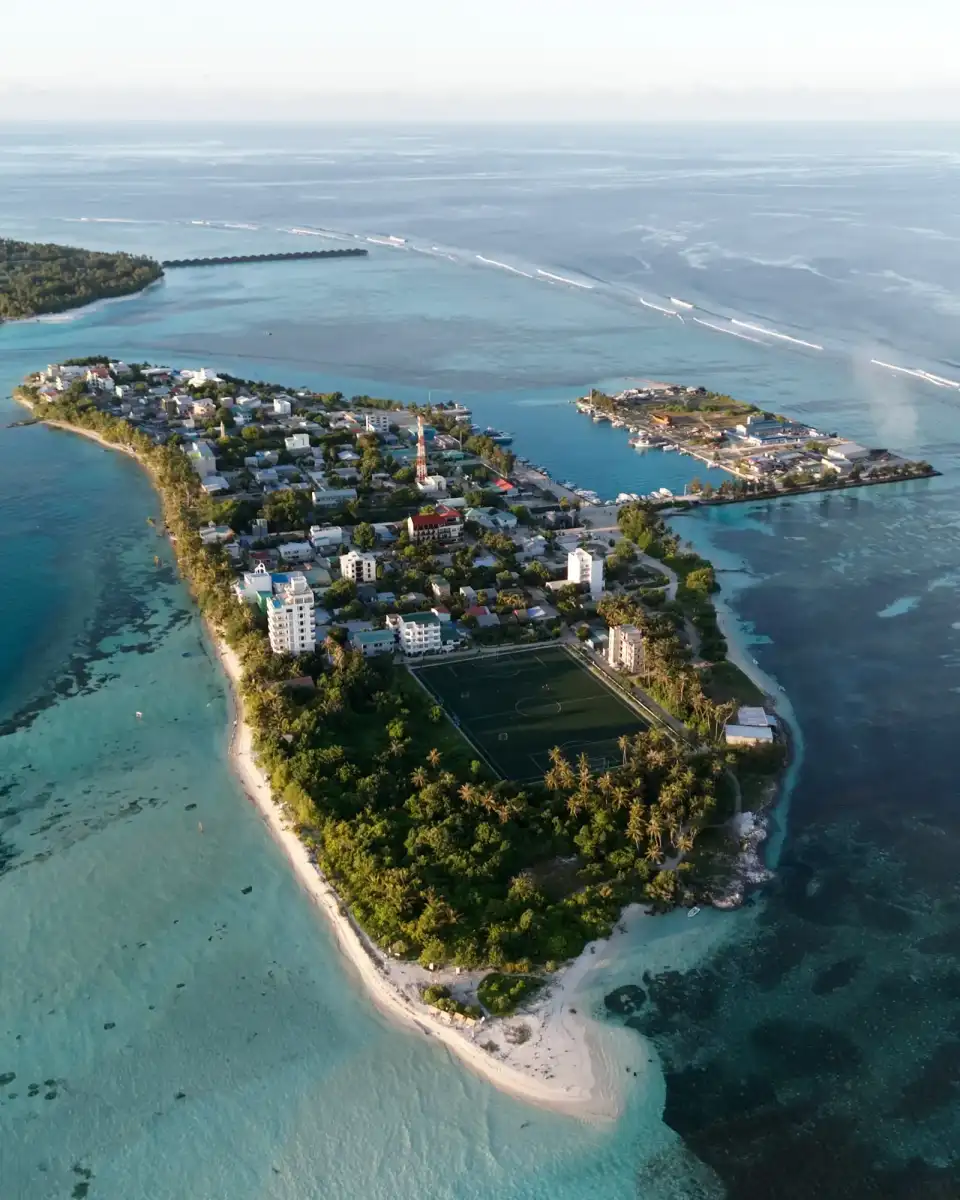
Dhiffushi is a typical local island in Malé Atoll (Kaafu), about 37 km north-east of Malé. The 2022 census counted about 1,270 people living here, which makes it a small, close community by most standards.
That number is useful context for visitors. On an island this size, people know their neighbours, the school and the mosque are at the centre of daily life, and a new face is noticed quickly. The island council handles local services, and our history of Dhiffushi and island life tells the island’s own story.
Kaafu as a whole grew by about 11% in resident Maldivians between 2014 and 2022. The bureau credits its closeness to the capital and the long-established tourism in the central atolls.
What the numbers mean for visitors
- Most of the country is local islands. Nearly half of all residents live on administrative islands. Visiting one shows you how most Maldivians live. Our local islands guide explains how they work.
- Malé is busy. With four in ten residents in the capital region, expect traffic, crowds and a city pace that is very different from the atolls.
- You will meet foreign residents. One in four residents is from overseas. You will meet them in many workplaces.
To see how residents compare with visitor numbers, read our Maldives tourism statistics guide.
Questions people ask
What is the population of the Maldives?
The 2022 Population and Housing Census, run by the Maldives Bureau of Statistics, counted 515,132 people. That total includes 382,639 resident Maldivians and 132,493 foreign residents. Tourists and short-stay visitors are not included. The census reference time was midnight at the start of 13 September 2022, and fieldwork ran for about two weeks after that.
How many people live in Malé?
The greater Malé area, which takes in Malé, Villimalé, Hulhumalé and the airport island of Hulhulé, had 211,908 residents in 2022. That is about 41% of the national population. Roughly a quarter of the area’s residents were foreigners. Malé itself covers just 5.8 square kilometres, making it one of the most densely populated cities in the world.
How many islands in the Maldives are inhabited?
The 2022 census counted people on 187 inhabited (administrative) islands, 168 resort islands and 106 industrial islands. The inhabited islands are the ones with their own councils and communities, often called local islands. Most of the country’s roughly 1,200 coral islands have no permanent community at all.
Why are there so many more men than women in the Maldives?
Among Maldivians the balance is close, at 103 men per 100 women. The gap comes from foreign residents: in 2022 there were 117,432 foreign men and only 15,061 foreign women. Most come to the Maldives to work, so atolls with large workforces, such as Kaafu and the Ari atolls, show far more men than women in the census.
How old is the average Maldivian?
The median age of resident Maldivians was 30 in the 2022 census, up from 16 in 1990. About 20% of residents are under 15 and about 4% are 65 or older. Falling birth rates and longer lives explain the change. The fertility rate was 1.7 children per woman in 2022.
When is the next census in the Maldives?
The Maldives Bureau of Statistics has not announced a date that we could confirm. Recent censuses were held in 2000, 2006, 2014 and 2022, so the gap has varied between six and eight years. For the latest official figures, check the bureau’s website, statisticsmaldives.gov.mv.

