


Island councils and local government in the Maldives
Who runs a local island? A plain guide to Maldivian island and city councils, the 2026 changes, the Local Government Authority and when visitors might deal with a council.
 By Dhiffushi Island Council8 min readUpdated
Every inhabited island in the Maldives outside the five cities is run day to day by an elected island council, a small body of three or five councillors chosen by local residents. The system began with the Decentralisation Act of 2010, and since May 2026 there are two tiers only: island councils and city councils, overseen nationally by the Local Government Authority.
Why local government matters in an island nation
The Maldives is spread across around 1,200 coral islands, and 187 of them were inhabited at the 2022 census (Maldives Bureau of Statistics). Many are small communities hours by boat from Malé, so the 2008 Constitution (Chapter VIII) set out that the country should be administered in a decentralised way. The Decentralisation Act (Law No. 7/2010) turned that into a working system.
For visitors, the council is often the body behind the beaches, public spaces and local events you see on a local island.
A short history of the system
2010: the Decentralisation Act
The Act, passed by the People’s Majlis in 2010, created three kinds of elected local authority: atoll councils, island councils and city councils. It also set up the Local Government Authority (LGA) to oversee them. The first local council elections followed in February 2011.
Changes over the years
The Act has been amended many times. A few changes stand out:
- Longer terms. Council terms were extended from three years to five.
- Seats for women. Amendments reserved a share of council seats for women, set at around a third (33%).
- More autonomy. The eighth amendment, ratified by the President at the first Councillors’ Conference in December 2019, was described as giving councils legal and fiscal autonomy to develop their islands.
2025–2026: atoll councils abolished
The 17th amendment to the Act was passed by the People’s Majlis on 27 November 2025 and ratified by the President on 1 December 2025. A separate constitutional amendment, passed around the same time, removed the constitutional provision for atoll councils.
The amendment said atoll councils would be dissolved once councillors elected at the next local council election took office. Those elections were held on 4 April 2026. A President’s Office directive (No. 12/2026) then abolished all atoll councils and their secretariats with effect from 17 May 2026. Funds held for atoll councils were to pass to the island councils within each atoll, and their assets to the LGA, as reported by national news.
The 20 administrative atolls still exist, with their names and letter codes, but no longer have their own elected council. For how they fit together, see our guide to atoll codes and island addresses and the wider atolls guide.
The two tiers today
Island councils
Under the 2025 amendment, each inhabited island outside the cities is governed solely by its own island council. The council answers to the LGA and to the island’s residents.
Council size depends on population:
| Island population | Councillors | Seats reserved for women |
|---|---|---|
| Fewer than 2,000 | 3 | 1 |
| 2,000 or more | 5 | 2 |
For the April 2026 elections, the Elections Commission set council sizes using population data as of 30 September 2025. As reported by MMTV, 133 islands elected three councillors and 46 islands elected five, giving 629 island council seats in all.
Each island council also has a secretariat of paid staff who keep services running.
City councils
Five places have city status, each with an elected mayor and councillors:
- [Malé City](/guides/male-maldives-capital-city-guide/), which takes in Malé, Villimalé, Hulhulé and Hulhumalé
- Addu City, in the far south
- Fuvahmulah City, the one-island atoll
- Kulhudhuffushi City, in the north
- Thinadhoo City, in Gaafu Dhaalu
City council sizes are set by population, with some exceptions in law. Seats for women apply to city councils too. Addu was reorganised in May 2026: Meedhoo and Hulhudhoo now have their own island councils, and Addu City Council covers Hithadhoo, Maradhoo, Maradhoo-Feydhoo and Feydhoo (President’s Office).
Women’s Development Committees
Alongside each council sits a Women’s Development Committee (WDC), elected at the same time. Under the 2025 amendment, a WDC has the same number of members as its council, and its chairperson is elected directly by voters and serves full time. One WDC chairperson also sits on the LGA’s board.
The Local Government Authority
The LGA is the national body set up under the Decentralisation Act to regulate, oversee and develop local government. Its job includes checking that councils act within the Constitution and the law, coordinating councils’ work, and keeping standards and procedures consistent across the country. The 2025 amendment gave it a stronger role: island councils are now directly accountable to it, and it can open offices in the capital island of each administrative division.
What island councils do
The Act lists public services councils must provide and requires each council to plan and carry out development for its island fairly. In practice, a council’s work usually includes:
- Island planning and land. Councils take part in land-use planning and the management of island land, subject to national rules. Rules on leasing land, lagoons and reefs have been tightened by recent amendments, especially near the end of a council’s term.
- Public spaces and waste. Upkeep of roads, beaches, harbour areas and public buildings, and local waste collection, often with state-owned companies.
- Community services. Supporting local schools, the health centre, sports and youth activities, and keeping local records and registers.
- Local business and permits. Councils handle some local permits and approvals, within national law.
- Events. National days, Eid gatherings and island festivals are often organised or supported by the council.
- Tourism promotion. On islands with guesthouses, councils help shape how tourism fits into island life.
Councils are funded through a mix of central government grants and their own income, such as fees and rents. The details have changed with each amendment, so check current law if you need specifics.
Big infrastructure projects, such as new harbours, sewerage or land reclamation, are usually led by central government ministries and state-owned companies. Councils are consulted and often push for them. For the bigger picture, see the Maldivian economy explained.
Elections
Local council elections are run by the Elections Commission, the same independent body that runs presidential and parliamentary votes. The April 2026 elections were the fifth local council elections since 2011 and were held alongside the WDC elections and a constitutional referendum. National news outlets reported a record turnout for a local vote.
Under the 2025 amendment, a councillor loses their seat if they leave or change the party they were elected for, or if they were elected as an independent and then join a party. Candidates often stand for national parties, but much of a council’s daily work is practical and local.
A worked example: Dhiffushi
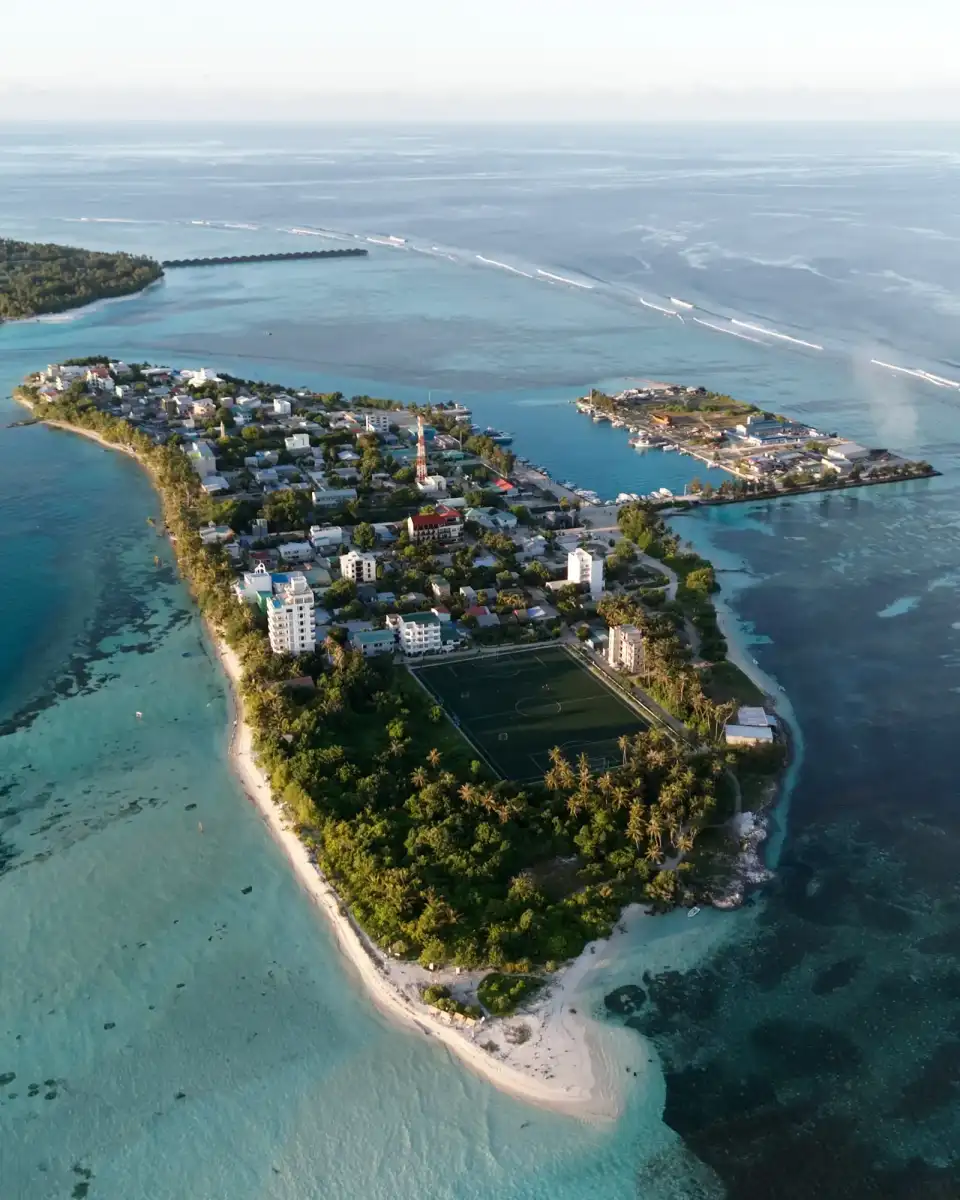
Dhiffushi, on the eastern rim of North Malé (Kaafu) Atoll, is home to about 1,270 people (2022 census), so it falls in the group of islands with three-member councils. The Dhiffushi Island Council handles local administration and public services and works with central government on the island’s development.
It also runs this website, which is why the site promotes local islands and public information rather than any one business. For the wider area, see the North Malé Atoll guide.
When visitors might deal with a council
Most visitors never need to. Your guesthouse handles everyday questions, the police deal with crime and lost property, and the health centre with medical needs. The council is the right contact for:
- Filming, events or [drone flights](/guides/flying-a-drone-in-the-maldives/) on an island. Drone use needs national permits and local approval as well.
- Organised group visits, school trips or research on the island.
- Feedback about beaches, waste, signs or public areas.
- Concerns you could not sort out with a business.
A few tips:
- Council offices keep government hours and are closed on Fridays, Saturdays and public holidays.
- Email first, keep it short, and include your dates and contact details.
- Respect local rules even when they differ from island to island, such as where the designated bikini beach is. Our local island etiquette guide explains the basics.
Questions people ask
Who runs a local island in the Maldives?
Each inhabited island outside the five cities is run by an elected island council of three or five members, depending on population. The council has a secretariat of paid staff who run day-to-day services. It works with central government ministries and state-owned companies on bigger projects, and is accountable to the Local Government Authority and to the island’s own residents.
Are there still atoll councils in the Maldives?
No. The 17th amendment to the Decentralisation Act, ratified on 1 December 2025, abolished atoll councils from the next local elections. A President’s Office directive dissolved all atoll councils and their secretariats with effect from 17 May 2026. The atolls remain as administrative divisions with their names and codes, but local government now has only island councils and city councils.
What is the Local Government Authority?
The Local Government Authority is the national body created by the Decentralisation Act to regulate, oversee and develop local government in the Maldives. It checks that councils act within the law, coordinates their work and keeps standards consistent. Since the 2025 amendment, island councils answer directly to it, and it can open offices in the capital island of each administrative division.
How often are local council elections held?
Council terms were extended from three to five years by an amendment to the Decentralisation Act, so local elections now fall roughly every five years. The most recent were held on 4 April 2026, run by the Elections Commission. They were the fifth local council elections since the first ones in February 2011, and were held alongside Women’s Development Committee elections.
Do councils set the rules for tourists on local islands?
The big rules are national, such as the ban on alcohol on inhabited islands, and dress expectations come from national custom. Councils manage local matters within that framework, such as public beaches, designated bikini beaches, local events and some permits. Your guesthouse can explain how things work on its island, and the council is the right contact for anything unusual.
How many seats on a council are reserved for women?
On island councils with three members, one seat is reserved for a woman. On councils with five members, two seats are reserved. City councils also have seats set aside for women, spread across their constituencies. Each council also has a Women’s Development Committee, whose chairperson is elected directly by voters and works full time.

