


History of the Maldives: a short guide for visitors
From Buddhist stupas and cowrie-shell trade to sultans, the Portuguese, British protection and independence in 1965: the Maldives’ story, and where to see it.
 By Dhiffushi Island Council8 min readUpdated
The Maldives has been lived in for well over 2,000 years. Its people were Buddhist for many centuries, became Muslim in the 12th century (traditionally dated 1153), and were ruled by sultans for most of the time since. The country was a British protectorate from 1887, became fully independent on 26 July 1965 and a republic on 11 November 1968, and opened to tourism in 1972.
Below is that story in plain language, plus places where you can still see the past. For today’s way of life, read our guide to Maldivian culture, people and language.
Maldives history at a glance
| Period | What happened |
|---|---|
| Before c. 500 BCE to early centuries CE | Settlement by seafaring peoples (exact origins debated) |
| Early centuries CE to 1153 | Buddhist kingdom; monasteries and stupas across many atolls |
| 1153 | Conversion to Islam, by tradition |
| 1558–1573 | Portuguese occupation of Malé, ended by Mohamed Thakurufaanu |
| 1887–1965 | British protectorate; sultans keep internal rule |
| 26 July 1965 | Full independence |
| 11 November 1968 | Republic declared |
| 1972 | First tourists arrive and the first resort opens |
Early settlement and seafaring
Nobody knows exactly who the first Maldivians were. The islands sit on old Indian Ocean sea routes, and people reached them by boat long ago. The main theories are:
- South Asian settlers. The Maldivian language, Dhivehi, belongs to the Indo-Aryan family and is closely related to Sinhala, spoken in Sri Lanka., which suggests early settlers came from Sri Lanka and southern India.
- Mixed origins. Settlement in waves, with people from the Indian subcontinent and possibly Arabia, East Africa and Southeast Asia, as you would expect on a trade crossroads.
- Older, unknown peoples. In the 1980s the Norwegian explorer Thor Heyerdahl excavated several sites and suggested even earlier sun-worshipping seafarers. His ideas were popular but remain unproven, and most scholars treat them with caution.
All accounts agree that Maldivians were skilled sailors and boat builders, and that the sea shaped their food, trade and faith.
The Buddhist period
For many centuries before Islam, the Maldives was Buddhist. Archaeologists have found the remains of Buddhist monasteries, stupas (dome-shaped shrines, locally called *havitta* or *ustubu*) and carved coral stone across the country. The Maldivian historian Hassan Ahmed Maniku recorded possible Buddhist sites on as many as 59 islands.
Some of the best-known sites are:
- Kaashidhoo (Kaafu Atoll). A Norwegian–Maldivian team excavated a large monastery here between 1996 and 1998. It was in use for many centuries, and large numbers of cowrie shells found there link it to early trade.
- Nilandhoo (Faafu Atoll). The site called Foamathi was excavated in the 1980s.
- Thoddoo (Alifu Alifu Atoll). A stupa site here produced one of the most famous finds of the period, a large stone Buddha head.
Most sites are now low mounds and foundations. If you visit one, ask the island council first, do not climb on it and take nothing away.
Conversion to Islam (1153)
By tradition, the Maldives became Muslim in 1153, when the king converted and took the title of sultan. Maldivian tradition credits a visiting Muslim scholar, often named as Abu al-Barakat, with persuading the king.
Islam has been central to Maldivian life ever since: almost every island has a mosque at its heart, and Friday is the weekly day of rest. It is also why local islands have rules on alcohol and dress. Our local island etiquette guide explains what that means for visitors.
The sultanates and the trade in shells, rope and fish
For about 800 years the Maldives was ruled by a line of sultans (and a few sultanas, or female rulers) based in Malé.
The Moroccan traveller Ibn Battuta stayed in the Maldives in the 1340s and worked there as a judge.
The Maldives was known across the Indian Ocean for three products:
- Cowrie shells. These small, glossy shells were gathered in the lagoons and shipped in huge numbers to Bengal, other parts of India, and on to Africa and Southeast Asia, where they were used as small money. At home they were used in trade and were also paid as tax to the sultan. Historians debate how far they worked as money inside the Maldives, but they were clearly a major export.
- Coir rope. Made from coconut husk fibre, Maldivian coir was valued for rigging and for tying the planks of ships together.
- Dried fish. Tuna, caught by pole and line, was boiled, smoked and dried until hard. This “Maldive fish” travelled well and was sold widely, especially to Sri Lanka and south India. It is still a key ingredient in island cooking today: see our guide to Maldivian food and dishes to try.
In return the islands imported rice, cloth and other goods they could not produce.
The Portuguese occupation and Mohamed Thakurufaanu (1558–1573)
In the 16th century the Portuguese were building a trading empire in the Indian Ocean. In 1558 they took control of Malé.
It was ended by Mohamed Thakurufaanu, from the island of Utheemu in Haa Alifu Atoll, with his brothers. By tradition they fought a long campaign of night raids by sea. In 1573 they landed in Malé and defeated the garrison.
Mohamed Thakurufaanu then became sultan and is honoured as the Maldives’ greatest national hero. The victory is marked each year as National Day (*Qaumee Dhuvas*). Because it follows the Islamic calendar (the first day of the month of Rabi’ al-Awwal), its date moves each year in the Western calendar. See our guide to Maldives festivals and public holidays.
His family home, Utheemu Ganduvaru, a timber palace, is preserved and can be visited.
The British protectorate (1887–1965)
In 1887 the sultan signed an agreement making the Maldives a British protectorate. Britain handled foreign affairs and defence, while the sultans kept control of internal matters. It was never a colony. The first written constitution came in 1932, and from the Second World War Britain kept an air base on Gan, in Addu Atoll in the far south.
Independence (26 July 1965) and the republic (1968)
On 26 July 1965 the Maldives and the United Kingdom signed an agreement ending the protectorate, and the country became fully independent. Independence Day, 26 July, is the main national holiday. The Maldives joined the United Nations later that year.
After a public vote, the sultanate ended and the Maldives became a republic on 11 November 1968, still marked as Republic Day.
The start of tourism (1972)
Tourism, now the country’s biggest industry, began only in the early 1970s. The first small group of foreign visitors arrived in February 1972, staying in Malé, and the first resort opened on an island near Malé in October 1972, with 30 rooms.
For decades visitors stayed almost only on resort islands. That changed at the end of 2009, when guesthouses on inhabited local islands began welcoming tourists, and local island tourism has grown fast since. Our Maldives local islands guide explains how it works, and the Maldives travel guide covers the rest.
Heritage you can see as a visitor
Coral stone mosques
The old coral stone mosques are the country’s finest historic buildings: blocks of reef coral cut to fit tightly together and carved with fine patterns and Arabic script, with detailed woodwork and lacquer inside.
A group of six of these mosques was placed on UNESCO’s World Heritage Tentative List in 2013 as “Coral Stone Mosques of Maldives”. They include the Malé Friday Mosque (Hukuru Miskiy), rebuilt in the 1650s, and old mosques on islands such as Ihavandhoo, Meedhoo, Isdhoo and Fenfushi.
They are places of worship first. Dress modestly, remove your shoes, avoid prayer times and ask before entering or taking photos; non-Muslims may not always be allowed inside.
The National Museum in Malé
The National Museum, in Sultan Park in central Malé, holds royal objects from the sultanate era, old weapons, lacquerware, textiles, manuscripts and carved coral stone from the pre-Islamic period. Our Malé city guide has tips on getting around the capital.
Island cemeteries
Many islands have old cemeteries, often beside the mosque, with carved coral stone headstones. They are active, sacred places for local families: look from the edge, keep quiet, never walk over graves and do not photograph mourners.
Local islands themselves
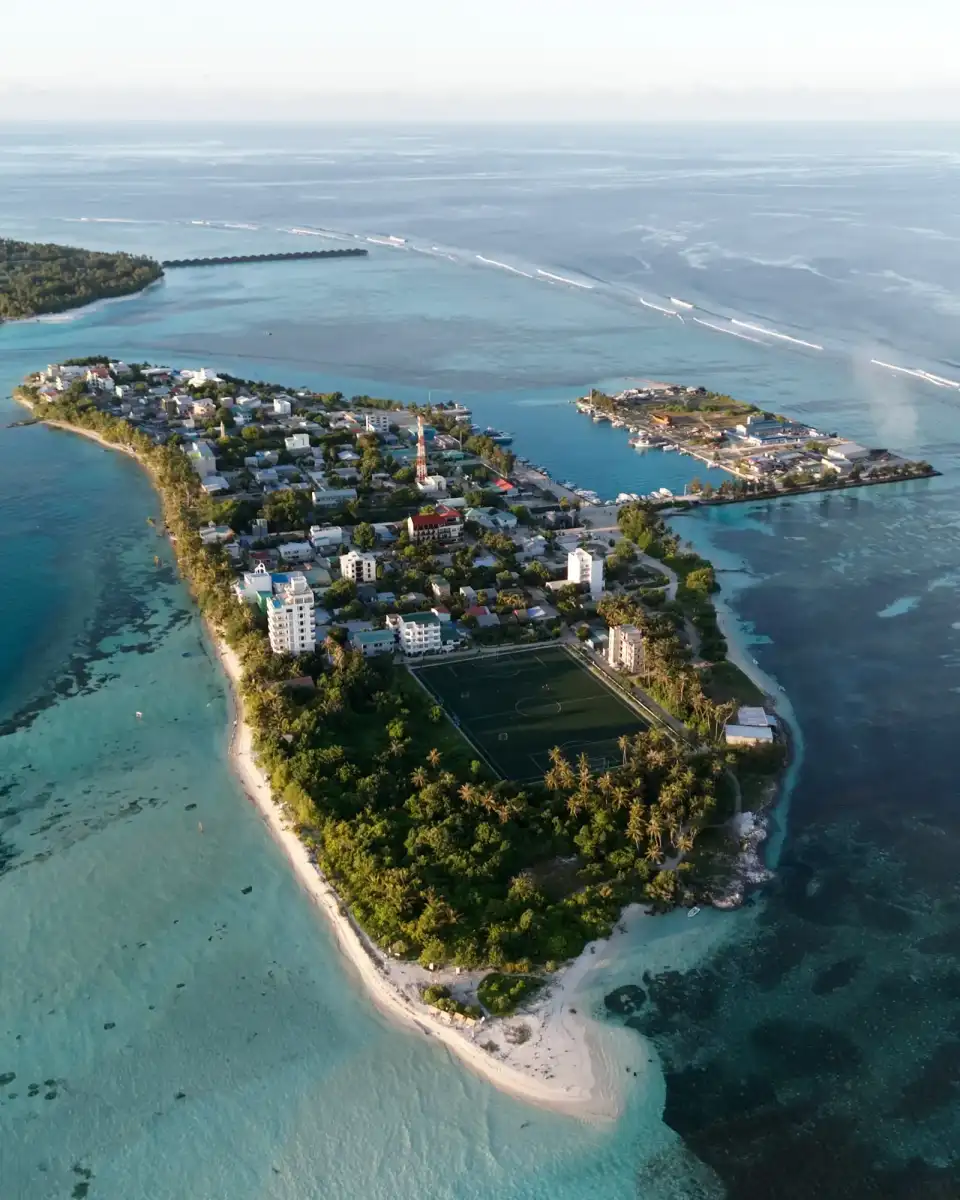
Everyday island life is heritage too: fishing boats, coral stone walls and the mosque at the centre. Dhiffushi, in Kaafu Atoll, is one example. Our Dhiffushi history and island life guide tells its story, and the map shows where things are.
Questions people ask
When did the Maldives become Muslim?
By Maldivian tradition, the country converted from Buddhism to Islam in 1153, when the king accepted Islam and took the title of sultan. A visiting Muslim scholar is credited with the conversion. Since then Islam has shaped Maldivian law, daily life and culture, and almost every inhabited island has a mosque at its centre. This is why local islands have their own rules on alcohol and dress.
Was the Maldives ever Buddhist?
Yes. Before Islam, the Maldives was Buddhist for many centuries. Archaeologists have found remains of monasteries and stupas on dozens of islands, including Kaashidhoo, Nilandhoo and Thoddoo. Most sites are now low mounds and foundations, but some carved coral stone from this period is kept in the National Museum in Malé. Always ask the island council before visiting a site, and never remove anything.
When did the Maldives gain independence?
The Maldives became fully independent from Britain on 26 July 1965, ending the British protectorate that began in 1887. Under the protectorate Britain handled foreign affairs and defence, while sultans ran the country’s internal affairs. Independence Day, 26 July, is the biggest national holiday. The country then became a republic on 11 November 1968, marked each year as Republic Day.
Who was Mohamed Thakurufaanu?
Mohamed Thakurufaanu is the Maldives’ national hero. With his brothers, he led the campaign that ended the Portuguese occupation of Malé in 1573, after about 15 years of foreign rule. He then became sultan. His victory is remembered on National Day, which follows the Islamic calendar, and his family home on Utheemu island in Haa Alifu Atoll is preserved for visitors.
When did tourism start in the Maldives?
Tourism began in 1972. The first group of foreign visitors arrived in February 1972, and the first resort opened near Malé in October that year. For many years tourists stayed only on resort islands. Guesthouses on inhabited local islands were allowed to take tourists from the end of 2009, which opened up local island travel for independent visitors.
What historic sites can visitors see in the Maldives?
The easiest to visit are the Malé Friday Mosque and the National Museum in Malé. Further afield, old coral stone mosques on several islands are on UNESCO’s Tentative List, Mohamed Thakurufaanu’s home stands on Utheemu, and many islands have old cemeteries with carved headstones. Dress modestly, ask before entering or photographing, and treat all religious and burial sites with respect.

