


Laamu Atoll guide: surf, causeways and local life
A quiet southern atoll with a 17 km island-linking road, reef-pass surf, a 1701 coral stone mosque and Buddhist ruins on Isdhoo, and everyday local island life.
 By Dhiffushi Island Council8 min readUpdated
Laamu is a large atoll in the south of the Maldives, best known for the road that links four of its islands, a quiet surf scene and some of the country’s oldest heritage sites. Most visitors fly in to Kadhdhoo, the airport island, and stay on local islands nearby. It suits independent travellers who want space, everyday island life and fewer boats than you see near Malé.
Laamu at a glance
Laamu is the administrative name. The natural atoll is called Haddhunmathi. It sits roughly 250 km south of Malé, a little north of the Equator, and is a wide, open ring of reef with a large lagoon and a string of islands along its eastern rim.
- People: around 14,700 residents in the 2022 census (Maldives Bureau of Statistics), on roughly a dozen inhabited islands.
- Largest island: Gan, with about 4,800 people. It is often described as one of the largest natural islands in the Maldives by land area.
- Main administrative island: Fonadhoo, home to most government services for the atoll.
- Airport: Kadhdhoo, a regional domestic airport on its own island, joined to its neighbours by causeway.
- Feel: farming, fishing and family life. Tourism is small-scale; resorts are private islands with their own rules.
For how Laamu fits into the wider map, see our guide to the atolls of the Maldives.
The link road: a rare road trip
Most Maldivian islands can be walked across in minutes. In Laamu, a road built on causeways joins four islands in a line along the eastern reef: Gan, Maandhoo, Kadhdhoo and Fonadhoo.
PSM News reported the road as about 17 km long, completed in August 2016 with grant aid from China. Other official documents give slightly shorter figures, so treat the exact length as “around 15 to 17 km”. Either way, it is one of the longest stretches of land you can travel by road in the Maldives.
What this means for visitors:
- You can cycle, take a taxi or ride a scooter (if you are licensed and insured) between villages, shops, mosques and beaches.
- Kadhdhoo airport is on the road, so the trip from the runway to Fonadhoo or Gan does not need a boat.
- Expect quiet stretches of palms and lagoon views. Carry water and sun cover; shade is patchy.
- Drive slowly through villages and give way to children and cyclists.
Islands to know (A to Z)
Laamu has no single “tourist island”. These are the inhabited islands you are most likely to hear about. Guesthouse numbers change, so check current options before you travel.
Fonadhoo
The administrative hub, at the southern end of the link road, with government offices, schools, shops and cafés. A practical base if you want services nearby.
Gan
The biggest and most populous island, at the northern end of the road. Gan was an early home of guesthouse tourism: one opened here in 2012 was reported as among the first resort-style guesthouses on an inhabited island. It is big enough to explore by bicycle, with farmland, wetlands and quiet beaches.
Hithadhoo
Known for its mangrove, declared a protected area in December 2021 (see below).
Isdhoo
Home to the old coral stone mosque and to ruins from the Buddhist era. More on both under heritage below.
Kadhdhoo
The airport island, linked by causeway to Maandhoo to the north and Fonadhoo to the south. Most visitors pass through rather than stay.
Maandhoo
A small island in the middle of the link road, between Gan and Kadhdhoo.
Maavah
One of the more populous islands in Laamu. It is a local island first and a visitor destination second, so plan ahead.
Surf in Laamu
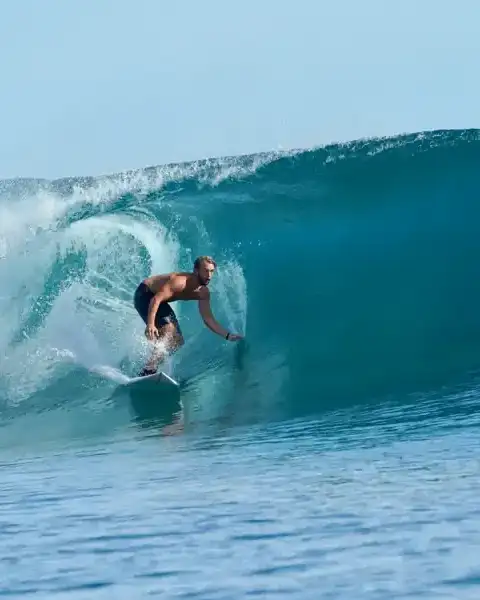
Laamu faces open ocean and picks up southern swell. Its waves break on reef passes along the atoll rim, and most need a boat. They suit intermediate and experienced surfers: the reef is shallow and sharp, and conditions change quickly.
- Season: the main swell window runs through the southwest monsoon months. Our guide to surfing in the Maldives explains timing and swell across the country.
- Access: some breaks lie close to resort islands, which can limit access. Ask locally first.
- Safety: wear reef booties, carry a basic first-aid kit, and never surf alone on an outer reef.
Short on time? Our guide to surfing near Dhiffushi covers the breaks on the eastern rim of Kaafu Atoll, a 40–50 minute speedboat ride from the airport.
Heritage: Isdhoo and the Buddhist past
Laamu holds some of the oldest evidence of life in the Maldives before Islam.
The Isdhoo old mosque
The old mosque on Isdhoo was built in 1701 from carved coral stone, with timber doors and roof. It is one of the coral stone mosques on the UNESCO Tentative List, and it is still used for prayer. The compound includes an old well and a cemetery with carved gravestones. More in our guide to the coral stone mosques of the Maldives.
The mosque is also linked to the Isdhoo Loamaafaanu, a set of copper plates dated to 1194 CE. It is the oldest copper-plate record found in the Maldives so far, written in an early form of the Dhivehi script.
Buddhist-era ruins
Before the islands converted to Islam in the 12th century, the Maldives was largely Buddhist. Heritage surveys have recorded large mounds and ruins of monasteries and stupas on Isdhoo and on other islands along Laamu’s eastern reef, including Dhanbidhoo and Gan. Many are unexcavated and look like overgrown mounds.
How to visit respectfully:
- Ask the island council or a local guide first; some sites are on farmed land.
- Don’t climb on mounds, remove stones or dig.
- At the mosque, dress modestly (shoulders and knees covered), remove shoes before entering, and visit outside prayer times. Non-Muslims should ask permission before going inside.
For more sites across the country, see historical sites of the Maldives.
Nature and protected areas
Laamu’s large lagoon, mangroves and seagrass meadows make it rich in reef fish, turtles and rays. In December 2021 the government designated six protected areas in the atoll, as reported by national media. They include:
- the mangrove on Hithadhoo and the sea around it;
- the land and lagoon of Gaadhoo, a former inhabited island, with beach, reef and mangroves;
- reef fish breeding areas and a seabird area around Gaadhoo, Bodu Finolhu and Vadinolhu;
- a site at Gan and a river and sea area at Maabaidhoo.
Stay on paths, don’t anchor on seagrass, and never touch or feed wildlife. Our guides to protected areas and mangroves and wetlands explain more.
Getting to Laamu
By domestic flight
This is the usual route. Flights from Velana International Airport to Kadhdhoo take under an hour. From Kadhdhoo, you can reach Gan or Fonadhoo by road, and other islands by speedboat. See seaplanes and domestic flights for how booking, baggage and weather delays work.
The government signed an agreement in April 2024 to upgrade Kadhdhoo to an international airport, and works have been reported under way since 2025. Plans have changed before, so check the current status.
By boat
There is no quick sea route from Malé. Within the atoll, speedboats and local ferries connect the islands, often on limited timetables. Confirm times with your accommodation, and allow a spare day before your flight home.
Practical tips for local islands
Laamu’s inhabited islands follow the same rules as every local island:
- Alcohol is not sold or allowed on inhabited islands.
- Swimwear only on designated bikini beaches. Elsewhere, cover shoulders and knees. See what to wear in the Maldives.
- Friday prayer: shops and cafés close for a while at midday.
- Ramadan: don’t eat, drink or smoke in public in daylight.
- Money: carry some rufiyaa for small shops and boats. Check whether your island has an ATM that takes foreign cards before you arrive.
- Health: island health facilities handle minor problems; serious cases go to Malé. Get insurance that covers evacuation.
Our local islands guide covers etiquette and guesthouse stays.
Questions people ask
Where is Laamu Atoll?
Laamu is in the south of the Maldives, roughly 250 km south of Malé and a little north of the Equator. Its natural name is Haddhunmathi Atoll. It lies between Thaa Atoll to the north and Huvadhu (the Gaafu atolls) to the south. Most visitors reach it on a domestic flight from Velana International Airport to Kadhdhoo, the atoll’s regional airport.
How do I get to Laamu from Malé?
Take a domestic flight from Velana International Airport to Kadhdhoo, which takes under an hour. From Kadhdhoo, the link road connects to Gan and Fonadhoo, and speedboats run to other islands. Your guesthouse can usually book or arrange the transfer. Sea travel from Malé is possible but slow, so most independent travellers fly both ways and keep a spare day before international departure.
Which islands in Laamu are connected by road?
Four islands are joined by a road built on causeways: Gan, Maandhoo, Kadhdhoo and Fonadhoo. The road was completed in 2016 and runs for roughly 15 to 17 km, depending on the source. It makes Laamu one of the few places in the Maldives where you can cycle or drive between islands without a boat, including from the airport to the atoll’s main villages.
Is Laamu good for surfing?
Yes, for intermediate and experienced surfers. Laamu catches southern swell on reef passes and is far less crowded than the breaks near Malé. Most waves need a boat, break over shallow reef and work best during the southwest monsoon months. Some breaks sit near resort islands, so ask locally about access. Beginners will find easier, more accessible waves elsewhere.
What is special about Isdhoo?
Isdhoo has an old coral stone mosque built in 1701, still used for prayer and on the UNESCO Tentative List with five other mosques. The island is also linked to the Isdhoo Loamaafaanu, copper plates dated to 1194 CE and the oldest such record found in the Maldives. Heritage surveys have also recorded Buddhist-era ruins and stupa mounds on the island.
Can I drink alcohol in Laamu?
Not on the inhabited islands. Alcohol is not sold or allowed on any local island in the Maldives, including Gan, Fonadhoo and the rest of Laamu. Only licensed resorts, the airport hotel island near Malé and liveaboards can serve it. If you bring alcohol into the country, customs will hold it at Velana International Airport on arrival.


