


Surfing in the Maldives: seasons, atolls and local islands
When to surf the Maldives, the main surf regions, reef safety, boat access, boards and why a local island guesthouse is the affordable way to chase waves.
 By Dhiffushi Island Council9 min readUpdated
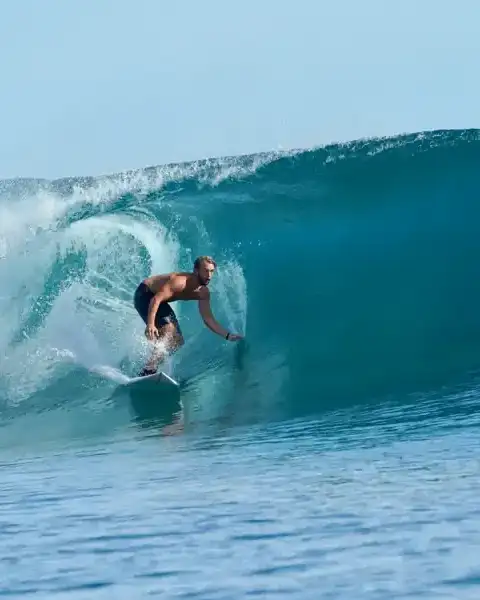
The Maldives has world-class surf, but it is all reef breaks reached mostly by boat. Surf forecasters and local surf guides generally say the season runs from about March to October, with the biggest swells in June to August and smaller, friendlier waves in the shoulder months. Staying on a local island is the most affordable way to surf here: you sleep in a guesthouse and take boat trips out to the waves.
Why the Maldives has surf
The Maldives sits in the Indian Ocean, open to the south. Storms deep in the southern Indian Ocean send long-period groundswell north across open water, and it meets coral reefs that rise steeply from deep water.
The waves break where the reef is cut by a channel, called a pass. Water flows in and out of the lagoon through these gaps, and the swell wraps around the reef edge on either side. That creates long, clean lefts and rights that peel along the coral.
A few things follow from this:
- Every wave is a reef break. There are no sandy beach breaks to learn on.
- The breaks are on the outer rim of the atolls, usually beside a channel, not in front of a typical guesthouse beach.
- Wind direction matters. Many breaks work as pairs on opposite sides of a pass, so one is often clean when the other is blown out.
When to surf in the Maldives
The Maldives Meteorological Service divides the year into a dry northeast monsoon (January to March) and a wetter southwest monsoon (mid-May to November), with April and December as transition months. Surf follows the swell, which is a slightly different calendar. For weather month by month, see our best time to visit the Maldives guide.
Surf forecasters and local surf guides generally describe the year like this:
| Months | What surfers usually find |
|---|---|
| March to April | Season starting; smaller waves, light winds, quieter line-ups |
| May | Swell building; weather turning more changeable |
| June to August | Biggest and most consistent swell; busiest breaks; more wind and rain |
| September to October | Swell easing; often a good balance of size and crowds |
| November to February | Small and inconsistent; flat spells are common |
These are patterns, not promises. Check a surf forecast in the week before you travel, and stay flexible.
In short: experienced surfers usually aim for June to August, while intermediates and beginners often do better in the shoulder months.
The main surf regions
The surf is spread across several atolls. Each region has its own character, distance from the airport and way of getting to the waves.
North Malé Atoll (Kaafu)
The best-known surf region, and the closest to Velana International Airport. The breaks line the eastern and southern rim of the atoll, a short boat ride from several local islands. Names you will hear include Chickens and Cokes off Thulusdhoo, Jailbreaks off Himmafushi, and Sultans and Honky’s on Thanburudhoo (often spelt Thamburudhoo). It is the easiest region to reach quickly, and the busiest in peak season.
For the breaks closest to us, levels and boat times, see surfing near Dhiffushi.
Malé itself
The capital has its own city wave, Raalhugandu, the heart of local surf culture. It is a busy local spot, so be respectful if you paddle out.
South Malé Atoll
Also in Kaafu, south of the capital. There are fewer breaks, and some sit beside resort islands. Surfers usually reach them by boat.
The central atolls
Atolls further south, such as Meemu and Laamu, have breaks on their outer passes. They are less crowded than North Malé and usually need a domestic flight or a longer boat journey. Local islands in some of these atolls host surfers in guesthouses.
The southern atolls
The large southern atolls, around Huvadhoo (Gaafu Alif and Gaafu Dhaalu), are the most exposed to southern swell and have many passes. Surf guides generally say they pick up swell a little earlier and hold it a little later than the north. They are remote: plan on a domestic flight, then a boat, and allow extra time.
Getting to the breaks
Almost every break is reached by boat; only a few can be paddled to from shore. Surfers go out in a dhoni (a traditional wooden boat) or a speedboat, with a crew who know which wave is working that day.
Access to breaks
Most breaks are open to anyone who arrives by boat. A small number sit directly off resort islands, and local surf guides say access to those is generally limited to that resort’s guests. If you are unsure whether a wave is open, ask your boat crew before you paddle out.
One public decision is worth knowing. In 2020 the government declared Thanburudhoo island a protected area, following a recommendation that recognised its value to surfing. The island’s two well-known waves stay open to surfers arriving by boat.
Reef breaks and safety
Maldivian waves are friendly-looking but unforgiving. They break over live coral, often in shallow water, with currents running through the passes.
Before you paddle out
- Know your level. These are not learner waves. If you cannot reliably take off, turn and kick out on a green wave, start with a lesson on a small day.
- Check the tide. Some breaks become very shallow at low tide. Your crew will usually time sessions around it.
- Watch the current. Water can pull hard through a pass. Note where the boat is and where you would drift.
- Never surf alone. Always go with a boat and at least one other surfer, and tell someone on land where you are going.
Gear that helps
- Reef booties protect your feet getting in and out over the coral.
- A rash vest or thin long-sleeve top helps against both the sun and reef scrapes.
- A helmet is worth considering on shallow, hollow waves.
- A small first-aid kit with antiseptic and dressings. Clean coral cuts straight away; they get infected easily in the heat.
On the reef
Do not stand on or grab the coral. Fall flat, cover your head and let the wave pass. Broken coral takes years to grow back.
Surfing from a local island
You do not need a resort or a boat trip lasting a week to surf the Maldives. Many surfers stay in guesthouses on local islands near the breaks.
Why it works:
- It is affordable. Guesthouse rooms and local meals cost much less than resort stays. For taxes and typical costs, see Maldives money, costs and taxes.
- Boats are arranged on the island. Your guesthouse or a local operator can organise surf boats, often one or two sessions a day, and choose breaks to match the wind and swell.
- Rest days are easy. When the swell drops, you can snorkel, visit a sandbank or simply rest. The surf season overlaps with the rainy months, so a slower day is often welcome.
- You see daily life, from fishing boats to evening football.
Remember that local islands have their own norms. Alcohol is not sold or allowed. Swimwear is for designated bikini beaches; elsewhere, cover shoulders and knees. On the surf boat, out at the reef, boardshorts and rash vests are normal. Our local island etiquette guide explains the rest, and the Maldives local islands guide helps you choose one.
Using Dhiffushi as a base
Dhiffushi is a local island on the eastern rim of North Malé Atoll, about 40–50 minutes from the airport by shared speedboat. It has no surf break of its own, but well-known North Malé breaks are a short boat ride away, and the island is quieter than the surf-focused islands closer to them. See how to get to Dhiffushi for transfers.
Boards: bring or rent
Travelling with a board
- Check your airline’s sports equipment rules before you book. Fees and size limits vary widely.
- Pack it well. Use a padded bag and remove fins. Boards travel stacked on small boats, so padding matters.
- Bring spares. Fins, a fin key, leash, wax for warm water and a small ding-repair kit. These can be hard to find outside the main surf islands.
Renting
Board hire is available on the main surf islands, but the range is limited. If you ride a particular shape, bring your own. For beginners or short trips, renting can beat airline fees.
Other water sports in surf season
The same southwest monsoon that brings swell also brings steadier wind. In the windier months, kitesurfing and windsurfing become popular in sheltered lagoons. Kitesurfing takes place on lagoons rather than on the surf reefs, so it suits days when the waves are blown out. On Dhiffushi you can find out more on our kitesurfing page.
On flat days, try snorkelling, paddleboarding in the lagoon or a sandbank trip. Seas can be rougher in the windiest weeks, so keep plans flexible. For the bigger picture of travelling in the country, start with our Maldives travel guide.
Questions people ask
When is the best time to surf in the Maldives?
Surf forecasters and local surf guides generally say the season runs from about March to October. June to August usually brings the biggest, most consistent swell, along with more wind, rain and crowds. March to May and September to October are often better for intermediates, with smaller waves and quieter line-ups. November to February is usually small, with flat spells common.
Can beginners surf in the Maldives?
Yes, but carefully. All Maldivian waves are reef breaks, often fast and shallow, so the main breaks are not learner waves. Beginners should come in the shoulder months, take lessons with a qualified guide and surf only on small days. Wear reef booties and a rash vest.
Do I need a boat to surf in the Maldives?
Usually, yes. Most breaks sit on the outer reef passes, away from where people stay, so surfers go out by dhoni or speedboat. A few waves can be paddled to from a nearby island. Your guesthouse can arrange boats, and the crew will pick the break that suits the day’s wind, tide and swell.
Can I surf from a local island instead of a resort?
Yes. Many surfers stay in guesthouses on local islands near the breaks in North Malé and other atolls. It is more affordable, boat trips are arranged on the island, and rest days are easy to fill. Remember local island norms: no alcohol, and swimwear only on bikini beaches, though boardshorts and rash vests are normal on the surf boat.
Are all Maldives surf breaks open to everyone?
Most are open to anyone arriving by boat. A small number sit directly off resort islands, and local surf guides say access there is generally limited to that resort’s guests. In 2020 the government declared Thanburudhoo island, home to two well-known waves, a protected area. If you are unsure whether a break is open, ask your boat crew before paddling out.
Should I bring my own surfboard to the Maldives?
If you have a board you love, bring it in a padded bag, and check your airline’s sports equipment fees first. Rentals exist on the main surf islands, but the choice is limited. Pack fins, a leash, warm-water wax and a ding-repair kit, as these are hard to find on most islands. Boards travel on small boats here, so pad them well.


