Dhivehi phrases for travellers (with pronunciation)
Say hello, thank you and how much in Dhivehi. Easy pronunciation, numbers 1–10, food words and a quick look at Thaana, the Maldives’ right-to-left script.
 By Dhiffushi Island Council8 min readUpdated
You don’t need Dhivehi to travel in the Maldives: English is widely spoken in guesthouses, shops and boats. But a handful of words goes a long way on a local island. Start with *assalaamu alaikum* (hello), *shukuriyyaa* (thank you) and *ma’aaf kurey* (excuse me, sorry), and you’ll get smiles almost everywhere.
About the Dhivehi language
Dhivehi (also spelt Divehi, and called Maldivian in English) is the national language of the Maldives. It’s an Indo-Aryan language, related to Sinhala in Sri Lanka, but the two aren’t mutually understandable. The name comes from older words meaning “island dwellers”, so *Dhivehi bas* is simply “the islanders’ language”.
It’s also spoken on Minicoy, an Indian island to the north, and it has gifted at least one word to English: “atoll” comes from the Dhivehi *atholhu*, borrowed through Portuguese. You’ll see it everywhere once you know, from atoll names on maps to the Maldives atolls guide.
Regional dialects exist, especially in the far south (Addu and Fuvahmulah), but the phrases below are standard Dhivehi as spoken around Malé and in the central atolls. For more on people, religion and daily life, see our guide to Maldives culture, people and language.
Thaana script basics
Dhivehi has its own alphabet, Thaana. It looks a little like Arabic at first glance, and like Arabic it’s written from right to left.
- Consonants carry the vowels. Each letter is a consonant; small strokes above or below it (called *fili*) add the vowel sound.
- About two dozen basic letters, plus extra letters with dots for Arabic loanwords.
- An unusual origin. The first nine letters come from Arabic numerals and the next nine from old local numerals, which is why the alphabet looks so tidy and compact.
- Centuries old. Thaana appears in inscriptions from the 15th century, and its modern form was in use by the early 1700s.
You’ll also see Dhivehi written in Latin letters. An official Latin transliteration was formally announced on 23 May 1977, and it’s still used for island names, street signs and many people’s names. That’s where the “dh” in Dhiffushi and the “th” in Thaana come from: they stand for soft, dental sounds, not the English “th” in “the”.
How to pronounce Dhivehi
Romanised spelling isn’t always consistent, so you’ll see the same word written two or three ways. These simple rules cover most of it:
- aa as in “father”; ee as in “see”; oo as in “moon”; ey as in “hey”; oa as in “boat”.
- dh is a soft “d” with your tongue touching your teeth. th is a soft “t”, the same way. Neither is the English “th”.
- lh is an “l” with the tongue curled back; an ordinary “l” is close enough for visitors.
- Double consonants (as in *shukuriyyaa*) are held a fraction longer.
- A final “h” (as in *ekeh*, one) is a light catch in the breath, almost silent.
Don’t worry about getting it perfect. People appreciate the effort far more than the accent.
Useful Dhivehi phrases for travellers
The phrases below appear in more than one published phrase list (see sources). Where lists disagree, we’ve noted it. The pronunciation column is a rough English guide, with the stressed part in capitals.
| English | Dhivehi | Say it like |
|---|---|---|
| Hello (formal, Islamic greeting) | Assalaamu alaikum | as-sa-LAA-mu a-LAI-kum |
| Reply to the greeting | Wa alaikum assalaam | wa a-LAI-kum as-sa-LAAM |
| Welcome / you’re welcome | Maruhabaa | ma-ru-ha-BAA |
| How are you? | Haalu kihineh? | HAA-lu ki-hi-NEH |
| Fine, thank you | Ran’galhu, shukuriyyaa | RAN-ga-lu, shu-ku-RIY-yaa |
| Thank you | Shukuriyyaa | shu-ku-RIY-yaa |
| Please | Adhes kohfa | a-DHES KOH-fa |
| Excuse me / sorry | Ma’aaf kurey | ma-AAF ku-REY |
| Yes | Aan | aan |
| No | Noon | noon |
| Goodbye (informal) | Dhanee | dha-NEE |
| Good morning | Baajjaveri hendhuneh | baaj-ja-VE-ri hen-dhu-NEH |
| Good night | Baajjaveri reygande | baaj-ja-VE-ri REY-gan-de |
| What is your name? | Kon nameh kiyanee? | kon NA-meh ki-ya-NEE |
| My name is … | Aharenge namakee … | a-ha-REN-ge na-ma-KEE |
| Do you speak English? | Ingireysin vaahaka dhakkan ingeytha? | in-gi-REY-sin VAA-ha-ka DHAK-kan in-GEY-tha |
| I don’t understand | Ahannakah neyngunu | a-HAN-na-kah NEYN-gu-nu |
| How much is this? | Kihaavarakah? | ki-HAA-va-ra-kah |
| Where is the toilet? | Faahanaa kobaa? | FAA-ha-naa ko-BAA |
| Very tasty | Varah meeru | VA-rah MEE-ru |
| Water | Fen | fen |
| Fish | Mas | mas |
| Rice | Bai | bai |
| Tea | Sai | sai |
| Boat | Dhoani | DHOA-ni |
| Island | Rah | rah |
| 1 | Ekeh | E-keh |
| 2 | Dheyeh | DHEY-eh |
| 3 | Thineh | THI-neh |
| 4 | Hathareh | HA-tha-reh |
| 5 | Faheh | FA-heh |
| 6 | Hayeh | HA-yeh |
| 7 | Hatheh | HA-theh |
| 8 | Asheh | A-sheh |
| 9 | Nuvaeh | NU-va-eh |
| 10 | Dhihaeh | DHI-ha-eh |
A few notes on the table:
- Spellings vary. “Shukuriyyaa” is also written “shukuriyaa”; “good morning” appears as both “baajjaveri” and “ba’ajjeveri”. Both are understood.
- “Kihineh?” on its own is also used as a casual hello, a bit like “how’s it going?”.
- The toilet phrase is given differently in different phrase lists, so we’ve marked it. Pointing and saying “toilet?” works perfectly well.
Words you’ll see and hear around the islands
Some Dhivehi words turn up again and again on menus, maps and signs, even on English-language pages.
Food words
- Mas (fish) appears in *mas huni*, the shredded tuna, coconut and onion breakfast, and *mas riha* (fish curry).
- Garudhiya is the clear tuna broth eaten with rice, lime and chilli.
- Hedhikaa are the short eats (savoury and sweet snacks) served with tea in the afternoon.
- Roshi is the thin flatbread that goes with almost everything.
Our guide to Maldivian food and dishes to try explains them all, and the food in Dhiffushi guide shows where they fit into island life.
Place words
- Atholhu is an atoll, the origin of the English word.
- Faru is a reef, as in Dhiffushi’s Manta Bay, *Dhiya Adi Faru*.
- Dhoani is the traditional wooden boat, now usually motorised, used for fishing and excursions.
- Magu is a street, as in the main roads of Malé.
Using Dhivehi on a local island
On local islands, language is part of good manners. A few pointers:
- Greet first. Saying *assalaamu alaikum* when you enter a small shop or meet an older person is polite and always welcomed. The reply is *wa alaikum assalaam*.
- Thank people often. *Shukuriyyaa* to the boat crew, café staff and anyone who gives you directions.
- Use English when it matters. For prices, transfers, medical questions or anything you need to be sure about, switch to English. Most people working in tourism speak it well, and children learn it at school.
- Respect prayer times and Ramadan. You’ll hear the call to prayer five times a day, and during Ramadan people fast in daylight; see visiting Dhiffushi during Ramadan.
Language goes hand in hand with dress and behaviour. Our local island etiquette guide covers bikini beaches, covering up in the village and Friday prayers.
Dhiffushi as an example
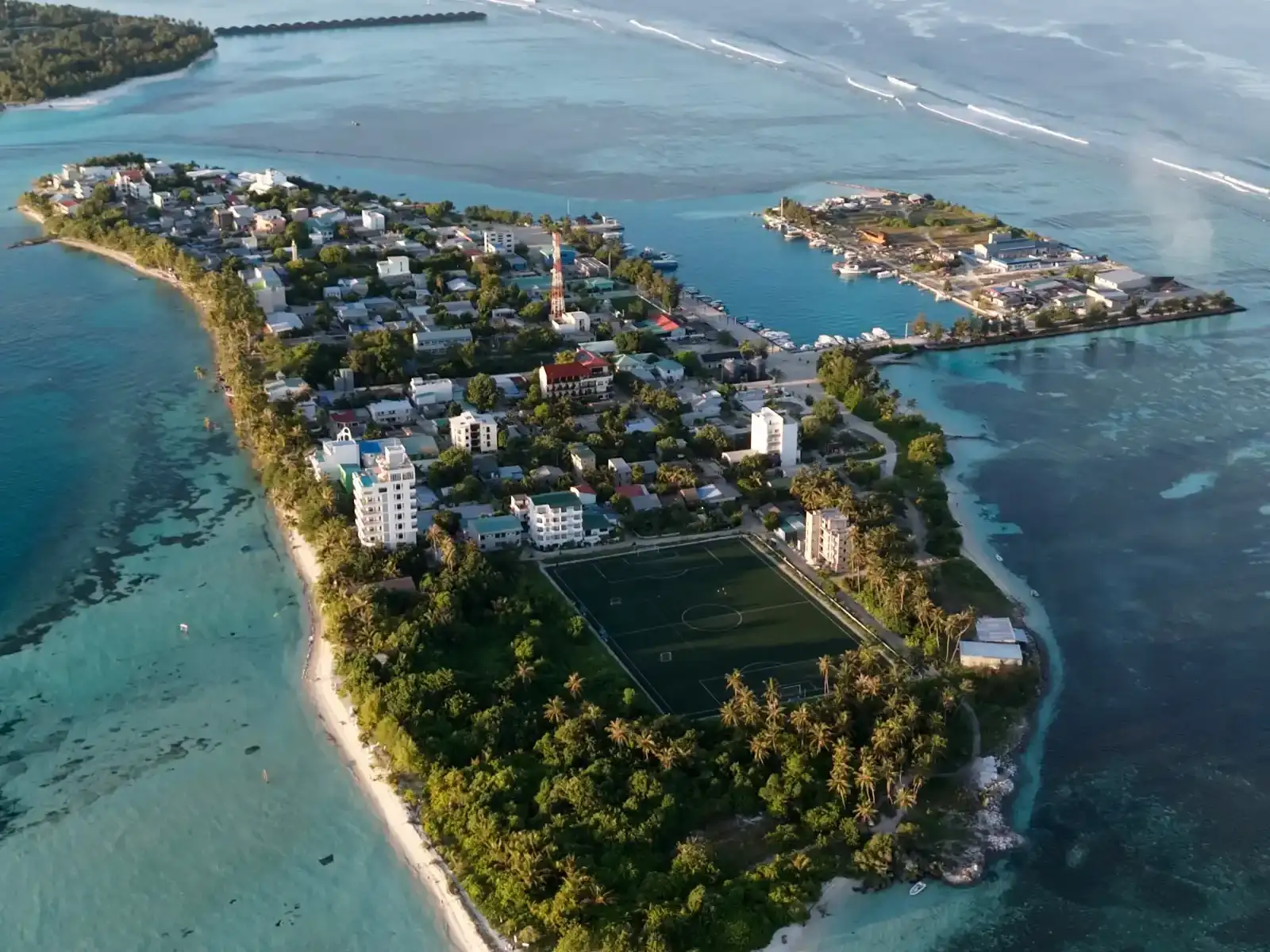
Dhiffushi, on the eastern rim of North Malé Atoll, is a typical local island of about 1,270 people. Guesthouse staff, café owners and boat crews speak English, but you’ll hear Dhivehi everywhere: in the harbour, at the school gate and from the football pitch in the evening. Try a *shukuriyyaa* after your first *mas huni* breakfast and see what happens. Start planning on our Plan your trip page, and read the Maldives local islands guide for the bigger picture.
Do you need Dhivehi to visit the Maldives?
No. From the moment you land at Velana International Airport, signs are in both Thaana and English, and immigration, transfers and accommodation all work in English (see arriving at Velana airport). Menus in tourist cafés are in English, and prices are usually written in US dollars or rufiyaa.
Where Dhivehi helps is in small, human moments: buying fruit from a corner shop, chatting with fishermen on the jetty, or thanking an aunty who points you to the right beach. It shows you see the island as a home, not just a backdrop.
For broader context on where the islands sit and who lives there, see where is the Maldives? Facts and map.
Questions people ask
What language is spoken in the Maldives?
The national language is Dhivehi, an Indo-Aryan language related to Sinhala and written in its own right-to-left script, Thaana. English is widely spoken, especially in tourism, government and business, and is taught in schools. Arabic is used for religious purposes. On local islands you’ll hear Dhivehi in daily life, but staff at guesthouses, cafés and boat services almost always speak English well.
How do you say thank you in Dhivehi?
Thank you is *shukuriyyaa*, said roughly “shu-ku-RIY-yaa”, holding the double “y” slightly longer. You’ll also see it spelt “shukuriya” or “shukuriyaa”; all are understood. If someone thanks you, a friendly reply is *maruhabaa*, which also means welcome. It’s the single most useful word to learn before you arrive.
How do you say hello in the Maldives?
The usual greeting is the Islamic *assalaamu alaikum* (“peace be upon you”), answered with *wa alaikum assalaam*. It’s polite with everyone, especially older people and shopkeepers. Among friends, people often say *kihineh?*, meaning “how are you?” or “how’s it going?”. A simple “hello” in English is also perfectly fine.
Is English widely spoken in the Maldives?
Yes. English is used in schools, government, business and almost all of tourism, so you can travel the whole country using it. Guesthouse owners, boat crews, café staff and airport officials will speak English. Older people on smaller islands may speak less, which is where a few Dhivehi words help. Signs are commonly in both Thaana and English.
Why do Maldivian place names have “dh” and “th” in them?
These spellings come from the official Latin transliteration announced in 1977. “Dh” and “th” stand for soft, dental “d” and “t” sounds made with the tongue against the teeth, not the English “th” in “the”. So Dhiffushi starts with a soft “d”, and Thaana with a soft “t”. The same system gives the Maldives’ many double letters.
Is Dhivehi hard to learn?
Speaking a few phrases is easy, and most visitors manage greetings, thanks and numbers within a day. Fluency is harder: Dhivehi has its own script, different levels of politeness and grammar unlike English. Reading Thaana takes practice, but with about two dozen basic letters, many travellers enjoy picking out simple words on signs.