


Arriving in the Maldives: Velana airport guide
From the IMUGA declaration and free visa on arrival to customs, cash and speedboats: a step-by-step guide to landing at Velana airport and reaching your island.
 By Dhiffushi Island Council8 min readUpdated
Almost every trip to the Maldives starts at Velana International Airport, on Hulhulé island right next to Malé. Fill in the free IMUGA traveller declaration online within 96 hours before you land, collect your free 30-day tourist visa at immigration, clear customs (no alcohol or pork), and then head out by speedboat, seaplane, domestic flight, ferry, bus or taxi. Most arrivals are on their way to an island within an hour or two.
Velana airport at a glance
Velana International Airport (code MLE) is run by Maldives Airports Company Limited (MACL), which is fully owned by the government. It sits on its own island, Hulhulé, joined by bridge and road to Malé and to Hulhumalé, the reclaimed island next door.
A few things worth knowing before you fly:
- A new main terminal. Terminal 1 was officially opened on 26 July 2025, and airlines moved across in stages. Check your booking or the airport’s live flight board for which terminal you use.
- The seaplane base. The Noovilu seaplane terminal opened in 2022 on the airport island’s eastern lagoon. Since early 2026, seaplane passengers check in at Terminal 1 and are taken by bus to the seaplanes.
- Domestic flights to regional airports also leave from Hulhulé. Your airline will tell you where to check in.
- Water on all sides. Boat jetties are a short walk from arrivals, so you can be on a boat within minutes of landing.
Before you fly: the IMUGA traveller declaration
Every traveller, of every age, must complete the Traveller Declaration online at imuga.immigration.gov.mv. It is free, and it has to be done within 96 hours before you arrive.
- Each person needs their own declaration, including children, who also need their own passport.
- Keep the confirmation (a QR code by email) handy for check-in and arrival.
Since 15 August 2024 (as reported), departing travellers no longer need a separate departure declaration, so this is an arrival task only.
Step by step: from the plane to the arrivals hall
1. Immigration
Follow the signs to the arrival immigration halls on the ground floor. Visitors join the general queue; there are separate counters for residents and work-visa holders. The automatic passport gates are for Maldivian citizens only.
The tourist visa is free, issued on arrival and valid for 30 days, for most nationalities. Have these ready:
- a passport valid for at least one month (many airlines want six months, so check with yours)
- a return or onward ticket
- a confirmed booking at a registered guesthouse, hotel or resort, or proof of enough money for your stay
- your IMUGA confirmation
Entry is always at the immigration officer’s discretion. Our visa and entry guide covers the rules in detail.
2. Baggage and customs
All luggage is screened before it reaches the baggage belts. The Maldives is a Muslim country with strict import rules, and Maldives Customs takes them seriously.
Not allowed in:
- alcohol, including duty-free bought on the way (it will be taken off you at customs)
- pork and pork products
- narcotics
- pornography
- idols for worship and religious material offensive to Islam
Some things, such as controlled medicines, need a permit in advance. Carry prescription medicine in its original packaging with your prescription. The airport’s arrival guide lists a tobacco allowance of 200 cigarettes, 25 cigars or 250 g of tobacco. Full details are at customs.gov.mv.
3. The arrivals hall
Outside, you’ll find people holding name boards, transfer desks, cafés, shops and a 24-hour airport clinic. If your guesthouse is arranging your speedboat, someone will usually meet you here and walk you to the jetty, so send your host your flight number before you fly.
Money, SIM cards and Wi-Fi on arrival
- Money. The currency is the Maldivian rufiyaa (MVR). US dollars are widely accepted in tourism, but ferries, buses, small shops and cafés on local islands often prefer rufiyaa. Change or withdraw a modest amount at the airport for the first day. Our money, costs and taxes guide explains cards, cash and the taxes on your bill.
- SIM cards. Local SIM cards and tourist data packages are on sale in the arrivals area. Bring your passport, as it is needed to register a SIM. See our SIM card and Wi-Fi tips for what to look for.
- Wi-Fi. Save your host’s number and boat time offline before you fly, rather than relying on airport Wi-Fi.
Getting from the airport to your island
The right option depends on where you are staying. Many guesthouses on local islands arrange or recommend transfers, so ask when you book. For a fuller picture, read getting around the Maldives.
| Option | Best for | Good to know |
|---|---|---|
| Shared speedboat | Local islands in nearby atolls | Leaves from the airport jetty; set departure times, so check your flight fits |
| Private speedboat | Late arrivals, groups | Most flexible, but the most expensive by boat |
| Public ferry (MTCC) | Travellers with time | Leaves from Malé, not the airport; cheap, slow, cash in rufiyaa, usually no Friday service |
| Domestic flight | Distant atolls | Often combined with a speedboat at the other end |
| Seaplane | Mainly resort transfers | Daylight only; check in at Terminal 1 |
| Bus, taxi or airport ferry | Malé and Hulhumalé | Quick and inexpensive |
Speedboats from the airport jetty
Shared speedboats are how most independent travellers reach local islands near Malé. They run on fixed timetables from the airport jetty; book your seat through your guesthouse. Boats can be delayed or cancelled in rough weather, and timings change, so allow a buffer.
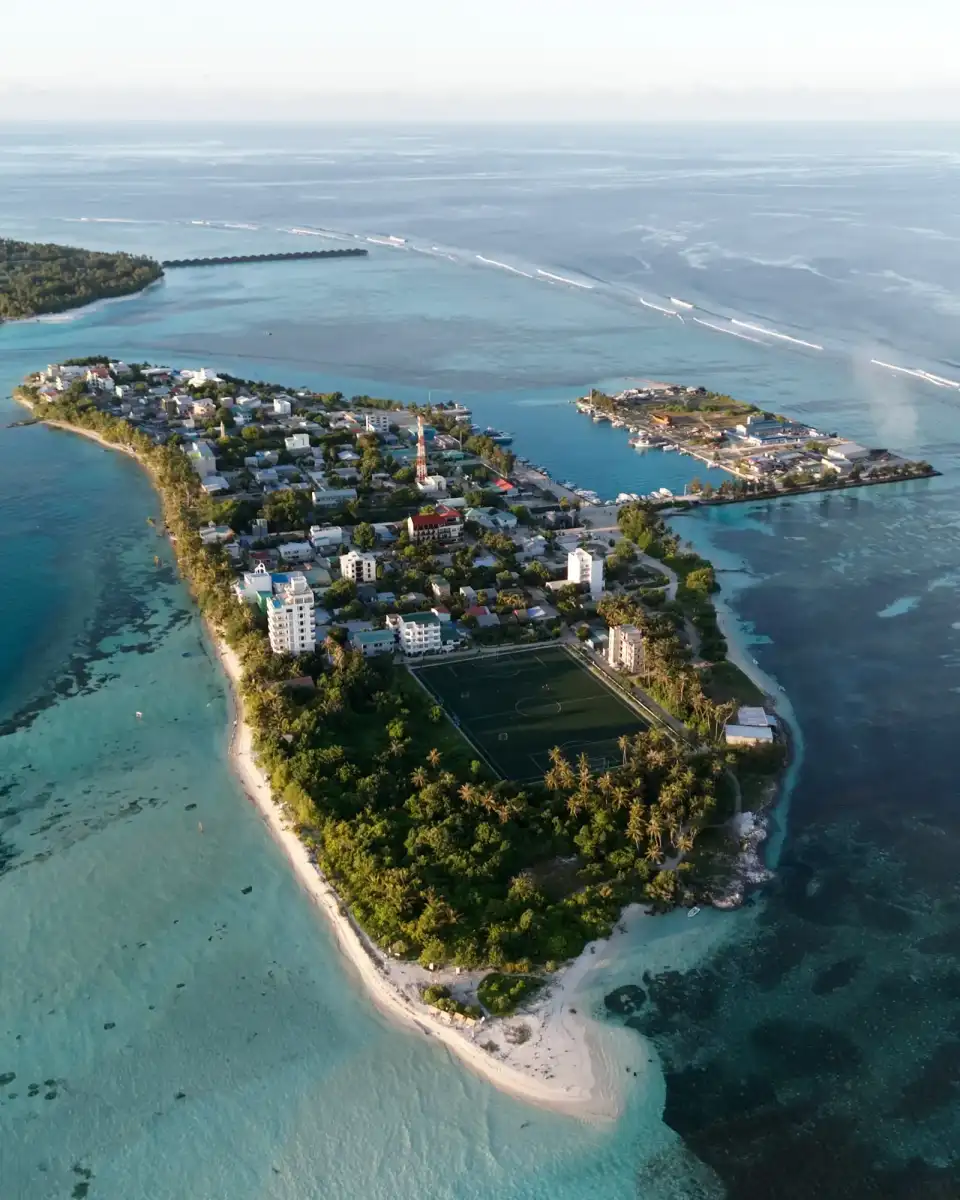
Dhiffushi is a good example: it lies about 37 km north-east of Malé, and the shared speedboat takes around 40 to 50 minutes from the airport. Our guide on how to get to Dhiffushi has the details.
Into Malé and Hulhumalé
- Public bus. Regional Transport Link (RTL) buses connect the airport with Malé and Hulhumalé, crossing the bridge. Routes and tickets are in the RTL app.
- Taxi. Taxis wait outside arrivals and run across the bridge to Malé and Hulhumalé. Agree or check the fare before you set off.
- Airport ferry. A public ferry crosses from Hulhulé to Malé roughly every 15 minutes from about 5.30 am to midnight, according to the airport.
Visiting the capital? See our Malé city guide.
Public ferry from Malé
MTCC public ferries are the cheapest way to reach many local islands, but they leave from Malé, not the airport, and are slow and infrequent. Most routes do not run on Fridays. For Dhiffushi, see the MTCC public ferry route 308 page for the latest information before you plan around it.
Domestic flights and seaplanes
For far-off atolls, domestic flights go from the airport to regional airports, often followed by a short boat ride. Seaplanes fly in daylight only and mostly serve resorts.
Landing late: overnight near the airport
Many long-haul flights land in the evening, after the last shared speedboats and seaplanes have gone. Rather than pay for a private transfer, many travellers spend the first night in Hulhumalé, a short bus or taxi ride from the airport. It has places to stay at many prices, a public beach and late cafés.
Remember that Hulhumalé and Malé are inhabited islands, so the local dress code and alcohol rules apply there, just as on any local island. See what to wear in the Maldives.
Leaving the Maldives: departure tips
- Get there early. The airport advises checking in at least two hours before your flight. Most check-in counters open around then.
- Plan the boat back. Speedboats from local islands run on timetables and can be held up by weather. Many travellers come back to Hulhumalé or Malé the night before an early flight.
- Departure charges are already paid. The departure tax and airport development fee (about USD 100 in total for economy) are included in tickets issued since 1 December 2024.
- Hand luggage rules. Liquids over 100 ml go in checked bags; power banks stay in your hand luggage.
- Don’t pack the reef. Coral, shells and turtle products need permits to leave the country, and taking them harms the reef. Don’t buy or collect them.
Questions people ask
Do I need to fill in IMUGA before flying to the Maldives?
Yes. Every traveller, including children, must complete the free Traveller Declaration at imuga.immigration.gov.mv within 96 hours before arriving. You’ll need your passport, flight details and accommodation address, and should keep the confirmation on your phone. Avoid third-party sites that charge a fee, as the official form is free.
Can I get to a local island the same night I land?
Often, yes, if you land in the afternoon or early evening. Shared speedboats run until the evening on many routes, and private speedboats can go later at a higher price. Seaplanes fly in daylight only. If your flight lands late, a night in Hulhumalé is a calm, affordable option before a morning boat.
Can I bring alcohol into the Maldives?
No. Alcohol cannot be brought into the country, including duty-free bought on the way, which customs will hold. Alcohol is also not sold or allowed on local islands. Only resorts, the airport hotel island and liveaboard boats are licensed to serve it. Pork, narcotics, pornography and idols for worship are also prohibited.
How do I get from the airport to Malé?
You have three easy options. Public RTL buses cross the bridge to Malé and Hulhumalé, taxis wait outside arrivals, and a public airport ferry crosses to Malé about every 15 minutes from early morning until midnight. All are quick and inexpensive, and the ferry ride is a pleasant first look at the lagoon.
Do I pay departure tax at the airport?
No, not separately. Since 1 December 2024, the departure tax and airport development fee have been included in the price of tickets issued from that date. For economy passengers on foreign flights, this comes to about USD 100 in total. It is higher in business and first class. Check your ticket breakdown if you are unsure.
Where can I get rufiyaa when I land?
There are ATMs and money exchange counters at the airport. It’s worth having some rufiyaa for ferries, buses, local cafés and small shops, which often prefer local cash. US dollars are widely accepted in tourism, but small change is easier in rufiyaa. Some local islands, such as Dhiffushi, also have an ATM that accepts foreign cards.

