


Maldivian island names: what they mean
Why so many Maldivian islands end in -dhoo or -fushi, which island pairs mean big and small, and why one island can be spelt three ways.
 By Dhiffushi Island Council8 min readUpdated
Most Maldivian island names are built from everyday Dhivehi words, and the endings tell you the most. *-dhoo* is an old word for “island”, *-fushi* is a small island, and many names start with words for big, small or long. Once you know a dozen of these pieces, a map of the Maldives starts to read like a description of the islands themselves.
Why island names are worth a look
There are a lot of islands to name. The Maldives Bureau of Statistics (Census 2022) counts 187 inhabited islands, 168 resort islands and 106 industrial islands, plus many uninhabited ones. Their names come from Dhivehi, which shares old roots with Sinhala; our guide to Dhivehi and the Thaana script explains the language.
A word of caution: names are old, and sounds and meanings have shifted over the centuries. Some pieces can be traced with confidence, others can’t, and islanders often have their own stories about a name. Those stories are part of island life, even when they differ from the dictionary.
For the meanings below we have used Hassan Ahmed Maniku’s *A Concise Etymological Vocabulary of Dhivehi Language*, hosted online by the University of Chicago’s Digital Dictionaries of South Asia, and Sonja Fritz’s academic grammar *The Dhivehi Language* (2002). Where we couldn’t find a reliable source for a meaning, we have left it out.
The two most common endings
-dhoo: island
*Dhoo* means “island”. Maniku traces it to the same root as Sanskrit *dvipa*, island, and Fritz explains that the old Dhivehi word for island has vanished as a word on its own. It survives only at the end of place names.
You will see it everywhere:
- Thulusdhoo, a near neighbour of Dhiffushi in North Malé Atoll
- Thinadhoo, Funadhoo and Felidhoo across the country
- Meedhoo, Maradhoo and Hithadhoo, which Fritz gives as examples
The same old word also hides inside *Dhivehi* itself. Fritz explains the name as coming from a compound meaning “island inhabitant”, so Maldivians are, quite literally, the island people.
-fushi: a small island
*Fushi* is the ending most visitors notice first, because so many local islands and resorts carry it. Maniku defines *fushi* as a minor island, one formed of stones and pebbles, and an unproductive island. In other words, it described a smaller, rougher island than a full *dhoo*.
Today the distinction is history. Some *-fushi* islands are now busy towns, and Kulhudhuffushi in the far north has been a city since 2020.
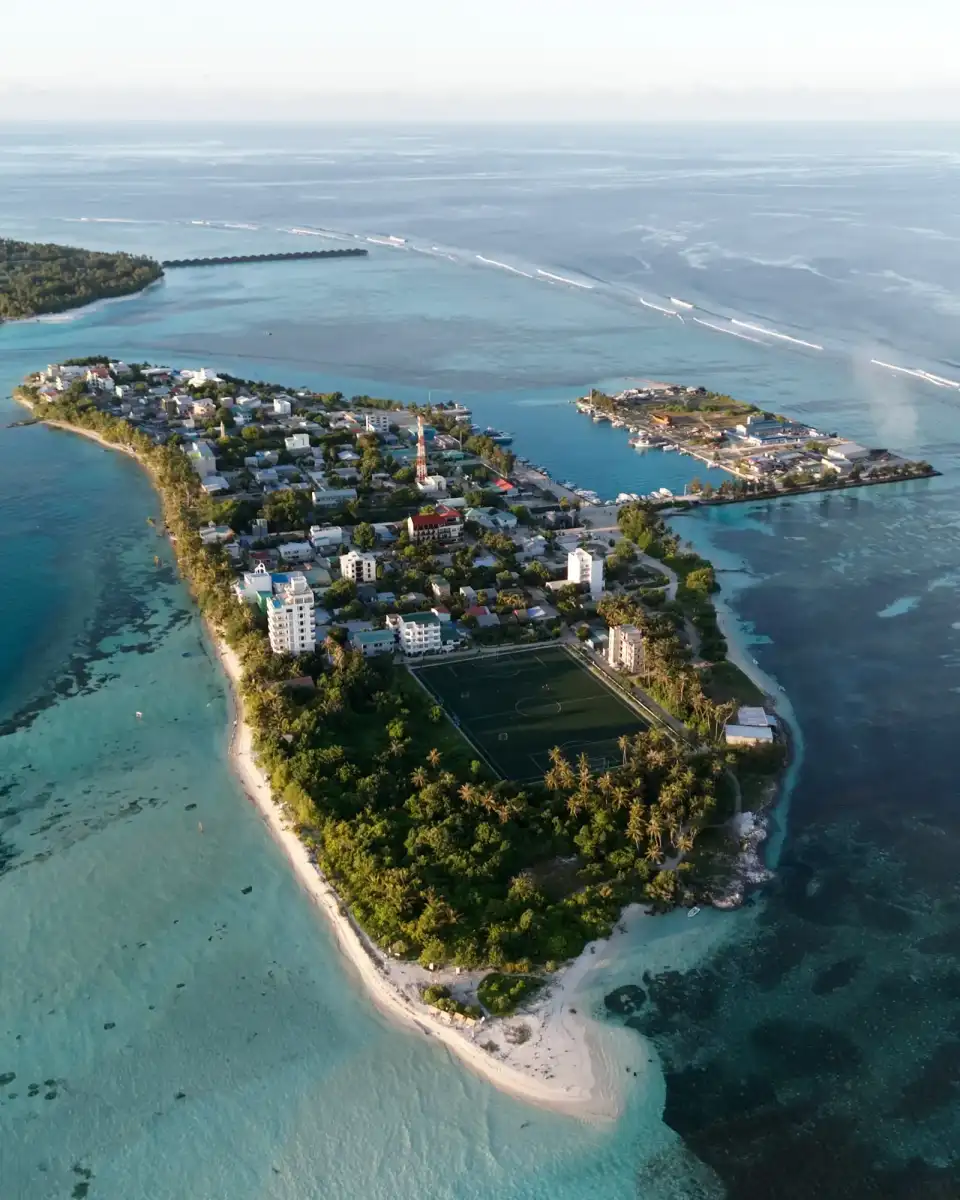
Dhiffushi is one of these islands. We haven’t found a reliable source for the first part of its name, so we won’t guess; our Dhiffushi history and island life guide tells the island’s story.
Maniku also notes a regional twist: in Huvadhoo Atoll in the south, *fushi* is pronounced *futtaa* or *huttaa*. Our guide to Maldivian dialects explains more of these differences.
Words for size and shape
Many names begin with a word that describes the island. These are the ones you will meet most often.
| Word | Meaning (Maniku) | Where you will see it |
|---|---|---|
| *maa* | great, big, large | names beginning Maa- |
| *hulhu* | small, lesser (old word) | Hulhudhoo, Hulhulé |
| *kuda* | small, little | names beginning Kuda- |
| *bodu* | big, large | island and reef names |
| *dhigu* | long, tall | names beginning Dhigu- |
Be careful with *maa*. In Maniku’s dictionary the same word can also mean “flower”, so a name starting with Maa- is not always “big”.
Paired islands: big and small
The old word *hulhu* means small or lesser. Maniku notes that it now survives mainly in island names, often paired with a “big” island in the same atoll:
- Hulhudhoo and Maaddoo
- Hulhulé and Malé
- Hulhudheli and Maadheli
- Hulhuvaarulu and Maavaarulu
- Hulhimendhoo and Maamendhoo
So Hulhulé, the airport island, is named as the “lesser” partner of Malé, the capital across the water.
Words for reefs, sand and water
Island names often borrow from the reef around them, and the same words turn up in dive-site names.
- Thila – a shallow shoal or shelf (Maniku). Divers use it for a reef that rises from the seabed but stays underwater.
- Giri – a collection of coral inside an atoll or lagoon (Maniku). Often a coral patch close to the surface.
- Falhu – a lagoon, an area of sea enclosed by a reef (Maniku). As an adjective, the same word means empty or uninhabited.
- Finolhu – an unvegetated sandbank. Reef scientists use the Dhivehi word in exactly this sense in their research on how Maldivian islands formed (Kench, McLean and Nichol, *Geology*, 2005).
- Velu – the lagoon inside a ring-shaped reef, as Maldivians call it (Perry and colleagues, *Geology*, 2013).
- Veli – sand (Maniku).
- Kandu – a channel through the atoll rim. Our currents and channels guide explains why they matter.
Many *finolhu* are the places people visit on a day trip; see our sandbanks and picnic islands guide.
Faru and huraa
Two other endings are very common: *-faru*, as in Naifaru in Lhaviyani Atoll, and *-huraa*, as in Huraa in North Malé Atoll. Faru also appears in reef names, such as Manta Bay (Dhiya Adi Faru) near Dhiffushi. Reef scientists use “faro” for the ring-shaped reefs found in Maldivian atolls. We haven’t found a dictionary definition of *faru* or *huraa* that we trust, though, so we leave their exact meanings open.
Names with a history
Some names hold clues to the islands’ past.
- Gan. Maniku explains *gan* as an island, village or settlement, related to the Sinhala word for village. Fritz adds that the old word for village survives in modern Dhivehi only in this island name. Maniku notes there are three islands called Gan, all larger than average.
- Thoddoo. Maniku records that in the Isdhoo copper plates (*loamaafaanu*), which he dates to 1194, Thoddoo was written Thotadhoo. The first part is an old word for reef, which still exists today as *thoshi*.
- Dhambidhoo. Fritz explains this island name in Laamu Atoll as “rose-apple tree island”, from an old word for the rose-apple tree.
- Addu. Fritz suggests the name of the southernmost atoll may come from old words meaning “eight islands”. Treat this as a scholar’s explanation rather than settled fact.
For the wider story, see our history of the Maldives.
Where “atoll” comes from
One Maldivian place word has gone global. The UK’s Permanent Committee on Geographical Names notes that the English word “atoll” comes from the Dhivehi *atholhu*. Each natural atoll has its own Dhivehi name, such as Maalhosmadulu or Huvadhu Atholhu. Our atolls guide explains the geography.
Why spellings vary
You will see the same place spelt several ways, such as Fuvahmulah and Fuvammulah, or Malé and Maale. There are three main reasons.
Two scripts
Dhivehi is written in Thaana, from right to left, so every English spelling is a transliteration. The official Latin rules were announced on 23 May 1977, according to the front matter of Maniku’s dictionary. Older maps and books used other spellings.
The rules themselves
Long vowels are written doubled, so *dhoo* rather than *dho*, and some names carry an apostrophe, such as Vilin’gili. The UK’s naming committee notes that strict transliteration gives Fuvammulah, while most sources write Fuvahmulah. Malé is a conventional English form of Maale.
Official spellings since 2025
Since March 2025, the President’s Office has directed that official documents, databases and websites must use the Dhivehi and English island, atoll and code names set out in Presidential Decree 2/2025. That should bring government sources into line, even if signs, maps and booking sites still disagree. Our atoll codes and island addresses guide explains the codes, such as the K. in K. Dhiffushi.
Using names on your trip
- Check the atoll too. Some islands share a name, so tickets and bookings should show the atoll code.
- Expect spelling differences. A name that looks nearly right probably is.
- Ask about the name. Islanders usually enjoy explaining it, and it starts a good conversation.
- Learn to say it. Long vowels matter; our Dhivehi phrases guide helps.
On Dhiffushi, our island map shows reefs, beaches and landmarks by name.
Questions people ask
What does “fushi” mean in Maldivian island names?
*Fushi* means a small island. Maniku’s etymological dictionary describes it as a minor island formed of stones and pebbles, smaller or rougher than a full *dhoo*. The meaning is historical, though. Some *-fushi* islands, such as Kulhudhuffushi, are now large towns. In Huvadhoo Atoll the word is pronounced *futtaa* or *huttaa*, which shows how much local speech can vary across the country.
What does “dhoo” mean?
*Dhoo* means island. It comes from the same old root as the Sanskrit word for island, and linguist Sonja Fritz explains that the old Dhivehi word now survives only at the end of place names, such as Thulusdhoo, Meedhoo and Hithadhoo. The same root is part of the word *Dhivehi*, which Fritz explains as “island inhabitant”, so Maldivians are the island people.
What does Dhiffushi mean?
The ending *-fushi* means a small island, according to Maniku’s dictionary. We haven’t found a reliable written source for the first part of the name, so we don’t offer a full translation. Islanders may tell you their own explanation, and that local knowledge is worth hearing. You can find out more about the island and its past on our Dhiffushi history page.
Why is Hulhulé called Hulhulé?
*Hulhu* is an old Dhivehi word meaning small or lesser. Maniku notes that it survives mainly in island names, often paired with a “big” island nearby. He lists Hulhulé and Malé as one such pair, so the airport island is named as the smaller partner of the capital. Other pairs include Hulhudhoo and Maaddoo, and Hulhimendhoo and Maamendhoo.
Why do Maldivian island names have so many spellings?
Dhivehi is written in its own script, Thaana, so English spellings are transliterations. The official Latin rules date from 1977, but older maps used other systems, and strict rules sometimes differ from common use, as with Fuvammulah and Fuvahmulah. Since March 2025, official bodies must follow the spellings in Presidential Decree 2/2025, though signs and websites may still differ.
Does the word “atoll” come from the Maldives?
Yes. The UK’s Permanent Committee on Geographical Names notes that the English word “atoll” comes from the Dhivehi *atholhu*. It is one of the few Dhivehi words used around the world. Scientists have also borrowed other Maldivian words, such as *finolhu* for an unvegetated sandbank and *velu* for the lagoon inside a ring-shaped reef.

