


The Maldivian economy explained: tourism, fishing and more
Tourism is a fifth of GDP, fish is the main export and almost everything is imported. A plain guide to the Maldivian economy and what it means for visitors.
 By Dhiffushi Island Council8 min readUpdated
The Maldivian economy runs mainly on tourism. Tourism is the largest single sector, about a fifth of national output in 2025, and most of the country’s foreign currency comes from it. Fishing, trade, construction and government services make up much of the rest, and almost everything people eat, drive or build with is imported.
The economy at a glance
The Maldives is a small, open island economy: around 515,000 people on 187 inhabited islands (Census 2022). Land is scarce, so the economy leans on what the setting offers: the sea, the beaches and the reefs.
Key figures from the Maldives Bureau of Statistics (annual GDP release, September 2026):
- Size: nominal GDP of about MVR 119 billion in 2025.
- Growth: real GDP grew by 6.3% in 2025, after 3.4% in 2024.
- Income per person: GDP per capita was about US$13,300 in 2025.
- Largest sector: tourism, with 20.3% of nominal GDP in 2025.
The Asian Development Bank (ADB) describes the Maldives as an upper middle-income small island state with a narrow economic base.
Tourism: the main engine
Tourism took over from fishing as the leading activity in the late 1970s, according to ADB. The story of how that happened is told in our short history of tourism in the Maldives.
How big is tourism?
It depends on how you count:
- Direct share: the Bureau of Statistics puts tourism (accommodation and food services) at 20.3% of GDP in 2025. ADB notes the direct share has averaged a little over 21% since 2003.
- Wider share: once you add the businesses that depend on tourism, such as transport, trade and construction, the share is far higher. ADB cites an estimate of about 64% of GDP for 2025 when indirect effects are included.
- Foreign currency: tourism accounts for more than 93% of services exports and supplies most of the country’s foreign exchange (ADB).
- Tax revenue: tourism made up almost 45% of government tax receipts in 2024 (ADB).
About 2.25 million tourists arrived in 2025, up 9.8% on 2024 (Ministry of Tourism figures, as reported). The Bureau of Statistics links 2025’s growth in tourism output to more bed-nights, mainly from European and Chinese visitors.
Resorts and local islands
Most visitors still stay at resorts, which are private islands run under their own licences. But a growing share choose guesthouses on local islands. In 2025 about 22% of tourists, roughly half a million people, stayed in guesthouses, and guesthouses operate on about 116 islands across 20 atolls (Ministry of Tourism figures, as reported).
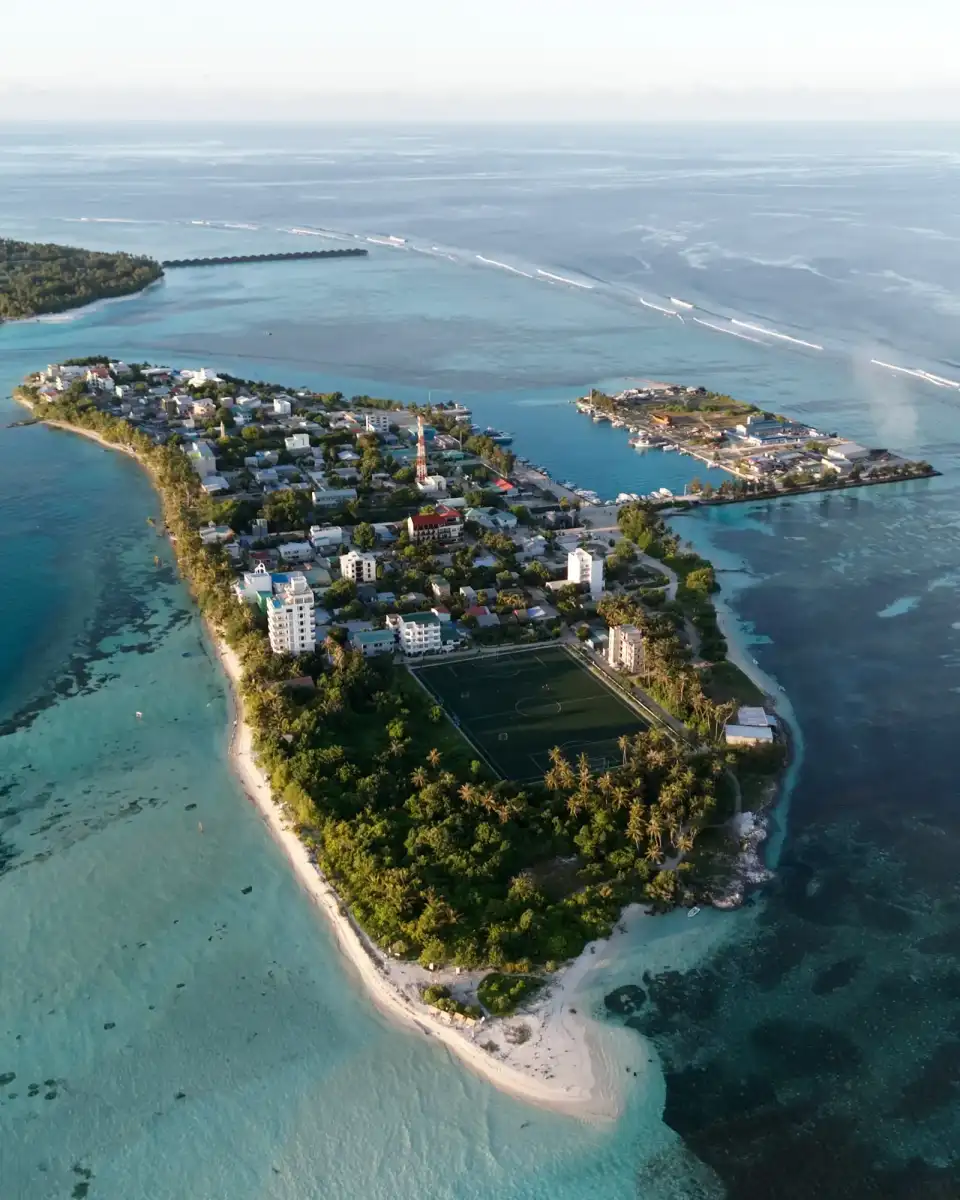
This matters for island economies. On a resort, money mostly flows through one company. On a local island, a visitor’s spending is spread across family-run guesthouses, cafés, small shops, boat crews and guides. On Dhiffushi, for example, guesthouse and excursion work now sits alongside fishing. Our guide to local islands and resorts explains the differences for travellers.
Tourism employs tens of thousands of people, many of them foreign workers at resorts; on local islands, more of the work is done by islanders.
Fishing: the traditional backbone
Before tourism, fishing was the heart of the economy, and it is still central to island life and food. Maldivian tuna is caught mainly by pole and line, one fish at a time, a method described in our guide to pole-and-line tuna fishing.
- Share of GDP: fisheries made up 3.4% of GDP in 2025 (Bureau of Statistics).
- A strong year: fisheries output grew by 24.8% in 2025, after the fish catch rose by 39.4% (Bureau of Statistics).
- Exports: fish is the main home-grown merchandise export; skipjack and yellowfin tuna make up most of the catch (ADB; Maldives Monetary Authority data as reported by national media).
- Jobs and food: agriculture and fisheries together provided about 7.4% of jobs in 2019, and fishing remains a main source of food and income outside the Greater Malé area (ADB).
Fishing is small in GDP terms, but it shapes daily life, from the boats in island harbours to tuna in breakfast mas huni.
Other parts of the economy
The Bureau of Statistics lists the next largest sectors after tourism as:
- Wholesale and retail trade: 8.1% of GDP, closely tied to imports.
- Public administration: 7.5%.
- Financial services: about 7.2%.
- Construction: about 5.3%, driven by housing, land reclamation and infrastructure.
Farming is limited: ADB counts only about 27 square kilometres of arable land.
Imports: almost everything arrives by sea or air
The Maldives produces very little of what it consumes. ADB reports that:
- imports averaged about 73% of GDP between 2017 and 2025;
- imports supply more than 90% of the food people eat;
- fuel is a major import, which is why electricity on islands has long relied on diesel generators (see our guide to solar and renewable energy).
This is the main reason prices can feel high: goods are shipped in, often twice, first to Malé and then on to the islands. Basic food staples, fuel and electricity are subsidised by the government (ADB).
The rufiyaa and the US dollar
The national currency is the Maldivian rufiyaa (MVR), issued by the Maldives Monetary Authority (MMA). The rufiyaa is managed against the US dollar, with an official rate of around 15.42 MVR per dollar. ADB dates the dollar link to 1994; the current band was set in 2011.
Because tourism earns dollars and imports are paid in dollars, the US dollar is used widely in the tourism economy. Since January 2025, the Foreign Currency Act requires tourism businesses to bank their foreign currency earnings, and banks sell most of these inflows to the MMA (ADB).
ADB also notes that a parallel (unofficial) market for dollars exists, at a weaker rate than the official one. For visitors, the simple advice is to change money at banks or licensed money changers and keep receipts. More on notes, coins and paying is in our rufiyaa guide.
Public finances, debt and the outlook
International institutions describe the Maldives’ public finances in cautious terms. In plain language:
- Debt: the World Bank reported public and publicly guaranteed debt of about US$9.5 billion at the end of June 2025, equivalent to around 127% of GDP. ADB reported total public debt at about 123% of GDP in mid-2026.
- Reserves: foreign currency reserves have been low compared with import needs. A US$500 million sukuk (Islamic bond) was repaid in 2026, which eased immediate pressure but reduced reserves for a time (ADB).
- IMF view: after its 2026 Article IV mission, the IMF said the deficit and debt are expected to stay high and that the risk of debt distress remains high, calling for steady reforms to spending and revenue (as summarised by ADB).
- Growth outlook: ADB expects slower growth in 2026, citing the effect of the Middle East conflict on travel and higher oil prices. The World Bank sees growth settling at around 4% over the medium term.
Conditions can change quickly in a tourism-led economy: GDP fell by about a third in 2020 during the pandemic (ADB).
What it means for visitors
Prices are often in US dollars
Guesthouses, excursions, transfers and resorts usually quote in US dollars. Local shops, cafés and the public ferry are more likely to want rufiyaa, especially for small amounts. Our money, costs and taxes guide covers cards, cash and ATMs.
Taxes fund the state
Tourism taxes are a large part of government income. As of October 2026:
- Tourism GST: 17% since 1 July 2025 (MIRA).
- Green tax: USD 6 per guest per night at guesthouses and hotels with 50 rooms or fewer on inhabited islands; USD 12 at resorts, larger hotels and liveaboards; children under 2 are exempt (MIRA).
- Service charge: a 10% service charge is commonly added to bills. See tipping in the Maldives.
- Departure charges: about USD 100 for foreign economy passengers, already included in the air fare.
Your spending choices matter
Staying on a local island, eating at local cafés and booking trips with island crews keeps more of your money in the community. Island councils also play a part in local tourism, as our guide to island councils and local government explains. For more ideas, see responsible travel in the Maldives, or browse places to stay on Dhiffushi.
Questions people ask
What is the main industry in the Maldives?
Tourism is the main industry. The Maldives Bureau of Statistics puts tourism at 20.3% of nominal GDP in 2025, the largest single sector, and the Asian Development Bank estimates that tourism and the businesses that depend on it account for well over half of economic activity. Tourism also earns most of the country’s foreign currency and almost half of its tax revenue.
Is fishing still important in the Maldives?
Yes. Fisheries were 3.4% of GDP in 2025, a small share, but output grew by about a quarter that year as the catch rose sharply. Fish, mostly skipjack and yellowfin tuna, is the country’s main home-grown export. Fishing also feeds island families and provides work outside Malé, and pole-and-line fishing remains part of island identity.
Why is the Maldives expensive?
Mainly because almost everything is imported. Food, fuel, building materials and most goods arrive by ship or plane, often via Malé and then by boat to the islands. Tourism taxes, the green tax and a 10% service charge add to bills. Local islands and guesthouses are usually far more affordable than resorts, and local cafés charge local prices.
What currency does the Maldives use?
The Maldivian rufiyaa (MVR), issued by the Maldives Monetary Authority. It is managed against the US dollar at an official rate of around 15.42 rufiyaa per dollar. US dollars are widely accepted for tourism services, but small shops, cafés and public ferries often prefer rufiyaa. Change money at banks or licensed money changers.
Is the Maldives economy in debt?
Public debt is high. The World Bank reported it at around 127% of GDP in mid-2025, and the Asian Development Bank put it at about 123% in mid-2026. The IMF says the risk of debt distress remains high and recommends gradual reforms. For visitors, day-to-day travel is not directly affected, though prices and exchange rules can change.
How does tourism help local islands?
Since guesthouses opened on inhabited islands, tourism money reaches many more communities. About one in five visitors now stays on a local island, and their spending supports guesthouses, cafés, shops, boat crews and guides run by islanders. Tourism taxes, which make up almost half of government tax receipts, also help fund public services nationwide.

