


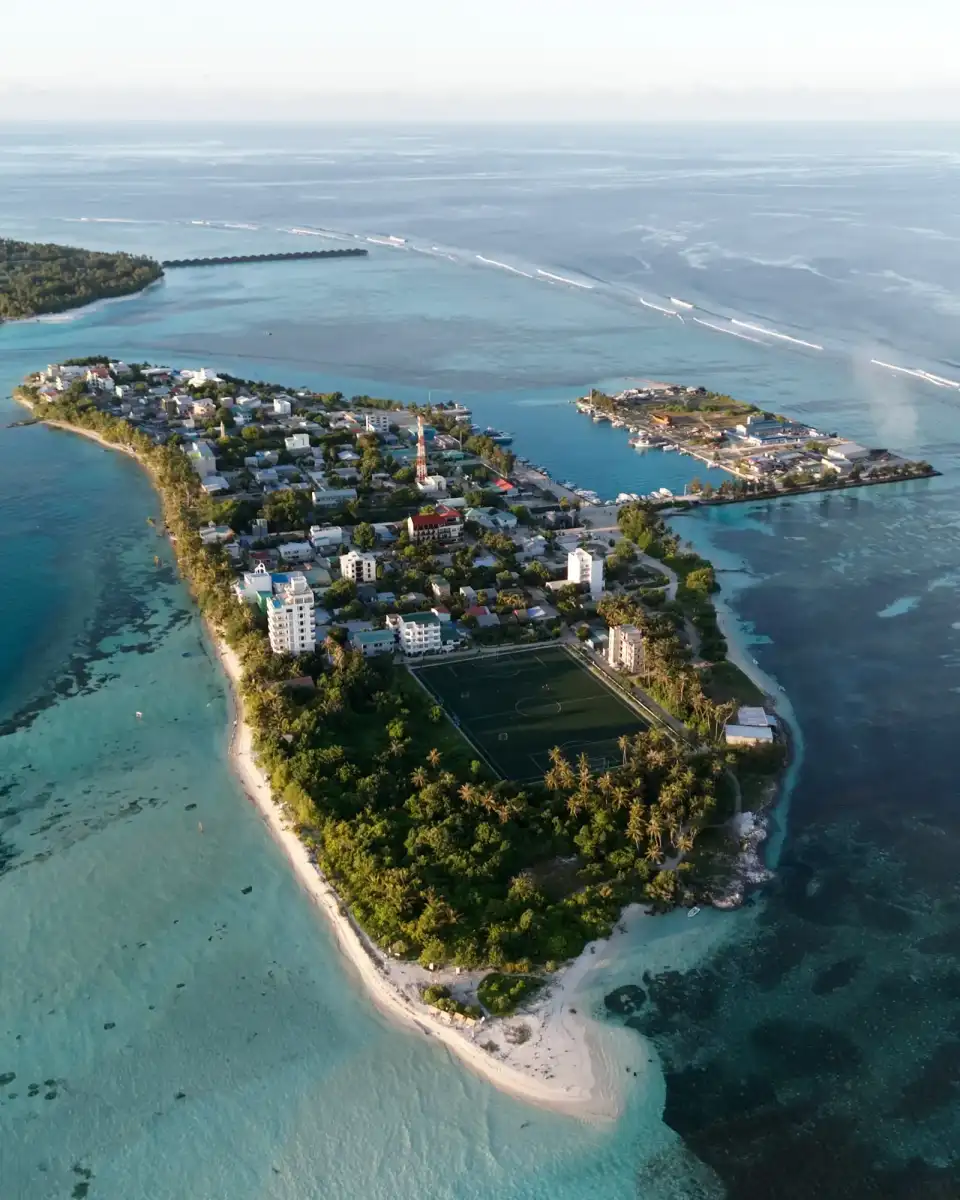
North Malé Atoll (Kaafu): a guide for visitors
The atoll around Malé and the airport: what Kaafu means, its local islands A to Z, surf breaks, protected dive sites, Gaafaru’s wrecks and how to get around by boat.
 By Dhiffushi Island Council8 min readUpdated
North Malé Atoll is the ring of reefs and islands around the Maldivian capital. It is where almost every visitor lands, at Velana International Airport, and where you can reach local islands, surf breaks and some of the country’s oldest protected dive sites within an hour or so by boat. Administratively it sits inside Kaafu, which also takes in South Malé Atoll and the outlying islands of Gaafaru and Kaashidhoo.
Kaafu, North Malé and Malé: what the names mean
The Maldives has 26 natural atolls, grouped into 20 administrative atolls. Each administrative atoll has a code letter from the Thaana alphabet, and Kaafu (K.) is the code for the Malé atoll division. You will see it written on ferry signs, addresses and maps, for example “K. Dhiffushi”.
Kaafu is not one natural atoll. It covers:
- North Malé Atoll, the larger ring to the north of the capital.
- South Malé Atoll, separated from it by the Vaadhoo channel.
- Gaafaru, a small separate reef system to the north of North Malé.
- Kaashidhoo, a single island standing alone in the channel north again.
There is one twist. Malé, the capital, sits inside North Malé Atoll on the map, but Malé City is its own administrative area and is not part of Kaafu. The city takes in Malé island itself, Villimalé, the airport island of Hulhulé and the reclaimed island of Hulhumalé.
For how Kaafu fits with the other atolls, see our Maldives atolls guide.
The Malé area: capital, airport and Hulhumalé
According to the Maldives Bureau of Statistics (Census 2022), about 41% of the country’s 515,132 people live in the Malé area. That makes the south-west corner of North Malé Atoll one of the most densely built places in the Indian Ocean, while the rest of the atoll is quiet reef, lagoon and small villages.
Malé
The capital is a compact, busy island of offices, markets, mosques and scooters. It is worth half a day for the fish market, the Friday Mosque area and the waterfront. Our Malé city guide covers what to see.
Velana International Airport (Hulhulé)
Hulhulé is the airport island, joined to Malé by a bridge and to Hulhumalé by road. Terminal 1 opened on 26 July 2025. Speedboat transfers to the atoll’s islands leave from the jetties right outside arrivals.
Hulhumalé
Hulhumalé is a planned, reclaimed island built up to about 2 m above mean sea level, according to the Housing Development Corporation. It has a long public beach, cafés and easy transport to the airport, which makes it a handy first or last night. Note that bikinis are not permitted on its public beach. Read more in our Hulhumalé guide.
Inhabited islands of North Malé and northern Kaafu (A to Z)
Outside Malé City, North Malé Atoll and its outliers hold a handful of inhabited local islands, alongside many resort islands and a few industrial ones. The islands below have tourist accommodation listed on the Ministry of Tourism’s register of facilities. They are in alphabetical order, not ranked.
- Dhiffushi – On the far eastern rim of the atoll, about 37 km north-east of Malé, and the easternmost inhabited island in the Maldives. Shared speedboats take about 40–50 minutes from Malé or the airport, and the public ferry also calls, though not on Fridays. A fishing village with bikini beaches, a long lagoon and around 1,270 people.
- Gaafaru – Out on its own reef to the north of North Malé. A remote fishing community, known to divers for the shipwrecks on its reef.
- Himmafushi – On the eastern side of North Malé, close to a cluster of surf breaks. A small, walkable fishing village, often used as a base by surfers.
- Huraa – On the eastern side of North Malé, near Himmafushi. A small, quiet village island.
- Kaashidhoo – A single island in the open channel north of the atoll. Further away, so check boat options before booking.
- Thulusdhoo – On the eastern side of North Malé, close to well-known surf breaks. A lively local island with a bikini beach.
South Malé Atoll has its own local islands, including Guraidhoo, Gulhi and Maafushi. For a side-by-side look at the islands on both Malé atolls, see local islands near Malé and Dhiffushi vs Maafushi vs Thulusdhoo.
Every inhabited island follows local island norms: no alcohol, swimwear only on designated bikini beaches, and modest dress in the village.
Dhiffushi on the eastern rim
Dhiffushi is the worked example of how the atoll’s geography shapes a visit. Because it faces the open ocean on the east, it is where the Maldives wakes first: sunrise reaches it before any other inhabited island. The eastern rim also matters for marine life. Manta rays tend to feed on the eastern sides of the atolls during the southwest monsoon, roughly May to November, and the island has its own manta spot, Manta Bay (Dhiya Adi Faru).
Planning a stay? Start with how to get to Dhiffushi.
Surfing in North Malé
The eastern side of North Malé Atoll is one of the country’s main surf areas. The breaks sit on reef passes between Thulusdhoo and Himmafushi, with names such as Cokes, Chickens, Jailbreaks, Sultans and Honky’s. Several are close enough to local islands that surfers stay in a village and take a short boat ride out.
These are reef breaks, often shallow and best suited to intermediate and experienced surfers. Some breaks near resorts have access arrangements, so ask before paddling out. For seasons, swell and etiquette, read surfing in the Maldives.
Diving and protected sites
North Malé was where Maldivian dive tourism began, and some of its best-known sites have been protected since 1 October 1995. The 2019 national list of protected areas includes these North Malé sites:
- Banana Reef (Gaathu Giri) – a curved reef with overhangs and caves, among the earliest dive sites in the country.
- HP Reef (Thanburudhoo Thila) – a channel reef known for soft corals in strong current.
- Makunudhoo Kandu – a channel on the north-west side of the atoll.
- Rasfari – a wider protected region on the western rim.
Protected status restricts fishing and the taking of marine life, so look but don’t take. The recreational diving depth limit is 30 m, and feeding sharks is illegal. Dive with a licensed centre and follow your guide’s briefing; currents in the channels can be strong.
For the bigger picture, see protected areas of the Maldives.
History: reefs, trade and shipwrecks
The atoll has been the political centre of the Maldives for centuries, with Malé as the seat of the sultans. The outer reefs were also a hazard to shipping crossing the Indian Ocean. Gaafaru’s reef, sitting on the northern approach, caught a number of vessels. A British colonial report from the 1880s mentions salvage from a steamship wrecked on the Gaafaru reef. Its remains are still visited by divers today, along with other wrecks on the same reef.
Getting around North Malé Atoll
Distances are short, but there are no roads between islands, so everything moves by boat.
- Shared speedboats run scheduled transfers between Malé, the airport and most local islands. They are the fastest everyday option.
- MTCC public ferries are cheap and slow, take cash in rufiyaa and do not run on most routes on Fridays. The route serving Dhiffushi is route 308.
- Private speedboats can be chartered for awkward times or groups.
Weather can delay or cancel boats, especially in the southwest monsoon, so leave a buffer before an international flight.
When to visit
The whole atoll shares the national climate. The northeast monsoon, roughly January to March, is the dry season, according to the Maldives Meteorological Service. The southwest monsoon, mid-May to November, brings more rain and bigger swell, which suits surfers. April and December are transition months. Air temperatures stay around 30–31°C all year, and the sea is about 28–29°C.
Questions people ask
Is North Malé Atoll the same as Kaafu Atoll?
Not quite. Kaafu is the administrative atoll, and it covers North Malé Atoll, South Malé Atoll and the outlying islands of Gaafaru and Kaashidhoo. North Malé is one natural atoll within it. Malé City, which includes the capital, the airport island and Hulhumalé, sits inside North Malé on the map but is administered separately from Kaafu.
Which local islands are in North Malé Atoll?
Inhabited local islands with tourist accommodation in North Malé and northern Kaafu include Dhiffushi, Gaafaru, Himmafushi, Huraa, Kaashidhoo and Thulusdhoo. Gaafaru and Kaashidhoo lie outside the main atoll ring. Each is a real village with mosques, schools and shops, so local rules on alcohol and dress apply. South Malé Atoll has others, such as Guraidhoo, Gulhi and Maafushi.
How do I get from the airport to the islands of North Malé?
Most visitors take a shared speedboat from the jetties outside arrivals at Velana International Airport. For Dhiffushi the trip takes about 40–50 minutes. MTCC public ferries are cheaper but slower, leave from Malé, take rufiyaa in cash and do not run on most routes on Fridays. Private speedboats are available for groups or late arrivals.
Can you surf in North Malé Atoll?
Yes. The eastern side of the atoll, between Thulusdhoo and Himmafushi, has several well-known reef breaks. They are shallow reef waves best suited to surfers with some experience. Swell is generally more consistent in the southwest monsoon months. Some breaks near resorts have access arrangements, so check locally before you paddle out and respect the line-up.
Are the dive sites in North Malé protected?
Several are. Banana Reef, HP Reef, Makunudhoo Kandu and the Rasfari region were declared protected areas on 1 October 1995. Protection restricts fishing and taking marine life. Dive with a licensed centre, stay within the 30 m recreational depth limit and never touch or feed marine life.
Why is Dhiffushi called the place where the Maldives wakes first?
Dhiffushi sits on the far eastern rim of North Malé Atoll and is the easternmost inhabited island in the country. With nothing but open ocean to the east, the sun reaches it before any other local island. Its east-facing beach is a popular sunrise spot, especially on New Year’s morning.

