


Land reclamation in the Maldives: building new islands
How the Maldives pumps sand into lagoons to make new land, from Hulhumalé to Ras Malé, why it does it, the concerns for reefs and fishing, and what you will notice as a visitor.
 By Dhiffushi Island Council8 min readUpdated
Land reclamation in the Maldives means pumping sand from the seabed into a shallow lagoon to make new, higher land. It has become one of the biggest forces shaping the country: a 2026 study counted at least 4,198 hectares reclaimed on and around inhabited islands between 2000 and 2024. The best-known example is Hulhumalé, next to the airport, and much larger projects are under way around Malé today.
What land reclamation is
Most Maldivian islands sit on wide reef platforms with a shallow lagoon around them. Reclamation turns part of that lagoon into dry land. The usual method:
- A dredger sucks sand and broken coral from a chosen “borrow” area, often deeper parts of the lagoon or the atoll basin.
- The sand is pumped through pipes into a zone marked out with temporary walls (bunds).
- Water drains away, leaving a flat platform of sand.
- The edges are then protected with rock or concrete revetments and breakwaters, because new sand washes away quickly without them.
Older projects were small: a harbour, a few plots, an airstrip. The newest create whole neighbourhoods.
Why the Maldives builds new land
Too little land, too many people in one place
The Maldives is mostly sea, and its land is split into small islands. According to the Maldives Bureau of Statistics (Census 2022), about 41% of the population lives in the Malé area. Malé itself has almost no room left to grow, so new housing has to go somewhere else.
Reclamation is the main answer governments have chosen. The 2026 study, by researchers from Charrette Studio in Malé and Curtin University, published in the *Maldives Journal of Engineering and Technology*, found that about 71% of reclaimed land is in the Central Region, and Kaafu Atoll alone accounts for more than half of the national total.
Harbours, airports and services
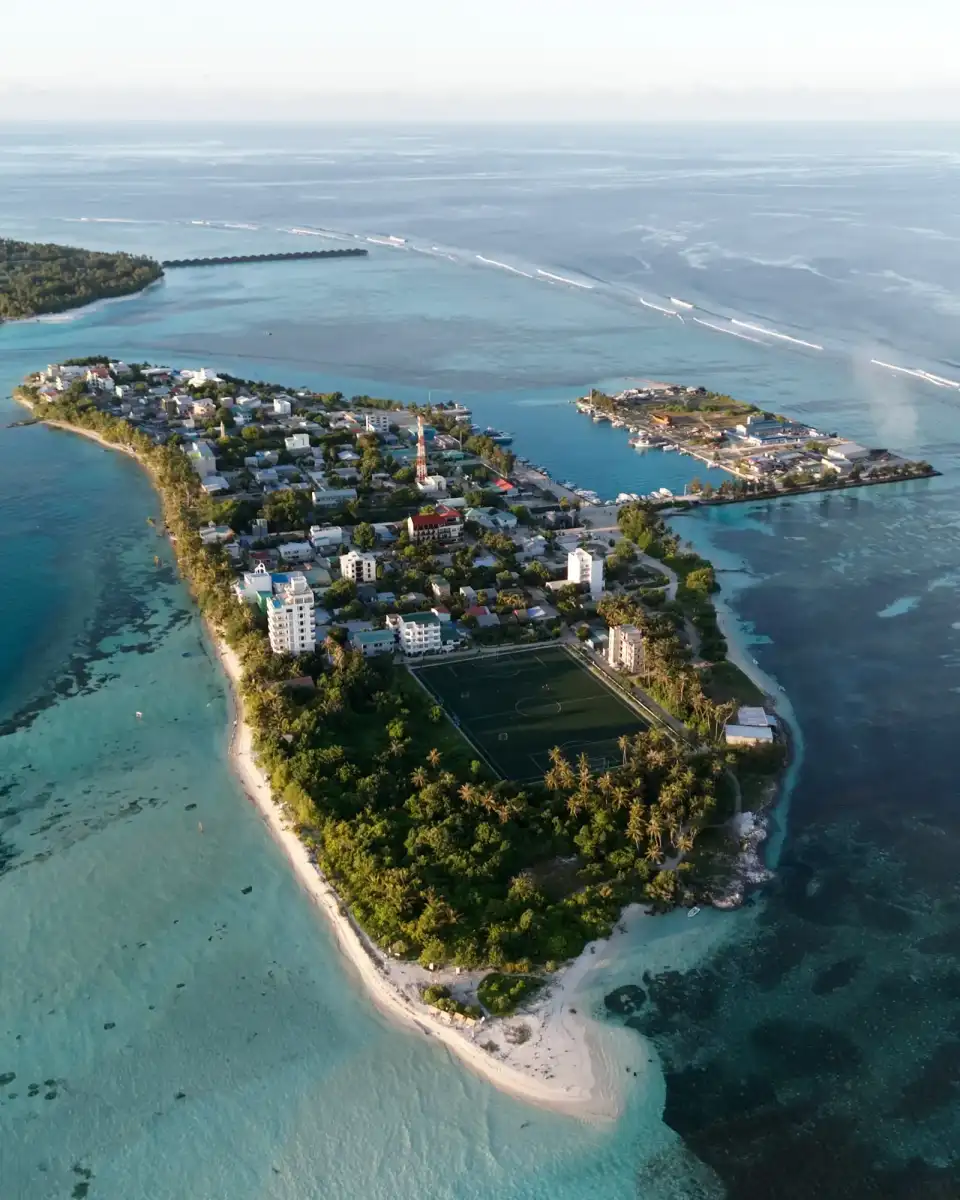
Away from Malé, projects are smaller. The same study found that most projects were justified as social and economic development, followed by airport and harbour development, with shore protection often a secondary aim. On many local islands, the harbour, the new school or the football ground sits on land that was once lagoon.
Height above the sea
New land can be built higher than the old, low islands, which is part of the case for reclamation as climate adaptation. Hulhumalé was raised to about 2 m above mean sea level, according to the Housing Development Corporation (HDC). For the bigger picture on sea level, see Is the Maldives sinking?
Hulhumalé: the first new city
Work on Hulhumalé began in 1997 in the lagoon north-east of the airport island. The first phase created about 188 hectares, according to a document held in the Maldives National University repository. The second phase, managed by HDC, added about 240 hectares in 2015, as reported by PSM News.
Today Hulhumalé is a planned town with apartment towers, a long public beach and bus links to Malé and the airport. It is the easiest place to see reclaimed land as a visitor. Our Hulhumalé guide covers the beach, stopovers and getting around. Expansion continues: national news in early 2026 described further dredging at Hulhumalé.
Gulhifalhu
Gulhifalhu is a lagoon about 4 km from Malé. Dredging began in 2010, stopped in 2013 and later restarted; the Ministry of Construction and Infrastructure confirmed that reclamation was finished on 15 April 2024, with about 150 hectares created, as reported by PSM News and Edition.
The site was once planned as the new commercial port for Malé. That plan changed: the port is now planned for Thilafushi, and Gulhifalhu is reserved mainly for housing plots. During the works, the High Court issued a temporary order halting the project after a claim of serious environmental damage; the State appealed and the Supreme Court stayed that order. As of the April 2024 reports, no final verdict had been given. For the neighbouring industrial island, see Thilafushi explained.
Ras Malé
Ras Malé (often written Rasmalé) is the largest reclamation project the country has attempted. It is being built in the Fushidhiggaru lagoon in Kaafu Atoll, with a ceremony to begin work held in December 2023.
What official statements and national news say about it:
- Size: about 1,009 hectares are planned from a lagoon of about 1,153 hectares (as reported by MMTV and Raajje). Some early reports gave a rounder figure of about 1,150 hectares.
- Progress: in April 2026, Infrastructure Minister Dr Abdulla Muththalib said about 504 hectares had been reclaimed, across 11 sites (MMTV).
- Who builds it: the work is carried out through Maldives Airports Company Limited (MACL), a state-owned company.
- The plan: the government describes Ras Malé as an “eco city” designed around renewable energy and low emissions, with housing as a central aim. At the launch, the President said the land would stand about 3 m high in the middle and about 2 m at the edges (Atoll Times).
- Land allocation: the government has said plots will be allocated only after land is reclaimed, not from open lagoon.
Environmental concerns
Reclamation also changes the reef, the lagoon and the water around them.
Sediment and coral
Pumping sand creates clouds of fine sediment. Environmental impact assessments (EIAs) for Maldivian projects, many of them held in the Maldives National University repository, repeatedly identify sedimentation as the biggest threat to the marine environment during dredging. Sediment can smother coral and block light well beyond the work site, depending on currents.
In February 2026, the *Maldives Independent* reported satellite images and aerial photos showing sediment plumes spreading across large parts of South Malé Atoll while dredging was under way. The same report described murky water at dive sites near Hulhumalé. Critics say silt controls and EIA rules have been weakened. The government says its environmental management plan includes moving and farming corals from the reclamation footprint.
Lagoons, seagrass and fishing
The lagoon lost under new land was a habitat too. Sandy lagoons and seagrass meadows shelter young fish and feed turtles. Borrow areas, where sand is taken, become deeper and change in texture.
Fishermen have raised a specific concern. The *Maldives Independent* reported that a tuna fishermen’s union asked the environmental regulator in January 2026 to stop sand being taken from important bait-fishing grounds inside the atoll. Live bait is essential to the country’s pole-and-line tuna fishery.
Is all the land needed?
A separate question is whether so much new land is used. A *Maldives Independent* investigation in October 2025, based on data obtained under the Right to Information Act, counted at least 52 reclamation projects since 2007 and found that much of the land created was still unused. The 2026 MJET study also points to fragmented development, duplicated infrastructure within atolls and weak national planning, and calls for policy to be recalibrated.
For a small, low-lying country there are real reasons to build higher land. The debate is about how much, where and with what safeguards.
What visitors will see
- From the plane: look for straight, geometric shorelines and pale new sand next to the rounded, green older islands. Hulhumalé, beside the airport, is the obvious one.
- Dredgers and pipelines: large ships working in the lagoons around Malé, sometimes with floating pipelines and a brown or milky plume in the water.
- Rock edges: new land is lined with stone or concrete revetments instead of natural beach. Beaches on reclaimed land are often man-made and maintained.
- Young landscapes: few mature trees and open sand plots waiting for buildings.
- Harbours on local islands: many island harbours and their quays are built on reclaimed land.
On a speedboat out of Malé you may pass active works, and water clarity can be poor near dredging. Islands further out on the atoll rims are generally away from the main works, though conditions change with projects and currents. If you want a feel for an older, long-settled local island, read about Dhiffushi’s history and island life and start planning on our plan page.
How to travel lightly around reclamation areas
- Don’t touch, stand on or collect coral anywhere, especially on reefs that are already stressed. Our coral reefs guide explains why.
- Learn how damaged reefs are being helped in our guide to coral restoration in the Maldives.
- Ask locals how their harbour, beach or lagoon has changed. Many are happy to tell you.
Questions people ask
Is Hulhumalé a man-made island?
Yes. Hulhumalé was built by pumping sand into a shallow lagoon next to the airport island. Work began in 1997, the first phase created about 188 hectares, and a second phase managed by the Housing Development Corporation added about 240 hectares in 2015. It was raised to about 2 m above mean sea level, higher than most natural Maldivian islands, and is now a full town with homes, shops and a public beach.
How much land has the Maldives reclaimed?
A study published in the Maldives Journal of Engineering and Technology in 2026 counted at least 4,198 hectares reclaimed for community use on inhabited islands between 2000 and 2024, across 109 projects. The authors call this a conservative figure. It excludes resort-only projects and most of the Ras Malé work begun in late 2023.
What is Ras Malé?
Ras Malé is a large reclamation project in the Fushidhiggaru lagoon in Kaafu Atoll, started in December 2023. About 1,009 hectares are planned, and the government reported roughly half reclaimed by April 2026. It is presented as an eco city with housing at its heart, built higher than older islands. Work is carried out through the state-owned Maldives Airports Company Limited.
Does land reclamation damage coral reefs?
It can. Official environmental impact assessments for Maldivian projects consistently name sedimentation as the main marine risk, because fine silt smothers coral and blocks light. National news has reported sediment plumes across parts of South Malé Atoll during recent dredging. The size of the damage depends on safeguards, currents and the location of borrow areas, and long-term independent monitoring is limited.
Can tourists visit reclaimed islands?
Yes, and many do without noticing. Hulhumalé is open to everyone, has a public beach and places to stay, and is linked to the airport and Malé by bus. Newer sites such as Ras Malé and Gulhifalhu are active construction zones and are not set up for visitors. Remember that local island rules on dress and alcohol apply on reclaimed land too.
Does reclamation protect the Maldives from rising seas?
Partly. New land can be built higher than old islands, so it starts with more height above the sea, and new edges are protected with rock. But reclamation cannot raise the many existing islands, and it brings its own environmental costs. Scientists and planners also stress the role of healthy reefs, which break waves and supply sand to natural islands.

