


Lhaviyani Atoll guide: tuna, wrecks and local life
A practical guide to Lhaviyani (Faadhippolhu): four local islands, the Felivaru tuna cannery, The Shipyard wreck dive, manta channels and getting there by air.
 By Dhiffushi Island Council8 min readUpdated
Lhaviyani is a compact atoll north of Kaafu, east of Baa, where life still turns on tuna. Four local islands, a state-run fish cannery and two wrecks lying in a current-swept channel give it a working, unpolished character. Guesthouse choice is small, so plan ahead, but it rewards travellers who want fishing-island life rather than a holiday bubble.
Lhaviyani at a glance
Lhaviyani is the administrative name. Its traditional, geographical name is Faadhippolhu, and you will still see both on maps, ferry signs and official papers.
According to the 2022 census (Maldives Bureau of Statistics), about 9,000 people live in the atoll, almost all on four inhabited islands:
- Naifaru: the largest island, with roughly 4,800 people, the atoll hospital and most shops and services.
- Hinnavaru: a busy fishing island of about 2,300 people, close to Naifaru.
- Kurendhoo: a quieter island of about 1,200 people.
- Olhuvelifushi: the smallest, with about 700 people.
There is also the industrial island of Felivaru, an airport island and around a dozen resort islands, which are private islands with their own rules.
Our Maldives atolls guide shows where it sits among the others.
Tuna and the Felivaru cannery
Fishing is the backbone of Lhaviyani, and Felivaru is the reason. This small island in the middle of the atoll holds the main processing plant of the Maldives Industrial Fisheries Company (MIFCO), which the government now owns outright.
The plant opened in 1978 as a joint venture between the Maldivian government and a Japanese fishing company. The government took full control in 1982 and later added a cannery. For decades Felivaru has handled a large share of the country’s skipjack tuna, and its canned fish is a familiar sight on shop shelves across the islands.
National news reports describe the cannery as ageing and say a larger new plant is being built in stages.
What this means for visitors:
- Felivaru is an industrial island, not a place to wander. Visits are not part of normal tourism, and you should not land there without permission.
- You will see the tuna economy everywhere else: pole-and-line boats heading out at dawn, catches unloaded at the harbours, and fish drying in yards.
- Ask your guesthouse about joining a local fishing trip. Our fishing guide explains how pole-and-line and night fishing work.
Diving and snorkelling
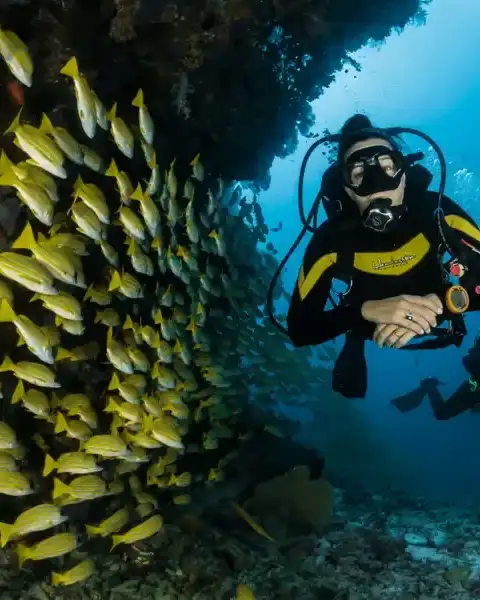
Lhaviyani sits on the north-eastern edge of the central Maldives, and its channels (kandu) pull nutrient-rich water in from the open ocean. That brings reef sharks, eagle rays, schools of fish and, in season, manta rays. Dive trips are run by local and resort-based dive centres; book through your guesthouse.
The Shipyard
The atoll’s best-known dive is called The Shipyard, a pair of wrecks in the channel near Felivaru. Visit Maldives describes two wrecks about 40 years old, one upright and one on its side at around 30 m. The bow of one wreck rises out of the water, so you can spot it from passing boats.
Accounts of the ships’ histories differ, but most link both to the fish factory era, so treat the details you hear on the boat as local storytelling.
The wrecks are now heavily grown with hard and soft corals and full of fish: sweepers, butterflyfish, morays and Napoleon wrasse. Grey reef sharks and nurse sharks patrol the channel. Currents can be strong, so this is a dive for people with some experience, and the deepest parts reach the national recreational limit of 30 m.
Protected sites
Several places in the atoll are legally protected:
- Fushifaru Thila area, protected since 1995. It is a submerged reef in a channel on the atoll’s north-east edge, known for cleaning stations where manta rays come in. Mantas tend to feed on the eastern sides of atolls in the southwest monsoon, roughly May to November.
- A channel reef and lagoon in the north-east of the atoll, protected since 1999.
- A further group of sites declared in September 2020, including the island of Vavvaru, the reef, lagoon and sandbank at Dhandifalhu, the Dhashugiri sandbank, Maagadhu (Anemone) Lagoon and wetland areas.
In protected areas, fishing and taking anything from the sea are banned. Our guide to protected areas of the Maldives covers the wider network, and the manta rays guide explains how to swim with them without disturbing them.
Snorkelling from local islands
House reefs around the local islands are patchy, and harbours are no place to swim. Join a boat trip to an outer reef or sandbank, with a local guide in any channel. Our diving guide covers the basics.
Where to stay
Lhaviyani has far fewer guesthouses than the atolls around Malé. In the Ministry of Tourism’s register of operating facilities (checked October 2026), all of the atoll’s registered guesthouses are on Naifaru, and there are only a handful.
That has a few consequences:
- Book early, especially in the dry season from January to March.
- Make sure your guesthouse is registered with the Ministry of Tourism, and that it can arrange your transfer from the airport.
- You can visit Hinnavaru, Kurendhoo and Olhuvelifushi as day trips by local ferry or boat, but staying overnight there is not a standard option right now.
The same norms apply as on any local island. Alcohol is not sold or allowed. Swimwear is for designated bikini beaches only; elsewhere, cover your shoulders and knees. Shops and cafés close for a while at Friday midday prayer. Our local islands guide covers the details.
Getting there and around
By air
Madivaru Airport opened in February 2022, the first airport in Lhaviyani. Domestic flights from Velana International Airport take about 25 minutes. It is the most practical way in for most visitors, and your guesthouse can meet you with a boat. Our guide to seaplanes and domestic flights explains how booking and baggage work.
By sea
Lhaviyani is well north of Malé across open sea. Speedboat transfers are possible but can be rough, especially in the southwest monsoon. If you get seasick, fly.
Between islands
Inside the atoll, MTCC runs a public ferry network linking Naifaru, Hinnavaru, Kurendhoo, Olhuvelifushi, Felivaru and the airport island. Schedules change, and services are reduced or don’t run on some days, so check current times locally before you count on a connection. Pay in rufiyaa, and carry small notes.
Things to do
- Walk Naifaru. A real small town of harbour, mosques, shops and teashops serving hedhikaa short eats.
- Watch the fishing fleet. Ask before photographing people.
- Visit a sandbank. Picnic trips are a highlight. Take nothing away, especially in protected areas.
- Go fishing with locals. Sunset and night fishing show you the atoll’s oldest skill.
Health and safety
The Lhaviyani Atoll Hospital is on Naifaru. It handles everyday care and emergencies, but serious cases may need transfer to the Malé area; the UK FCDO notes that the only fully equipped hospitals are in Malé and Hulhumalé. Make sure your travel insurance covers diving and medical evacuation.
In an emergency, call 911, the national emergency number. You can also call police on 119 or ambulance on 102.
When to go
The dry northeast monsoon, January to March, brings calmer seas and the best conditions for the long crossings. The southwest monsoon, mid-May to November, is wetter and windier, but it is also when mantas tend to gather on the eastern side of the atoll. April and December are transition months. See our guide to the best time to visit the Maldives.
Lhaviyani or an island near Malé?
Lhaviyani suits travellers with time who want a working atoll and good diving, and who are happy with a small choice of places to stay. If you have only a few days, an island closer to the airport is easier. On Dhiffushi, on the eastern rim of North Malé Atoll, the shared speedboat takes 40–50 minutes from the airport, and there is a wide choice of places to stay. Our guide to local islands near Malé compares the options.
Questions people ask
Where is Lhaviyani Atoll?
Lhaviyani is in the northern-central Maldives, north of Kaafu (the atoll around Malé) and east of Baa. Its traditional name is Faadhippolhu. It is a small natural atoll with four inhabited islands, Naifaru, Hinnavaru, Kurendhoo and Olhuvelifushi, plus the industrial island of Felivaru, a domestic airport island and about a dozen resort islands. Most visitors arrive by a short domestic flight from Velana International Airport.
How do I get to Lhaviyani from Malé?
The easiest way is a domestic flight from Velana International Airport to Madivaru Airport, which opened in February 2022 and takes about 25 minutes. Your guesthouse can then collect you by boat. Speedboat transfers from Malé are possible, but the crossing is long and exposed and can be rough, particularly in the southwest monsoon. Inside the atoll, MTCC public ferries link the main islands.
Can I stay on a local island in Lhaviyani?
Yes, but the choice is small. In the Ministry of Tourism’s register of operating facilities, checked in October 2026, all of the atoll’s registered guesthouses are on Naifaru, and there are only a few. Book well ahead, check that your guesthouse is registered, and arrange your airport transfer with it. You can visit the other local islands on day trips.
What is the Felivaru tuna factory?
Felivaru is the main processing plant of the Maldives Industrial Fisheries Company, a fully state-owned company. It opened in 1978 as a joint venture with a Japanese company, came under full government control in 1982, and has long processed much of the country’s skipjack tuna. It is a working industrial island, not a tourist attraction, so don’t land there without permission.
What is The Shipyard dive site?
The Shipyard is a pair of wrecks about 40 years old, lying in a channel near Felivaru. One stands upright with its bow above the water, and the other lies on its side at around 30 m. Both are covered in coral and full of fish, with reef sharks in the channel. Currents can be strong, so it suits divers with some experience.
Can I see manta rays in Lhaviyani?
Yes. Mantas visit cleaning stations in the atoll’s channels, including the Fushifaru Thila area, protected since 1995. They tend to gather on the eastern sides of atolls in the southwest monsoon, roughly May to November, but sightings are never guaranteed. Go with a registered dive or snorkel guide, keep your distance, never touch the animals and never use flash photography.


