


Diving in the Maldives: seasons, sites and safety
Maldives scuba diving explained: kandus and thilas, which side of the atolls is best in each monsoon, courses, safety, no-fly times and protected reefs.
 By Dhiffushi Island Council8 min readUpdated
Diving in the Maldives is good all year, but where it is best depends on the monsoon. From roughly December to April the eastern sides of the atolls usually have the clearest water, and from May to November the action, including manta rays, tends to shift to the west. Water is warm year-round, recreational dives stay within 30 metres, and you can dive from a local island for far less than you might expect.
Why the Maldives is a world-class dive destination
Each Maldivian atoll is a ring of reefs and islands around a lagoon, broken by gaps that let the open ocean flow in and out with the tides. That moving water brings nutrients, plankton and the big animals that feed on them.
You will hear a few Dhivehi words in every dive briefing, and in hundreds of dive-site names:
- Kandu – a channel through the atoll rim. Channel dives are usually drift dives and can have strong currents.
- Thila – a submerged reef or pinnacle rising from deeper water, its top a few metres below the surface.
- Giri – a smaller coral outcrop near the surface, usually inside the calmer lagoon.
- Faru – a reef, often a long one along the edge of a lagoon.
- Beyru – the outer reef, facing the open ocean.
Most dives mean drifting along a reef wall or through a kandu, circling a thila, or gentler lagoon dives that suit beginners. For how the atolls fit together, see our Maldives atolls guide.
Seasons and currents: when and where to dive
The Maldives Meteorological Service describes two monsoons. The northeast monsoon is the dry season, from January to March. The southwest monsoon is the wet season, from mid-May to November. April and December are transition months. For the bigger picture on weather, see the best time to visit the Maldives.
For divers, the useful rule is that the current generally flows *with* the monsoon wind through the channels, and this shapes visibility on each side of an atoll:
| Season | Clearer water | Where mantas tend to feed |
|---|---|---|
| Northeast monsoon (about Dec–Apr) | Eastern side of the atolls | Western side |
| Southwest monsoon (about May–Nov) | Western side of the atolls | Eastern side |
Water flowing *into* an atoll comes straight from the open ocean and is usually clear. Water flowing *out* the other side carries plankton from the lagoon: lower visibility, but exactly what manta rays come to feed on. Dive operators commonly report visibility of 20–30 metres or more on the clear side in the northeast monsoon, and less on the plankton-rich side.
This is a pattern, not a law. Some sites buck it, and it weakens away from the central atolls. Guides choose sites on the day’s current, so trust their call.
The sea stays warm all year, around 28–29°C, so most divers are comfortable in a thin wetsuit or shortie.
What you may see
Nothing is guaranteed, and a good operator will never promise a sighting. Maldivian reefs are known for:
- Reef sharks, especially grey reef and whitetip reef sharks in the channels, and nurse sharks resting on sandy bottoms.
- Manta rays, at cleaning stations and feeding areas that change with the monsoon.
- Eagle rays, stingrays and turtles on many reefs.
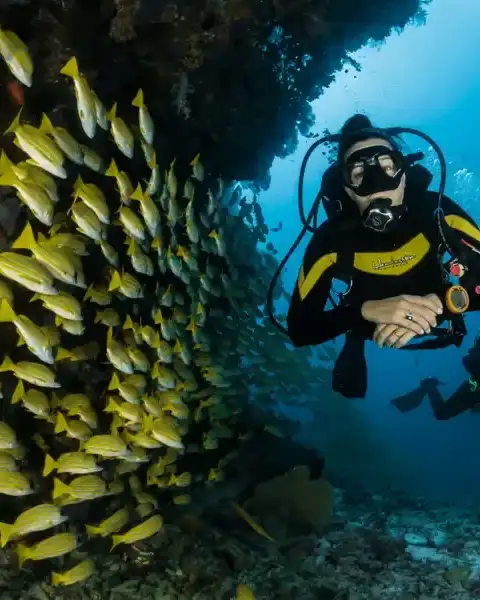
- Schools of fish such as snappers, fusiliers, jacks and barracuda along channel walls.
- Whale sharks, most famously in the South Ari Marine Protected Area, designated in 2009 to protect a year-round whale shark aggregation.
For seasons and encounter etiquette, read Maldives marine life: mantas, whale sharks and turtles.
Learning to dive and certification
Warm water and calm lagoons make the Maldives a gentle place to learn. Most dive centres teach through one of the big international training agencies, offering:
- A try dive – a supervised introductory dive in shallow water. It does not give you a certificate.
- An entry-level open water course – usually three to four days of theory, confined-water practice and open-water dives. It certifies you to dive with a buddy to a limited depth.
- Advanced and speciality courses – such as drift diving or enriched air (nitrox).
- A refresher – recommended if you have not dived for a year or more.
Already certified? Bring your card (or app) and logbook. Expect a medical questionnaire; a “yes” answer may mean you need a doctor’s sign-off, so check before you travel.
Strong-current channel dives need some experience. If you are newly qualified, say so, and a good guide will start you on easier sites.
Local island, liveaboard or resort
- From a local island. Many guesthouse islands have dive centres running boat dives to nearby reefs and channels. It is the most affordable option and mixes diving with village life. Our local islands guide explains what to expect.
- On a liveaboard. A boat you live on for a week or so, travelling between atolls and diving several times a day. Liveaboards pay the higher USD 12 per person per night green tax, and alcohol is permitted on board, unlike on local islands.
- At a resort. Resorts are private islands with their own rules and prices; many have a dive centre.
On a local island like Dhiffushi in Kaafu Atoll, several dive centres run trips to nearby channels, thilas and manta cleaning stations. Our Dhiffushi diving and snorkelling guide has the sites, seasons and practical details.
Diving safely in the Maldives
Currents
Channel currents can be strong and can change mid-dive. Listen to the briefing, stay with your guide, and be ready for a negative entry (descending straight away) if asked. If the current is beyond your experience, sit that dive out.
Depth limits
The standard limit for recreational diving in the Maldives is 30 metres, and dive centres must hold a licence. Stay within your training and your guide’s plan. Deep caves and overhead environments are not recreational diving.
Surface marker buoy
Carry a surface marker buoy (SMB) on every dive and know how to inflate it. On drift dives the boat follows from the surface, and an SMB helps the crew spot you if you come up away from the group.
Dive computer
Use your own dive computer and know how it works. Many dive centres require one per diver. It tracks depth, no-decompression time and ascent rate, and shows a no-fly time.
Flying after diving
Divers Alert Network (DAN) suggests a minimum surface interval of 12 hours after a single no-decompression dive, and 18 hours after several dives in a day or several days of diving, before flying. Waiting longer reduces the risk further. If your dive computer shows a longer no-fly time, follow it. Seaplane flights count as flying too. In practice, most divers plan their last dive the day before departure.
Decompression illness and recompression
If you feel unwell after diving (joint pain, unusual tiredness, tingling, dizziness or breathing difficulty), tell your dive centre straight away and don’t fly. On Dhiffushi, the council confirms that local dive centres use a hyperbaric (recompression) unit in Malé, reached by speedboat. Wherever you dive, ask which chamber your operator would use.
Insurance
Check that your insurance covers scuba diving to your planned depth, medical evacuation and recompression treatment. Many standard policies exclude diving or cap the depth. For wider health and safety advice, see is the Maldives safe?.
Protected areas and responsible diving
The Maldives has dozens of protected areas declared under the Environmental Protection and Preservation Act. By 2021 the government counted 71 protected sites, and more have been added since, including popular dive sites and wrecks. In 2024, two thilas in Kaafu Atoll were declared protected. Rules depend on the site, but fishing, collecting shells or coral and littering are generally banned in protected areas.
Since June 2014, manta rays and all other rays have been protected in Maldivian waters. Catching, trading or harming them is against the law.
Whatever the site, good habits protect the reef and the animals:
- Don’t touch, stand on or kneel on coral. Work on your buoyancy before reef dives.
- Never touch, chase, ride or feed marine animals.
- Give mantas and whale sharks space and let them approach you, not the other way round.
- Avoid flash photography close to animals’ eyes.
- Take all rubbish back to land, including small plastics.
See our responsible travel guide for more. Prefer the surface? The snorkelling in the Maldives guide covers reefs you can reach without a tank.
Questions people ask
When is the best time to dive in the Maldives?
You can dive all year. The northeast monsoon, roughly December to April, usually brings calmer seas and the clearest water on the eastern side of the atolls, which suits channel dives. The southwest monsoon, roughly May to November, is wetter and windier, but plankton draws manta rays to feeding areas. Choose based on what you most want to see.
Do I need to be certified to dive in the Maldives?
No, not for an introductory try dive, which is supervised and shallow. To dive on your own with a buddy, you need a recognised certification, such as an entry-level open water qualification. Many dive centres in the Maldives teach these courses over three to four days. Certified divers should bring their card or app and logbook, and expect a medical questionnaire.
How deep can you dive in the Maldives?
The standard limit for recreational diving in the Maldives is 30 metres, and many sites are shallower. Your personal limit also depends on your certification: entry-level divers are trained to shallower depths than advanced divers. Stay within your training and follow your guide’s plan. Deep cave or overhead diving is outside recreational limits.
How long should I wait to fly after diving?
Divers Alert Network (DAN) suggests at least 12 hours after a single no-decompression dive and at least 18 hours after multiple dives in a day or several days of diving. If your dive computer gives a longer no-fly time, follow it. Seaplane flights count as flying. Most divers simply finish diving the day before they leave.
Is there a recompression chamber in the Maldives?
Yes. There is a hyperbaric (recompression) unit in Malé, and the island council confirms that Dhiffushi’s dive centres use it, reached by speedboat. Before diving, ask your operator which facility they would use and how they would get you there. Make sure your insurance covers diving, recompression treatment and medical evacuation.
Can I dive from a local island instead of a resort?
Yes. Many inhabited islands with guesthouses have licensed dive centres running boat dives to nearby channels, thilas and reefs. It is usually the most affordable way to dive in the Maldives and lets you experience local island life between dives. Remember local island norms: no alcohol, and swimwear only on designated bikini beaches.
Will I see manta rays and whale sharks?
Possibly, but no one can promise it. Mantas follow the plankton, so the side of the atoll they feed on changes with the monsoon. Whale sharks are seen year-round in the South Ari Marine Protected Area, but sightings vary. Choose an operator that follows the encounter rules and doesn’t chase animals.


