


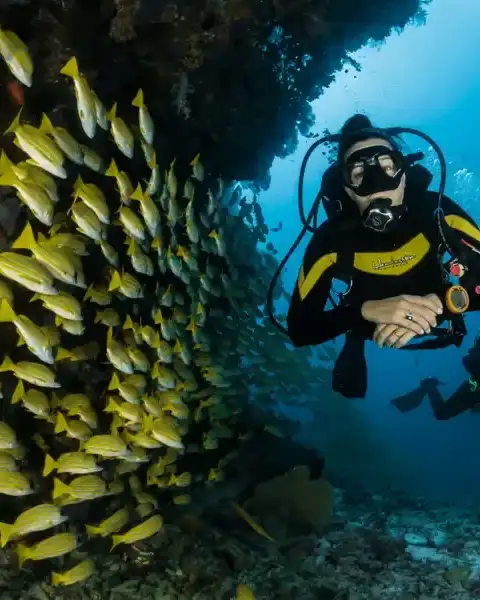
Learning to dive in the Maldives: courses and first dives
Warm water and calm lagoons make the Maldives a gentle place to learn to dive. Courses, medical forms, currents, dive centres and flying after diving.
 By Dhiffushi Island Council8 min readUpdated
Yes, the Maldives is a good place to learn to dive. The water is warm all year, sheltered lagoons make calm classrooms, and even training dives can bring turtles and reef sharks. The catch is the current: channel dives can be strong, so learn in easy water first, choose a licensed dive centre, and build up slowly.
Why learn to dive in the Maldives
The sea sits at around 28–29°C all year, so a thin wetsuit or shortie is usually enough and you are not fighting the cold while learning.
Each atoll wraps around a lagoon, and inside it there is often shallow, sandy water with little swell. That is ideal for the first skills of any course.
Even training dives can bring turtles, reef fish and small reef sharks, though nothing is guaranteed. Learning from a local island also keeps costs down. Our diving in the Maldives guide covers seasons, sites and dive styles for when you are certified.
Course levels, step by step
Several internationally recognised training agencies run courses here. Names differ, but the steps are much the same.
Try dive
A try dive (sometimes called a discovery dive) is a short, closely supervised first dive with an instructor beside you. It gives no certificate, is usually done in a lagoon or on a shallow house reef, and may count towards a full course.
Open water course
This is the entry-level certification, and it lasts for life. It usually takes three to four days and has three parts:
- Theory – pressure, dive planning and problem-solving. Many agencies let you do this online before you travel.
- Confined water – skills in shallow, calm water, such as clearing a flooded mask and sharing air.
- Open water dives – usually four dives, where you repeat the skills on a real reef.
Once certified, you can dive with a buddy to a limited depth set by your agency, typically shallower than the national maximum.
Advanced and speciality courses
An advanced course adds a deeper dive, navigation and other dives, and builds confidence for typical Maldivian sites. Useful specialities here include drift diving and enriched air (nitrox).
A refresher session is wise if you have not dived for a year or more.
The medical questionnaire
Before any course or try dive, you fill in a standard medical questionnaire covering asthma, heart and lung problems, epilepsy, diabetes, recent surgery, ear and sinus problems, pregnancy and certain medicines.
If you answer “yes” to any question, you will normally need a doctor to sign a form saying you are fit to dive before you get in the water. Sort that out with your own doctor before you fly.
Be honest: pressure changes can turn a minor problem into a serious one.
Minimum ages are set by each training agency, and children can usually start with junior courses from about the age of 10. Families should ask the dive centre about its rules before booking.
Depth limits and the 30 m rule
Maldivian rules set a 30-metre limit for recreational diving, under the Ministry of Tourism’s Recreational Diving Regulation. Beginners will dive well above that. An open water course keeps you shallower, and guides plan dives within each diver’s training.
Deep caves, overhead environments and decompression diving are not recreational diving.
Currents: why the Maldives can be tricky for beginners
An atoll’s rim is broken by channels, called kandu in Dhivehi. As the tide changes, ocean water pours through them into and out of the lagoon. Currents in a kandu can be strong, can change direction during a dive, and can push you up or down along a reef wall.
That is why many famous Maldivian dives are drift dives. You enter the water, descend and let the current carry you along the reef while the boat follows on the surface. It needs good buoyancy and the ability to stay close to your guide.
What this means for beginners:
- Do your training in lagoons and on sheltered house reefs, not in channels.
- Expect a negative entry on some dives, where everyone descends straight away to avoid drifting apart on the surface.
- Learn to use a surface marker buoy (SMB), the inflatable tube you send up so the boat can find you if you surface away from the group.
- Tell the dive centre you are new. A good guide will pick easier sites at first and brief you carefully.
- Sit a dive out if the current sounds beyond you.
The monsoons also shape conditions. The Maldives Meteorological Service describes the northeast monsoon (January to March) as the dry season and the southwest monsoon (mid-May to November) as the wet season, with April and December as transition months. See our best time to visit the Maldives guide for each month.
Choosing a dive centre
Dive centres that serve tourists must be licensed by the Ministry of Tourism. Beyond that, a few questions will tell you a lot:
- Can I see your licence?
- How many students per instructor? Smaller groups mean more attention.
- Where do you do confined-water training? Look for a calm lagoon or a shallow, sheltered spot.
- What is the plan if the current is too strong? The answer should be “we go somewhere easier”.
- Is there oxygen and a first-aid kit on the boat? There should be.
- Which recompression chamber would you use in an emergency, and how long would it take to get there? The answer should be clear and quick.
- What does the price include? Equipment, boat trips and learning materials vary.
Insurance
Check that your travel insurance covers scuba diving, including during a course, to the depths you will dive. It should also cover medical evacuation and recompression treatment; many standard policies exclude diving.
Recompression chambers
Decompression illness is rare in well-run recreational diving, but serious. The country has only a few recompression (hyperbaric) chambers, so distance matters. On Dhiffushi, the council confirms that local dive centres would use a hyperbaric unit in Malé, reached by speedboat. Wherever you learn, ask your dive centre which facility they would use.
For general health advice, including emergency numbers, see is the Maldives safe?
Your first dives after certifying
Build experience before tackling big channel dives.
- Start with lagoon dives, house reefs and gentle thilas (submerged reefs that rise towards the surface).
- Log every dive so the next guide can judge your level.
- Never touch, stand on or kick coral, and never feed or chase marine life. Feeding sharks, rays and whale sharks is illegal in the Maldives.
On rest days, snorkelling shows you the reef without tanks. Many dive sites lie within protected areas with their own rules, and some new divers also try freediving, which has its own training.
Flying after diving
Flying too soon after diving raises the risk of decompression illness, because cabin pressure is lower than at sea level. Divers Alert Network (DAN), a dive safety organisation, suggests a minimum surface interval of 12 hours after a single no-decompression dive and 18 hours after repeated dives or several days of diving. Waiting longer lowers the risk further. If your dive computer shows a longer no-fly time, follow it.
Maldivian rules go further: the tourism minister said in 2024 that the current rules require 24 hours between your last dive and a flight. Remember that seaplane and domestic flights count as flying. In practice, keep your final day dive-free.
Learning to dive on a local island
On a local island you walk to the dive centre in the morning and are back for lunch. On shore, local rules apply: swimwear only on the bikini beach, and covered shoulders and knees in the village.
Dhiffushi is a good example. It sits on the eastern rim of North Malé (Kaafu) Atoll, about 40–50 minutes from Malé by shared speedboat, with several dive centres running trips to nearby reefs, thilas and channels. Our Dhiffushi diving and snorkelling guide has the local sites and seasons, and you can compare the island’s dive centres in one place.
Later, a liveaboard takes experienced divers across several atolls in a week.
Questions people ask
Can you learn to dive in the Maldives if you can’t swim well?
You need basic water confidence. Training agencies usually ask you to show you can swim a set distance and float or tread water for a few minutes before you certify. A try dive is gentler, as the instructor stays right beside you, but you should still be comfortable in the sea. If you are nervous, ask for extra time in the shallows first.
How long does an open water course take in the Maldives?
Usually three to four days. That covers theory, skills practice in shallow water and around four open water dives. Doing the theory online before you travel saves holiday time. Allow slack in case weather or a cold delays a dive.
Is the Maldives too difficult for beginners because of currents?
Not if you start in the right places. Channels can have strong currents, but lagoons, house reefs and sheltered thilas are calm enough for training and first dives. Tell your dive centre you are new, listen closely to briefings and build up to drift dives gradually. A good guide will never push you into conditions beyond your training.
What is the maximum diving depth in the Maldives?
The legal limit for recreational diving in the Maldives is 30 metres, under the Ministry of Tourism’s Recreational Diving Regulation. Newly qualified divers should stay shallower, within the limit of their certification. Decompression diving, deep caves and other overhead environments fall outside recreational diving and should be left to specially trained technical divers.
Do I need a medical certificate to dive in the Maldives?
Not always. Every diver fills in a medical questionnaire before training. If all your answers are “no”, you can usually start straight away. If you answer “yes” to any question, you will normally need a doctor’s signed approval before diving. Get this from your own doctor before you travel, as finding one on a small island takes time.
How soon can I fly after diving in the Maldives?
Divers Alert Network suggests at least 12 hours after a single no-decompression dive and 18 hours after several dives or several days of diving. Longer is safer, and your dive computer’s no-fly time should be followed if it is longer. Seaplanes and domestic flights count. Most divers simply keep their last day in the Maldives dive-free.


