Fuvahmulah guide: the Maldives’ one-island atoll
The Maldives’ only one-island atoll: freshwater lakes, a white-pebble beach, tiger sharks, Buddhist ruins and a dialect of its own. How to visit, and what to know.
 By Dhiffushi Island Council8 min readUpdated
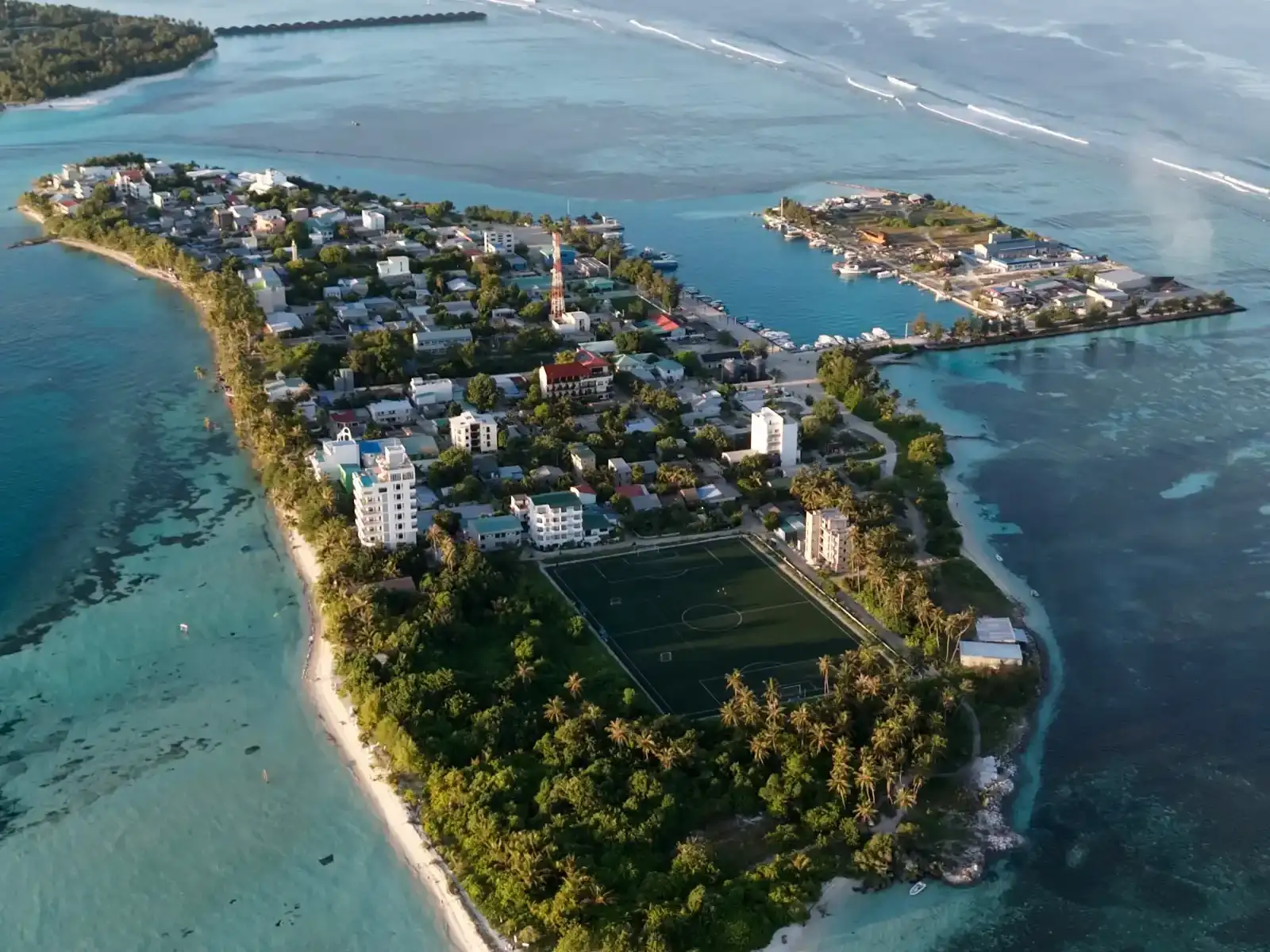
Fuvahmulah is the only atoll in the Maldives made of a single island: one large, green island in the deep south, with freshwater lakes, a beach of smooth white pebbles and open ocean on every side. Divers know it for tiger sharks, but it is also a lived-in city of around 9,000 people with its own dialect, history and pace. Reach it by domestic flight from Malé or by public ferry from Addu City.
Where Fuvahmulah is and why it is different
Fuvahmulah sits in the southern Maldives, between Huvadhu Atoll to the north and Addu Atoll to the south, close to the equator. Its official name is Gnaviyani Atoll, but everyone uses the island’s name.
Most Maldivian atolls are rings of small islands around a calm lagoon. Fuvahmulah has no lagoon of its own to speak of. It is one island, with a narrow fringing reef that drops quickly into deep water. That single fact shapes almost everything about a visit:
- The sea is open ocean. Swell and current reach the shore directly, so swimming off most beaches needs care.
- The diving is big-animal diving. Deep water close to the reef brings in sharks and other pelagic life.
- The island is large by Maldivian standards. Reports describe it as the third-largest natural island in the country, big enough for wetlands, woodland, taro fields and lakes.
A city, not a village
Fuvahmulah was declared a city in September 2016, the Maldives’ third after Malé and Addu (as reported at the time). The Maldives Bureau of Statistics counted 9,177 usual residents in the 2022 census. The island is traditionally divided into eight wards, each with its own character, and the city council runs local affairs today.
It feels spread out: roads link the wards and most people get around by motorbike. If you are used to a local island you can cross on foot in twenty minutes, such as Dhiffushi in North Malé Atoll, plan for more time here.
A UNESCO Biosphere Reserve
In October 2020, UNESCO’s Man and the Biosphere Programme designated Fuvahmulah a Biosphere Reserve, alongside Addu Atoll. Baa Atoll had been the country’s only one since 2011. A biosphere reserve is not a no-go zone: conservation and everyday life are meant to work side by side.
Several sites on the island were also declared protected areas nationally in June 2012 (as reported), including the two lakes and Thoondu beach. Our protected areas guide explains how this works across the country.
Freshwater lakes and wetlands
Freshwater lakes are almost unheard of in the Maldives.
Bandaara Kilhi
The larger lake by volume, surrounded by wetland, ferns, screwpine, coconut palms and taro plots. Its edges are muddy and the water is deep in places, so locals do not swim in it. Part of the surrounding wetland, known as Koda Kilhi, is used for mud bathing.
Dhadimagi Kilhi
A wide, shallow lake on the north side of the island, often described as the second-largest freshwater lake in the country. A small nature park with a boardwalk was built here under an EU-funded climate adaptation project, and it is a calm place for an early morning walk.
Birds of the wetlands
The wetlands support birds you rarely see elsewhere in the Maldives, including the white-breasted waterhen and herons. Bring binoculars and go early. Our birds of the Maldives guide covers what to look for.
Thoondu: the pebble beach
At the northern tip of the island, Thoondu beach is famous for being covered in small, smooth white pebbles rather than fine coral sand.
A few things to know:
- It is a public beach, not a bikini beach. Cover shoulders and knees, as you would anywhere on a local island. See what to wear in the Maldives.
- Currents can be strong. Swimming here can be dangerous; check conditions and ask locally before going in.
- Leave the pebbles. Collecting them as souvenirs has long been common, but Thoondu is a protected area. Take photos instead.
Tiger sharks and diving
Fuvahmulah is one of the few places in the world where divers regularly see tiger sharks. Thresher sharks and other species are also seen. This is serious open-ocean diving, usually for experienced divers.
How the tiger shark dive works
The main site, often called Tiger Harbour, lies just off the island’s harbour. Sharks gather there because fish waste from the local fishery has drawn them in over many years. That makes this a provisioned site, and it is worth being clear-eyed about what that means.
- Feeding sharks is illegal in the Maldives under the national diving regulation, and touching them is not acceptable.
- The city council has set rules for the site. In 2023 it gazetted rules banning feeding and touching and limiting the number of divers at one time (as reported). Fees and scheduling were disputed with dive operators, so check current rules when you book.
- Codes of conduct now exist. In 2024–25 a UK-funded programme worked with the city council, the national environment ministry, dive operators and fishers to write shark-diving codes of conduct for Fuvahmulah, including separate codes for divers and guides at Tiger Harbour.
Choose a dive operator that briefs you on these codes, keeps groups small and sticks to them. Our sharks in the Maldives guide covers species and safety.
If you do not dive
Open-water conditions limit snorkelling here. The lakes, the beach, the ruins and the bird life are good reasons to come on their own.
History and heritage
Like much of the Maldives, Fuvahmulah was Buddhist before the country converted to Islam in the 12th century.
Havitta
At the north-east of the island stand the remains of a Buddhist stupa known as the Havitta. The colonial archaeologist H.C.P. Bell described a mound around 12 metres high when he visited in 1922. Digging in the early 1980s damaged much of what was visible, so today it is a low, overgrown mound. Treat it as a heritage site: stay on paths and do not climb it.
Other old places
Fuvahmulah also has old mosques and an ancient circular bath with stone steps, Vasho Veyo, near the airport. Our historical sites of the Maldives guide puts these in context.
The Fuvahmulah dialect
Dhivehi is spoken across the Maldives, but the southern atolls have their own distinct dialects. Fuvahmulah’s dialect is usually described as one of the most distinctive, with different vowel endings and sounds, and speakers from the north can find it hard to follow. Standard Dhivehi phrases will still be understood, and English is used widely in tourism. Try a few words from our Dhivehi phrases guide.
Getting to Fuvahmulah
There are two main ways in.
By domestic flight
Fuvahmulah’s domestic airport opened in late 2011, with a short runway for turboprop aircraft. Flights connect it with Velana International Airport in Malé. Plans to lengthen the runway for jets have been discussed for years, but there is no confirmed date, so do not plan around international flights here.
By public ferry from Addu City
A state-run public ferry links Fuvahmulah with Addu City, taking around an hour and a quarter. Addu has Gan International Airport, so some travellers fly to Gan and continue by sea. Services have been suspended at times for technical reasons, and the ocean crossing can be rough, so keep a spare day in your plans. See our Addu City guide.
Practical tips for a visit
- Dress and behaviour. Fuvahmulah is a local island: no alcohol, modest dress in public, and quieter streets during Friday midday prayers. Our local islands guide explains the norms.
- Weather. Being so far south and fully exposed, the sea state varies a lot. Calm periods are more common in the northeast monsoon, roughly January to March, but the Maldives Meteorological Service is the place to check before boat trips.
- Taxes. Guesthouses add 17% Tourism GST (since July 2025) and a green tax of USD 6 per guest per night at smaller properties.
- Time. Give it at least three nights; four or five if you plan to dive.
If you want a smaller, closer local island for a first trip, our Dhiffushi trip planner is a good place to start.
Questions people ask
Why is Fuvahmulah called a one-island atoll?
Most atolls are rings of many islands around a lagoon. Fuvahmulah is a single, fairly large island surrounded by a narrow reef that drops quickly into deep ocean, with no wide lagoon or chain of islands. It is still counted as an administrative atoll, Gnaviyani, which is why it is often described as the only one-island atoll in the Maldives.
Is it safe to dive with tiger sharks at Fuvahmulah?
Tiger shark diving here has a long track record, but it is advanced diving in open water near large predators. Go with an operator that follows the local codes of conduct, keeps groups small and gives a full briefing. Feeding and touching sharks are not allowed. Check the city council’s current rules when you book, and make sure your insurance covers diving.
Can you swim at Thoondu beach?
You can, but take care. Thoondu faces open ocean and currents can be strong, so swimming is often unsafe. It is a public beach rather than a bikini beach, so dress modestly. On calm days a shallow pool sometimes forms near the shore. Ask locally about conditions, and leave the famous white pebbles where they are because the beach is protected.
How do I get to Fuvahmulah from Malé?
The simplest way is a domestic flight from Velana International Airport to Fuvahmulah’s domestic airport. Another option is to fly to Gan in Addu City and take the state-run public ferry, which crosses in about an hour and a quarter. The crossing can be rough and services are sometimes suspended, so build a spare day into your trip.
Is Fuvahmulah worth visiting if I don’t dive?
Yes, if you enjoy nature, history and local life. The two freshwater lakes and wetlands, the pebble beach, bird watching and the remains of the Havitta stupa make a full few days. It is not a typical beach-and-lagoon island, though. If calm turquoise water for easy snorkelling is your priority, an island in a sheltered atoll may suit you better.
Can I drink alcohol in Fuvahmulah?
No. Fuvahmulah is an inhabited local island, and alcohol is not sold or allowed on local islands in the Maldives. Only resorts, liveaboards and the airport hotel island are licensed. Any alcohol in your luggage, including duty-free bought on the way, is held by customs when you arrive in the country.