Time, weekends and calendars in the Maldives
UTC+5 all year, a Friday–Saturday weekend, Ramadan office hours and a moon-led Hijri calendar: how time really works in the Maldives, from ferries to holidays.
 By Dhiffushi Island Council8 min readUpdated
The Maldives runs on one clock all year: UTC+5, with no daylight saving. The working week is Sunday to Thursday, and the weekend is Friday and Saturday. Daily life follows two calendars at once. The Gregorian calendar sets most public dates, and the Islamic (Hijri) calendar sets Ramadan, the two Eids and other religious days, which move earlier every year.
One time zone, no clock changes
The whole country, from the far north to Addu in the south, keeps the same time: five hours ahead of Coordinated Universal Time (UTC+5). Clocks never go forward or back. The IANA time zone database, the standard reference that phones and computers use, lists the Maldives as UTC+5 since 1960. Before that, Malé kept its own local mean time, a few minutes behind today’s clock.
Because the Maldives sits close to the equator, days are much the same length all year. In Malé the sun rises at around 5:50 to 6:20am through the year. If you want exact times, see our guide to sunrise and sunset in the Maldives.
Time differences at a glance
| Place | Difference from Maldives time |
|---|---|
| India and Sri Lanka | Maldives is 30 minutes behind |
| United Arab Emirates | Maldives is 1 hour ahead |
| United Kingdom | Maldives is 5 hours ahead in winter, 4 in summer |
| Central Europe | Maldives is 4 hours ahead in winter, 3 in summer |
Your phone should switch to local time on its own once it connects to a Maldivian network.
Flights and boat times
Flight, ferry and speedboat times are all given in local time, so work out connections in Maldives time, not home time. Our guide to public ferries explains how the network runs.
Staying at a resort
If you are staying at a resort, ask whether it keeps the national time, and confirm boat and seaplane pick-ups in Maldives time. Local islands, ferries and the airport all keep the national time. More on this in Where is the Maldives?.
The weekend is Friday and Saturday
The working week runs from Sunday to Thursday. Friday and Saturday are the weekend, and government offices close on both days. When the government declares an extra holiday on a Sunday, it is to stretch that weekend.
What this means for you:
- Sunday is a normal working day. Offices, banks and most services open as usual.
- Friday is the quietest day. The midday Friday prayer is the most important of the week. On local islands, shops and cafés close for a while around it, and the island goes quiet.
- Public ferries mostly stop on Fridays. Most public ferry routes have no Friday service. That includes the route that serves Dhiffushi (MTCC route 308). Shared speedboats may still run, so check before you plan a Friday transfer.
- Saturday is calmer than a weekday, but shops and cafés open normally.
Government office hours
Hours vary by agency, and each publishes its own, so check the office’s website before you go.
Ramadan is different. Under a President’s Office directive first issued in March 2022, government offices work from 9am to 1pm throughout Ramadan and for the first seven days of the month that follows (Shawwal). The President’s Office confirmed the same hours again in February 2026. Since 2024, government offices also close for the last ten days of Ramadan, starting on the 20th day, under President’s Office Directive 02/2024. Essential services keep running during that closure.
Two calendars: Gregorian and Hijri
The Gregorian calendar covers everyday dates and most public holidays. The Islamic (Hijri) calendar sits alongside it for religious life.
How the Hijri calendar works
The Hijri calendar is lunar. Each month starts with the new crescent moon, so a month has 29 or 30 days and the year is about 11 days shorter than the Gregorian year. That is why Ramadan and the Eids arrive roughly 11 days earlier each year, and slowly move through every season.
In the Maldives, the Ministry of Islamic Affairs announces the start of key months such as Ramadan and Shawwal. For Ramadan 1447, the ministry held its moon-sighting ceremony on 17 February 2026 and announced that the fast would begin the next day, Wednesday 18 February. The decision draws on astronomical calculations and on confirmed sightings, including sightings reported from other Muslim countries. The exact date is often known only the evening before.
Looking ahead, Ramadan 2027 is expected to begin around 8 February, but treat that as an estimate until the ministry announces it.
Which holidays follow which calendar
- Fixed Gregorian dates: New Year’s Day (1 January), Labour Day (1 May), Independence Day (26 July), Victory Day (3 November) and Republic Day (11 November).
- Hijri dates that move: Ramadan, Eid al-Fitr, Eid al-Adha and other religious days.
The government sometimes adds a bridge day when a holiday falls close to the weekend, and it usually announces this only shortly before. Our guide to festivals and public holidays has this year’s dates. For the holy month itself, see Ramadan in the Maldives.
Ramadan and your daily rhythm
During Ramadan the whole day shifts towards the evening, when families break the fast after sunset. Visitors are not expected to fast, but on local islands don’t eat, drink or smoke in public in daylight.
Coming to Dhiffushi in Ramadan? See visiting Dhiffushi during Ramadan.
Prayer times and the shape of the day
Five daily prayers set the rhythm on every inhabited island, and on a small island you will hear the call to prayer clearly from before dawn to evening. In 2025 the Ministry of Islamic Affairs set fixed gaps between the call and the start of congregational prayer at every mosque in the country.
Prayer times follow the sun, so they shift a little through the year. For visitors, this mostly means keeping noise down near mosques during prayers, and planning a meal or shop visit around midday on Friday a little earlier or later.
The nakaiy: the old island calendar
Long before printed calendars, Maldivian fishermen and farmers read the year through the nakaiy. This traditional calendar splits the year into 27 periods of 13 or 14 days, each named after a star or group of stars. Each period carries its own expected weather and sea conditions. The cycle starts with Assida in early April.
Many islanders still mention the current nakaiy, especially when talking about fishing or rough seas. It is a tradition, not a forecast, so for weather use the Maldives Meteorological Service. Our guide to the nakaiy calendar lists every period and how it fits the two monsoons.
Where the Maldives wakes first
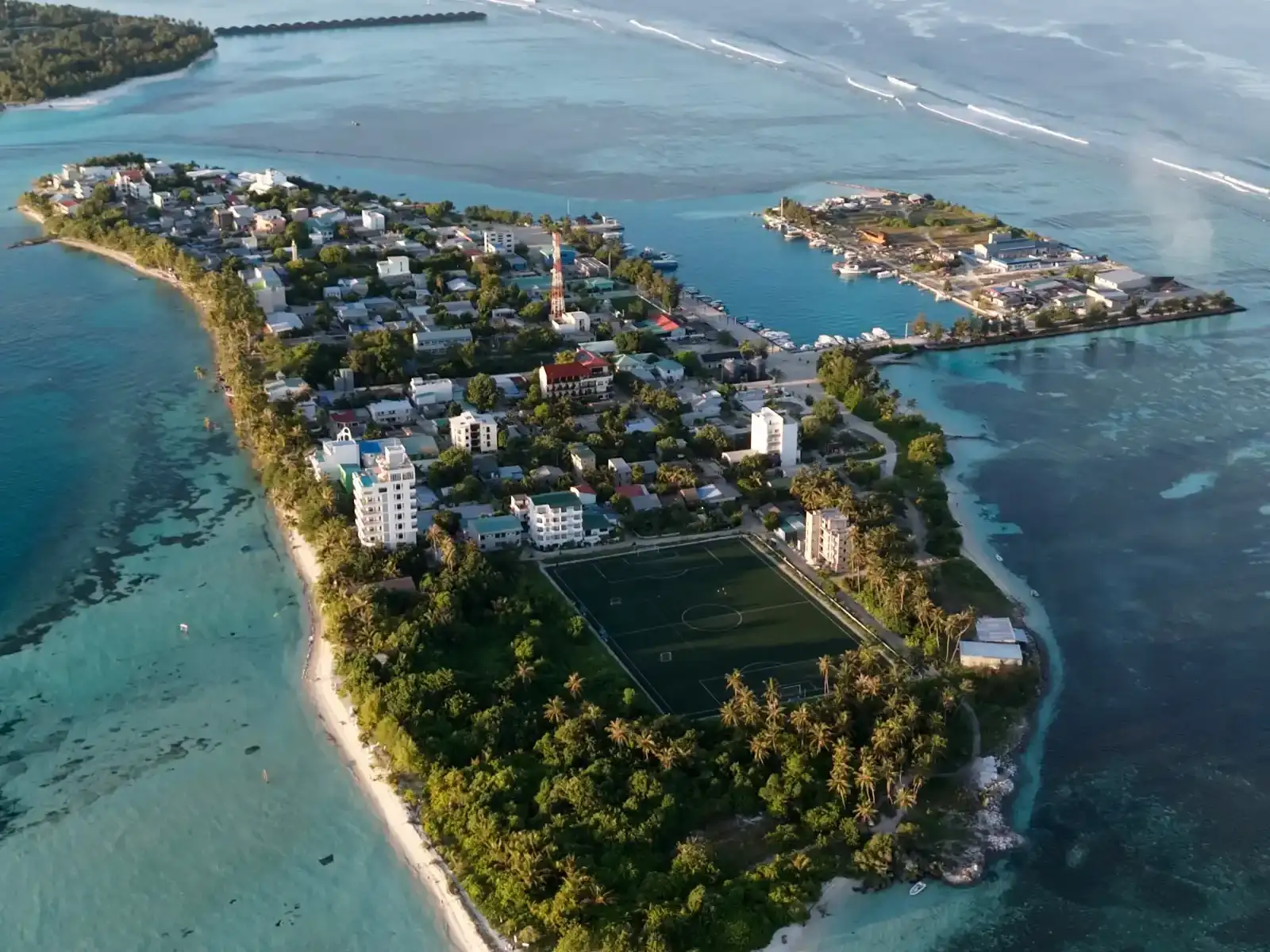
One clock does not mean one sunrise. Dhiffushi, on the eastern rim of North Malé (Kaafu) Atoll, is the easternmost inhabited island in the Maldives, so it is among the first places where islanders see the sun come up. The east beach is the place to watch it.
Practical tips
- Plan around Friday. Avoid relying on public ferries or official offices that day.
- Leave a buffer between flights and boats. Our how to get to Dhiffushi guide explains the boat options.
- Check holiday dates close to travel. Islamic holidays can move by a day after the moon sighting, and bridge days are announced late.
- Ask your resort about its clock if you are splitting a trip between a resort and a local island.
Questions people ask
What time zone is the Maldives in?
The Maldives is on UTC+5 all year, with a single time zone for the whole country. There is no daylight saving, so clocks never change. That makes it 30 minutes behind India and Sri Lanka and one hour ahead of the United Arab Emirates. The gap with the UK and Europe changes by an hour during the year, because those countries change their clocks and the Maldives does not.
What days are the weekend in the Maldives?
The weekend is Friday and Saturday, and the working week runs Sunday to Thursday. Government offices close on both weekend days. Friday is the quieter of the two because of the midday Friday prayer: on local islands, shops and cafés close for a while around it. Most public ferry routes do not run on Fridays, so plan island transfers for other days or use a shared speedboat.
Do resorts in the Maldives use a different time?
Ask your resort. Local islands, ferries, domestic flights and Velana International Airport all keep the national time, UTC+5. If you are staying at a resort, ask which clock it uses and confirm every pick-up time in Maldives time, so you do not miss a boat or flight.
Why do Ramadan and Eid dates change every year?
They follow the Hijri calendar, which is lunar. Each month begins with the new crescent moon, so the Islamic year is about 11 days shorter than the Gregorian year. Ramadan and the two Eids therefore arrive around 11 days earlier each year. In the Maldives, the Ministry of Islamic Affairs announces the start of Ramadan and Shawwal, often only the evening before, so treat any date published far ahead as an estimate.
Are government offices open during Ramadan?
Yes, but for shorter hours. Under a President’s Office directive first issued in 2022, government offices work from 9am to 1pm during Ramadan and the first seven days of Shawwal. Since 2024, they also close for the last ten days of Ramadan, starting on the 20th day, while essential services keep running. If you need an office during Ramadan, check its published hours and go early in the month.
What is the nakaiy calendar?
The nakaiy is the traditional Maldivian calendar of 27 periods, each lasting 13 or 14 days and named after a star or star group. Fishermen and farmers used it to judge the weather, sea and the best times to fish or plant. Many islanders still mention the current nakaiy today. It describes typical patterns rather than forecasts, so for actual weather planning use the Maldives Meteorological Service.