


Ari Atoll guide: whale sharks, mantas and local islands
North and South Ari explained: year-round whale sharks, manta seasons, local guesthouse islands from Dhangethi to Ukulhas, and how to get there by boat or plane.
 By Dhiffushi Island Council8 min readUpdated
Ari Atoll is a big oval of reefs and islands west of Malé. It is best known for whale sharks, which can be seen all year off its southern rim, and manta rays, which move from one side of the atoll to the other with the monsoon. It is also one of the easiest places in the Maldives to stay on a local island, with guesthouses on several inhabited islands and connections by speedboat, public ferry and domestic flight.
Ari Atoll at a glance
Ari is one natural atoll that is split into two administrative atolls:
- Alif Alif (North Ari) covers the northern half, plus the small, separate Rasdhoo Atoll and the lone island of Thoddoo to the north-east.
- Alif Dhaal (South Ari) covers the southern half, including the whale shark area along the southern outer reef.
The letters come from the Thaana alphabet. You will see “AA”, “North Ari”, “ADh” and “South Ari” on ferry boards and booking pages; they refer to the same places. For how Ari fits into the wider chain, see our Maldives atolls guide.
Ari mixes inhabited local islands, resort islands with their own rules, and uninhabited islands and sandbanks. This guide focuses on the local islands.
Whale sharks in South Ari
The outer reef of southern Ari is one of the few places in the world where whale sharks can be found throughout the year. They are mostly young males, and they feed and rest along this stretch of reef rather than passing through.
The area has been protected as the South Ari Marine Protected Area (often shortened to SAMPA) since 2009, and the government has since enlarged it and brought in a management plan. In recent years the rules on boats have tightened: vessels must be registered, fly a designated flag in the zone and share their location, and the number of boats allowed in the contact zone at one time is capped. Touching or feeding whale sharks is banned under the protected species rules.
Go with a licensed trip, keep your distance, never touch or chase the shark, and remember sightings are never guaranteed. We cover the rules, season and in-water etiquette in full in swimming with whale sharks in the Maldives, and the wider network of marine parks in protected areas of the Maldives.
Manta rays and other marine life
Ari is a good atoll for manta rays because it has reef channels on both its eastern and western sides. Mantas follow the plankton, and the plankton follows the monsoon currents:
- Southwest monsoon (about May to November): mantas tend to feed on the eastern side of the atoll.
- Northeast monsoon (about December to April): they tend to move to the western side.
Ask local crews which cleaning stations are active. All rays in the Maldives have been protected since 2014. Our manta rays guide explains how to behave at a cleaning station.
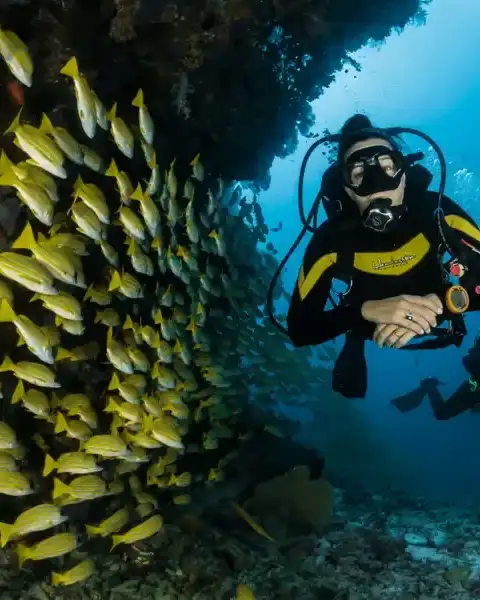
North Ari is also home to some of the country’s oldest protected dive sites. Maaya Thila and Fish Head (Mushimasmingili Thila) were among the first sites protected in 1995, and both are known for reef sharks and dense schools of fish. Turtles, eagle rays and shallow house reefs are common too.
Local islands with guesthouses (A to Z)
The islands below are inhabited local islands where guesthouses operate, based on official, news and established travel sources. Things change, so check your guesthouse’s registration and exact location before booking. The list is alphabetical, not a ranking.
Dhangethi (Alif Dhaal)
A lively South Ari island with a good number of guesthouses, and a practical base for both whale sharks and eastern-side manta sites.
Dhigurah (Alif Dhaal)
A long, narrow island on the south-eastern edge of the atoll, with a sandy tip that stretches out into the lagoon. It sits right next to the whale shark area, so boat rides to it are short. It is one of Ari’s busiest guesthouse islands.
Fenfushi (Alif Dhaal)
A smaller island on the south-western side of the atoll, with a handful of guesthouses and a quieter pace. Transfers from Malé take longer than to the eastern islands.
Maamigili (Alif Dhaal)
One of the larger islands in South Ari and home to the atoll’s airport. Guesthouses here are a convenient choice if you are flying in, and the whale shark area is close by.
Mahibadhoo (Alif Dhaal)
Historically the administrative centre of South Ari, with government offices, a health centre and a busy harbour. It has a small number of guesthouses and is a good place to see everyday island life.
Omadhoo (Alif Dhaal)
A small, walkable island in the east of South Ari with more than a dozen guesthouses. In late 2025 operators raised concerns about the island’s harbour, so ask how boats land before you travel.
Rasdhoo (Alif Alif)
The main island of tiny Rasdhoo Atoll, at the north-eastern edge of the Ari group and one of the closest Ari islands to Malé. It has historically been the administrative centre of North Ari and has many guesthouses. The channels around Rasdhoo Atoll are well known among divers.
Thoddoo (Alif Alif)
A single round island standing on its own north of Rasdhoo, and the Maldives’ best-known farming island. Its council told *The Edition* in 2023 that there were 112 farms, most of them growing watermelon, with harvests timed for Ramadan demand in Malé. Read more in our tropical fruits guide.
Ukulhas (Alif Alif)
A small island on the northern rim of the atoll. According to its island council, Ukulhas set up the first systematic waste management system on a Maldivian island in November 2011. It has a long beach and a range of guesthouses.
Getting to Ari Atoll
All international flights land at Velana International Airport, next to Malé. From there you have three main ways to reach Ari:
- Speedboat. Shared speedboats run on set schedules to the main guesthouse islands. Journey times are roughly one to two hours, depending on the island and the sea. Your guesthouse will usually arrange this.
- Public ferry. MTCC runs public ferries from Malé to parts of Ari. They are cheap and slow, are paid in rufiyaa, and run on limited days, with no Friday service on most routes. Check the current timetable before planning around them.
- Domestic flight. Maamigili airport, in South Ari, has scheduled domestic flights from Velana. The flight is short; you then take a boat to your island if you are not staying on Maamigili. See seaplanes and domestic flights.
Seaplanes serve some resort islands but are rarely used for local island stays. Keep a buffer day before your international flight, as rough weather can delay boats. More in getting around the Maldives.
When to go
Ari follows the national pattern described by the Maldives Meteorological Service:
- January to March: the dry northeast monsoon. Usually calmer seas and good visibility, and mantas on the western side.
- April and December: transition months, often calm and hot.
- Mid-May to November: the wetter southwest monsoon. More rain and wind, and some whale shark trips may be postponed, but mantas gather on the eastern side.
Air temperatures stay around 30–31°C and the sea around 28–29°C all year. See our best time to visit the Maldives for a month-by-month view.
Island life and etiquette
Ari’s local islands follow the same norms as every inhabited island in the Maldives:
- No alcohol. It is not sold or allowed on local islands.
- Swimwear on the designated “bikini beach” only. Elsewhere, cover shoulders and knees.
- No nude or topless sunbathing anywhere.
- Shops and cafés close for a while around Friday midday prayer.
- During Ramadan, don’t eat, drink or smoke in public in daylight on local islands.
Taxes are the same nationwide: Tourism GST of 17% (since July 2025), a green tax of USD 6 per guest per night at smaller guesthouses on inhabited islands, and a commonly added 10% service charge.
Ari or an island near Malé?
Ari suits travellers who put whale sharks first or have a longer stay. With only a few days, an island in North Malé Atoll can make more sense. Dhiffushi, for example, sits on the eastern rim of Kaafu Atoll, around 40–50 minutes by shared speedboat from the airport, and runs full-day whale shark and manta trips. Compare options in local islands near Malé, or start planning on our plan your trip page.
Questions people ask
Is Ari Atoll the same as Alif Alif and Alif Dhaal?
Yes. Ari is one natural atoll, but for administration it is split in two: Alif Alif covers North Ari, including Rasdhoo and Thoddoo, and Alif Dhaal covers South Ari. Booking sites, ferry boards and maps may use any of these names, or the short codes AA and ADh. They all refer to parts of the same area west of Malé, so check which island you are booking rather than the atoll label.
Can you see whale sharks all year in South Ari?
Whale sharks live along the southern outer reef of Ari throughout the year, which is unusual worldwide. That said, sightings are never guaranteed. On some days the sharks stay deep, and in the southwest monsoon, roughly mid-May to November, rough seas can cancel trips. Plan more than one attempt if seeing a whale shark matters to you, and always go with a licensed trip that follows the protected area rules.
Which local islands in Ari have guesthouses?
Guesthouses operate on several inhabited islands, including Dhangethi, Dhigurah, Fenfushi, Maamigili, Mahibadhoo and Omadhoo in South Ari, and Rasdhoo, Thoddoo and Ukulhas in North Ari. Each has its own character, from the farming island of Thoddoo to Dhigurah next to the whale shark area. New guesthouses open often, so check that yours is registered with the Ministry of Tourism before you book.
How do I get from Malé to Ari Atoll?
Most visitors take a shared speedboat from Velana International Airport or Malé, which takes roughly one to two hours depending on the island. MTCC public ferries are cheaper but slow and run on limited days, with no Friday service on most routes. For South Ari, you can also fly to Maamigili airport and finish the trip by boat. Your guesthouse can usually arrange transfers.
When are manta rays in Ari Atoll?
Mantas are seen in Ari all year, but they change sides with the monsoon. From about May to November, during the southwest monsoon, they tend to feed on the eastern side of the atoll. From about December to April, during the northeast monsoon, they usually move to the western side. Local crews know which cleaning stations are active, so ask on the island for the latest sightings.


