


Accessible travel in the Maldives: wheelchairs and boats
Wheelchair users and travellers with limited mobility can visit the Maldives. Here’s an honest look at the airport, boats, local islands and how to plan.
 By Dhiffushi Island Council8 min readUpdated
Yes, you can visit the Maldives with a wheelchair or limited mobility, but it takes more planning than most destinations. The airport offers free assistance through your airline, while local islands have sand paths, boat transfers with steps and few lifts. Choose your island and room carefully, tell everyone your needs in advance, and you can still enjoy the sea, the sunsets and island life.
The honest picture
The Maldives is a country of small, low coral islands linked by boats. That shapes almost everything about getting around.
- Paths are sand. On most local islands the streets are compacted sand or coral, not tarmac. Hard-packed sand can be fine for a sturdy chair; soft beach sand is very hard going without help.
- Every trip starts with a boat. Apart from Malé, Hulhumalé and the airport island, nearly every island is reached by speedboat, ferry or seaplane. Boarding usually means a step down from the jetty onto a moving deck.
- Jetty heights vary. At low tide the gap between jetty and boat can be large; at high tide it may be almost level. Crews are used to lifting bags, and many will help passengers on board, but there is rarely a ramp or lift.
- Few lifts. Guesthouses on local islands are mostly two to four storeys, and many have stairs only. Ground-floor rooms do exist, but you need to ask for them.
- Laws are improving, slowly. The Disability Act of 2010 promises equal access to buildings and transport. A UN review of the Maldives heard that compliance and inspection are still patchy, and the government has set targets to make public buildings fully accessible. Don’t expect ramps everywhere.
None of this rules the Maldives out. You’ll simply do best with a clear plan, a flexible pace and a host who knows your needs.
At the airport
Velana International Airport, on Hulhulé island next to Malé, is the gateway for almost every visitor. Read our Velana airport arrival guide for the full walk-through.
What the airport offers
According to the airport operator, Maldives Airports Company Limited (MACL):
- Free wheelchair assistance from the kerb to your aircraft seat, arranged through your airline.
- Dedicated check-in desks for passengers with reduced mobility, plus priority boarding help.
- Priority lanes at immigration, security and boarding gates.
- Accessible toilets with emergency call buttons in all terminals, tactile paving on the floors and automatic doors.
- A Calm Room in Terminal 1, opened in June 2026, for travellers with non-visible disabilities such as autism or sensory overload. Users receive a card and lanyard so staff can spot them and help faster, and a companion can stay with them.
How to make it work
- Book assistance with your airline when you book your flight, and confirm it again 48 hours before you fly.
- Ask your airline how you’ll board and leave the aircraft, and whether a lift vehicle is needed.
- If you use your own wheelchair, ask the airline about battery rules and whether it can be brought to the aircraft door.
- Allow plenty of time. Immigration queues and the walk to the boat jetties can be longer than you expect.
Getting around
Our getting around the Maldives guide covers the options in detail. Here is how each one works for limited mobility.
| Transport | What to expect |
|---|---|
| Shared speedboat | Fast (often under an hour). Steps from jetty to deck; crew can usually help you board. Can be bumpy in rough seas. |
| MTCC public ferry | Slow and affordable. Boarding over the side or a short gangway; seating on benches. No Friday service on most routes. |
| Domestic flight | Small regional airports; ask your airline about boarding by steps and help on arrival. |
| Seaplane | Boarding from a floating platform; very limited room. Ask about mobility requirements before you book. |
Tips for boats
- Tell the boat operator about your needs when you book, not on the jetty.
- Ask whether the crew can carry a folded wheelchair on board, and store it out of the spray.
- Check the weather. Boats can be delayed or cancelled when the sea is rough, so keep a buffer day before your flight home.
Malé and Hulhumalé
Malé is crowded and compact. Streets are narrow, pavements are often uneven or blocked by parked motorbikes, and kerbs can be high. Taxis are plentiful but are standard cars. See our Malé city guide.
Hulhumalé, the newer planned city on reclaimed land beside the airport, has wider streets and more modern buildings, so it is often easier for a first or last night. Our Hulhumalé guide has more.
Local islands
Local islands are where Maldivians live, and staying on one gives you real island life at an affordable price. Read our local islands guide for the basics. For limited mobility, a few points matter most.
Choosing an island
- Smaller islands mean shorter distances between harbour, shops, cafés and beach.
- Closer islands mean shorter boat rides. An island under an hour from the airport by speedboat is much easier than a long ferry or domestic flight.
- A health centre on the island is reassuring. Most inhabited islands have one, but check.
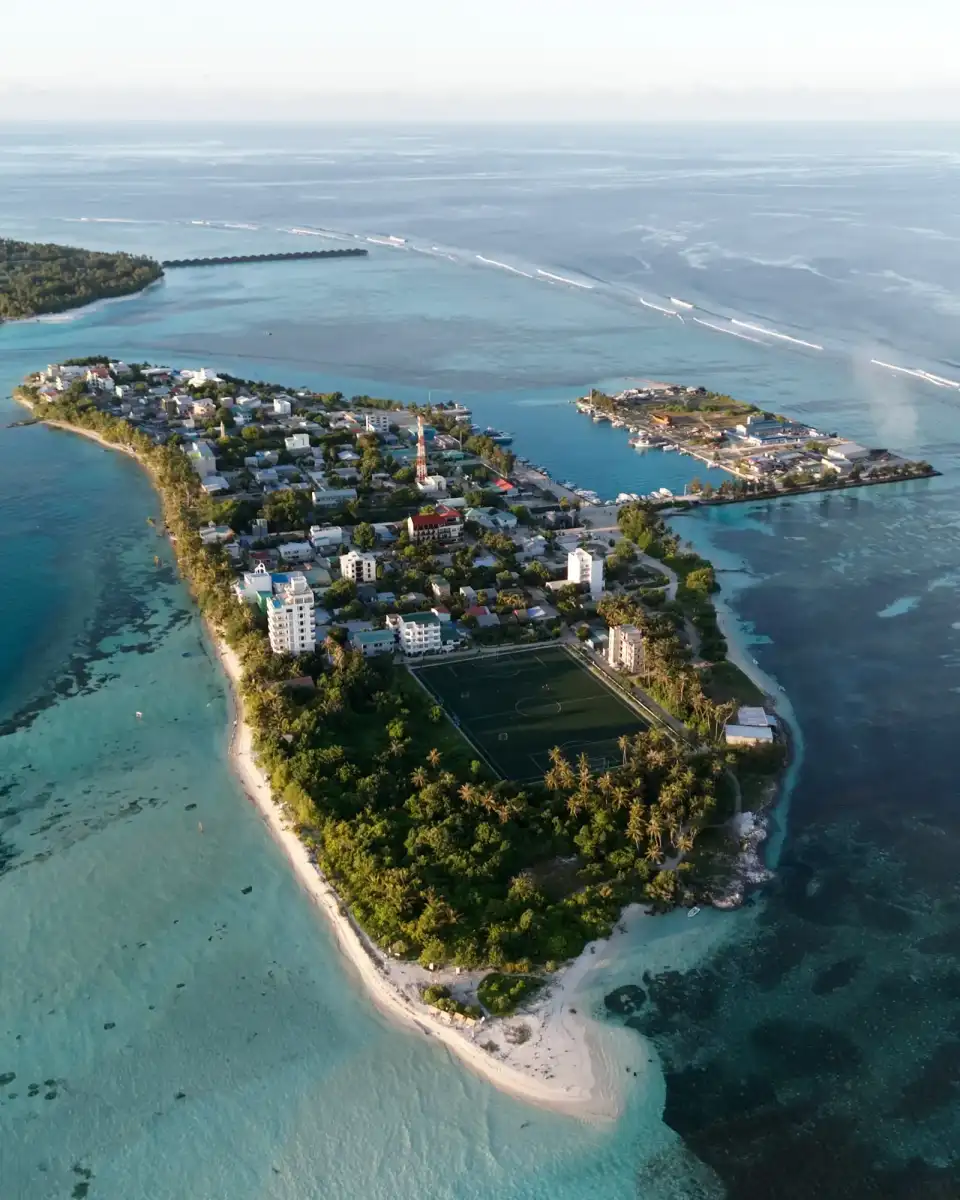
Dhiffushi is a useful example. It is about 37 km north-east of Malé, 40 to 50 minutes by shared speedboat from the airport, and nearly everyone arrives at the same harbour. Many guesthouses meet guests with a buggy for bags. The island has a government health centre for minor illness and first aid. See how to get to Dhiffushi for the transfer details.
Choosing a room
When you contact a guesthouse, ask direct questions and ask for photos:
- Is there a ground-floor room, or a lift?
- How many steps are there at the entrance, and is there a ramp?
- How wide are the doors, including the bathroom door?
- Is the shower level with the floor, and are there grab rails?
- How far is the room from the harbour and the beach, and is the path hard or soft sand?
- Can staff meet me at the harbour and help with boarding the boat?
Small family-run guesthouses are often flexible and happy to help. Browse the island’s places to stay and contact them before you book.
Beaches and the sea
Beach wheelchairs are rare on local islands, so don’t count on one. Soft sand near the water is the hardest part to cross. Some ideas that help:
- Ask your guesthouse whether there is a firmer path or a spot close to the water’s edge.
- Bring a lightweight beach mat or ask for help to reach a shaded spot.
- Calm, shallow lagoons on the sheltered side of an island can be gentle for floating and paddling.
- On a boat snorkelling trip, ask whether the boat has a ladder, and whether the crew can help you in and out. Wear a snorkelling vest for extra buoyancy.
Health and medical care
The main state hospital is Indira Gandhi Memorial Hospital (IGMH) in Malé. Most inhabited islands have a government health centre or clinic for first aid and minor problems, and serious cases are transferred to Malé by boat. Regional hospitals serve some atolls.
- Bring your own medicines for the whole trip, plus extra in case of delays. Island pharmacies have limited stock.
- Carry a letter from your doctor listing your conditions and medicines, and keep prescriptions in their original packaging.
- Pack spares for any equipment you rely on, such as wheelchair inner tubes, catheters or chargers. Replacements are very hard to find.
- Get travel insurance that covers your condition and medical evacuation. Read the small print carefully.
- Know the emergency numbers. The national emergency number is 911; ambulance is 102.
The heat is constant, around 30–31°C most days. If heat affects your condition, plan quiet afternoons in the shade and drink plenty of water. Our health and safety guide has more.
Planning checklist
- Pick the drier, calmer months if you can. January to March is the dry season; see our best time to visit guide.
- Book airline assistance with your flights.
- Question your guesthouse before booking, and ask it to arrange the boat and brief the crew.
- Keep a buffer day before your flight home.
- Travel with a companion if you need help with boarding or transfers.
Questions people ask
Is the Maldives wheelchair accessible?
Partly. Velana International Airport offers free wheelchair assistance through your airline, accessible toilets and priority lanes. Beyond the airport, local islands have sand paths, boat transfers with steps and few lifts, and beach wheelchairs are rare. Many wheelchair users do visit successfully, but it works best with careful planning, a ground-floor room, help for boat boarding and a companion who can lend a hand.
How do I get wheelchair help at Velana airport?
Book it through your airline when you buy your ticket, and confirm it a couple of days before you fly. The airport operator says wheelchair support runs from the kerb to your aircraft seat and is arranged through airlines. There are dedicated check-in desks and priority lanes at immigration and security. Ask your airline how you’ll leave the aircraft, as not every flight uses an air bridge.
Can I get on a speedboat in a wheelchair?
Usually you’ll need to leave the wheelchair and be helped down a step onto the boat, while the crew stows the chair. Crews are used to helping, but there are rarely ramps or lifts. Tell the operator your needs when you book, travel in calm weather if you can, and choose an island with a short transfer from the airport.
Are there accessible rooms on local islands?
Some guesthouses have ground-floor rooms, wide doors and level showers, but many small buildings have stairs only and no lift. Ask each guesthouse direct questions about steps, door widths, the shower and the distance to the harbour, and ask for photos. Small family-run places are often flexible and happy to help in practical ways once they know what you need.
What medical care is available on local islands?
Most inhabited islands have a government health centre or clinic for first aid and minor illness, with serious cases transferred to hospitals in Malé, including IGMH. Pharmacy stock on islands is limited, so bring all your medicines with spares, a doctor’s letter and travel insurance with evacuation cover. In an emergency, call 911 or ask your guesthouse for help.

