


Reef fish of the Maldives: what you will see snorkelling
Parrotfish, anemonefish, Moorish idols and Napoleon wrasse: the reef fish you will see snorkelling in the Maldives, which to avoid, and how to watch them well.
 By Dhiffushi Island Council8 min readUpdated
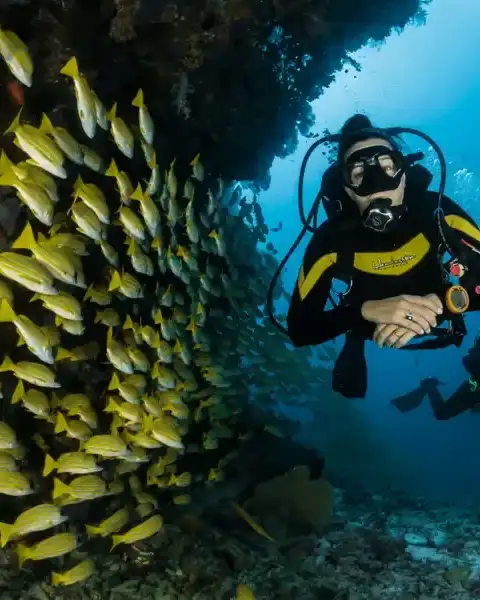
Put your face in the water on almost any Maldivian reef and you will see dozens of fish within minutes: parrotfish, butterflyfish, surgeonfish, triggerfish, groupers, clouds of orange anthias and, with luck, a Napoleon wrasse or a pair of anemonefish. Scientists have recorded more than 1,000 fish species in Maldivian waters. This guide covers the ones snorkellers meet most, a few to keep clear of, and how to watch them without harming the reef.
Why the Maldives is so good for reef fish
The Maldives sits in the middle of the Indian Ocean, with coral reefs ringing every atoll and island. Warm, clear water (around 28–29°C all year) and vast areas of shallow reef make it one of the easiest places to see tropical fish without diving.
Checklists of Maldivian fishes, starting with Randall and Anderson’s annotated list in 1993 and later additions, put the known shore and near-surface fish fauna at over 1,000 species. You do not need to learn them all: a handful of families make up most of what you see from the surface.
If you want the bigger picture of how reefs are built, read our guide to coral reefs of the Maldives. For the large animals, such as mantas, whale sharks and turtles, see Maldives marine life.
Common reef fish, A to Z
Anemonefish (clownfish)
Small orange fish that live among the stinging tentacles of sea anemones, protected by a layer of mucus. The Maldive anemonefish (*Amphiprion nigripes*), orange with a single white band behind the head, is found only around the Maldives and Sri Lanka. Clark’s anemonefish, with two or three white bands, is also common. Anemonefish defend their home bravely and may nip at a hand that gets close. Look, don’t touch: anemones are animals and damage easily.
Anthias
Tiny orange, pink and purple fish that hover in shimmering clouds above coral heads and along reef edges. The sea goldie is the classic Maldivian species. They feed on drifting plankton.
Butterflyfish
Flat, oval and brightly patterned, often yellow, white and black, and usually seen in pairs. Many feed on coral polyps, so a reef with plenty of butterflyfish is often a healthy one.
Groupers
Sturdy, big-mouthed predators that rest on the bottom or under ledges and watch you calmly. The peacock grouper (dark with blue spots) and the bright red coral grouper are easy to spot from the surface.
Moorish idol
Black, white and yellow, with a long trailing fin on top and a pointed snout. Often seen in pairs or small groups along the reef top.
Napoleon wrasse (humphead wrasse)
The giant of the wrasse family, with a bulging forehead, thick lips and fine maze-like markings on a green-blue body. Big adults can reach around 2 metres. The Maldives was the first country to ban the export of this fish, in 1995, and it is a protected species, so it cannot be caught or sold. Enjoy the encounter, but never feed or chase one.
Parrotfish
Blue, green, pink and turquoise, with fused teeth that look like a beak. You will hear them before you see them: a crunching sound as they scrape algae off dead coral. What passes through their gut comes out as fine white sand, and parrotfish produce a large share of the sand on Maldivian beaches.
Surgeonfish
Oval fish with a sharp, blade-like spine on each side of the tail, which is where the name comes from. The powder blue surgeonfish, blue with a yellow fin along the back, is one of the most common fish on shallow Maldivian reefs. The lined surgeonfish, striped blue and yellow, guards patches of algae in the surge zone.
Triggerfish
Solid, diamond-shaped fish with a locking spine on the back. Most are harmless: the red-toothed triggerfish forms dark blue clouds over the reef edge, and the Picasso triggerfish has painted-on stripes. The titan triggerfish is the exception (see below).
Other fish you will meet
- Angelfish: like butterflyfish but with a spine on the gill cover; the emperor and regal angelfish are stunners.
- Damselfish: small, bold and territorial; they will even chase snorkellers away from their algae gardens.
- Fusiliers: blue and yellow schools streaming along the reef edge.
- Moray eels: heads poking out of holes, opening and closing their mouths to breathe, not to threaten you.
- Pufferfish and boxfish: slow swimmers with comical faces. Never touch or try to make a puffer inflate.
- Trevallies: silver hunters that patrol the reef edge, sometimes following snorkellers.
Fish to watch out for
Very few fish are a danger to a careful snorkeller, but these are worth knowing.
Titan triggerfish
The largest triggerfish on the reef, with a dull green-brown body and big teeth. Most of the year it ignores people. During nesting, it guards a cone-shaped territory over a sandy nest and may charge and bite anyone who enters, including the fins and head. If one rises towards you, swim away horizontally rather than upwards, because the territory widens towards the surface. Hold your fins between you and the fish as you leave. Ask local guides where active nests are.
Lionfish
Slow, beautiful fish with long feathery fins and venomous spines. They are not aggressive, but a sting from a spine is very painful. Keep your distance and never try to touch one, especially at night when they hunt in the open.
Stonefish and scorpionfish
Masters of disguise that look like lumps of rock or coral. The stonefish has some of the strongest venom of any fish. The risk comes from stepping on one or putting a hand down on the reef, so never stand on coral, wear reef shoes when wading in, and keep your hands to yourself. Any sting needs medical help at once; our health and safety guide has emergency contacts.
Reef sharks and rays are part of the same scene, but have their own guides: see sharks in the Maldives and stingrays and eagle rays.
Reef etiquette: how to watch fish well
The calmer you are, the more you will see.
- Don’t feed fish. Feeding sharks is illegal, and feeding rays and whale sharks is banned under the Protected Species Regulation. Feeding any reef fish changes their behaviour and harms their health.
- Don’t touch. Not the fish, not the coral, not the anemones. Touching removes protective slime from fish and kills coral tissue.
- Don’t stand on the reef. Float, or move to sand to adjust your mask. A life vest or snorkel vest helps if you are not a strong swimmer.
- Don’t chase or collect. Let fish come to you. Shells, coral and other marine products often need a permit to leave the country, so leave them where they are.
- Keep fins high. Kicking near the bottom stirs up sand and breaks coral.
- Cover up. A rash vest means less sunscreen in the water.
Read more in our responsible travel guide.
Tips for identifying fish
- Shape first, colour second. Colours change with age, mood and depth. Body shape (oval, torpedo, diamond, flat) tells you the family.
- Note one detail. A tail spine, a long fin, a beak, a band through the eye. That is usually enough to look it up later.
- Use FishBase. The free FishBase database has photos and notes for almost every species, searchable by common or scientific name.
- Ask a local. Guides and boat crew grew up on these reefs and usually know Dhivehi names for the common fish.
When and where to see reef fish
Reef fish are there all year. Visibility is usually best in the dry northeast monsoon (about January to March), while the southwest monsoon (mid-May to November) can bring more plankton, slightly cloudier water and more mantas. Read the best time to visit the Maldives for the full picture.
You do not need a long boat trip. Most local islands have a house reef or a reef within a short boat ride. On Dhiffushi, for example, you can snorkel from shore on the house reef or join a trip to the coral garden. Our snorkelling in the Maldives guide covers gear, currents and safety.
Always snorkel with a buddy and check the current with locals before you go in.
Questions people ask
What fish will I see snorkelling in the Maldives?
On a typical shallow reef you will see parrotfish, butterflyfish, surgeonfish, damselfish, anthias, triggerfish, groupers, Moorish idols and angelfish within minutes. You may meet anemonefish, trevallies and moray eels too. Over 1,000 fish species have been recorded in Maldivian waters, so even experienced snorkellers keep spotting new ones.
Are there clownfish in the Maldives?
Yes. The most common is the Maldive anemonefish, orange with one white band behind the head, which is found only around the Maldives and Sri Lanka. Clark’s anemonefish, with two or three white bands, is also widespread. Look for them in sea anemones on reef tops and slopes, and keep your hands away: they guard their home and the anemone is easily damaged.
Are titan triggerfish dangerous?
They can be during nesting, when they guard a cone-shaped area above their nest and may bite intruders. Bites can be painful but are rarely serious. If one rises towards you, swim away horizontally, not upwards, and keep your fins between you and the fish. Ask your guide whether any nests are active on the reef before you get in.
Is it allowed to feed fish in the Maldives?
Feeding sharks is illegal, and feeding rays and whale sharks is banned under the Protected Species Regulation. For other reef fish, the simple rule is don’t. Feeding changes natural behaviour, can make fish aggressive towards swimmers and is bad for their health. Please don’t bring bread or snacks into the water.
Is the Napoleon wrasse protected in the Maldives?
Yes. The Maldives was the first country to ban the export of the Napoleon (humphead) wrasse, in 1995, and the fish is protected from catch and sale. It is listed as endangered internationally. Big, curious adults are often seen on channel edges and outer reefs. Watch from a respectful distance, never chase or feed one, and let it come to you.
Do I need to dive to see good reef fish?
No. Most common reef fish live in the top few metres, where snorkellers see them clearly in good light. Diving reaches deeper channels with bigger fish and schools, but a calm house reef can be just as rewarding. Many local islands have a reef you can reach from the beach or after a short boat ride.


