


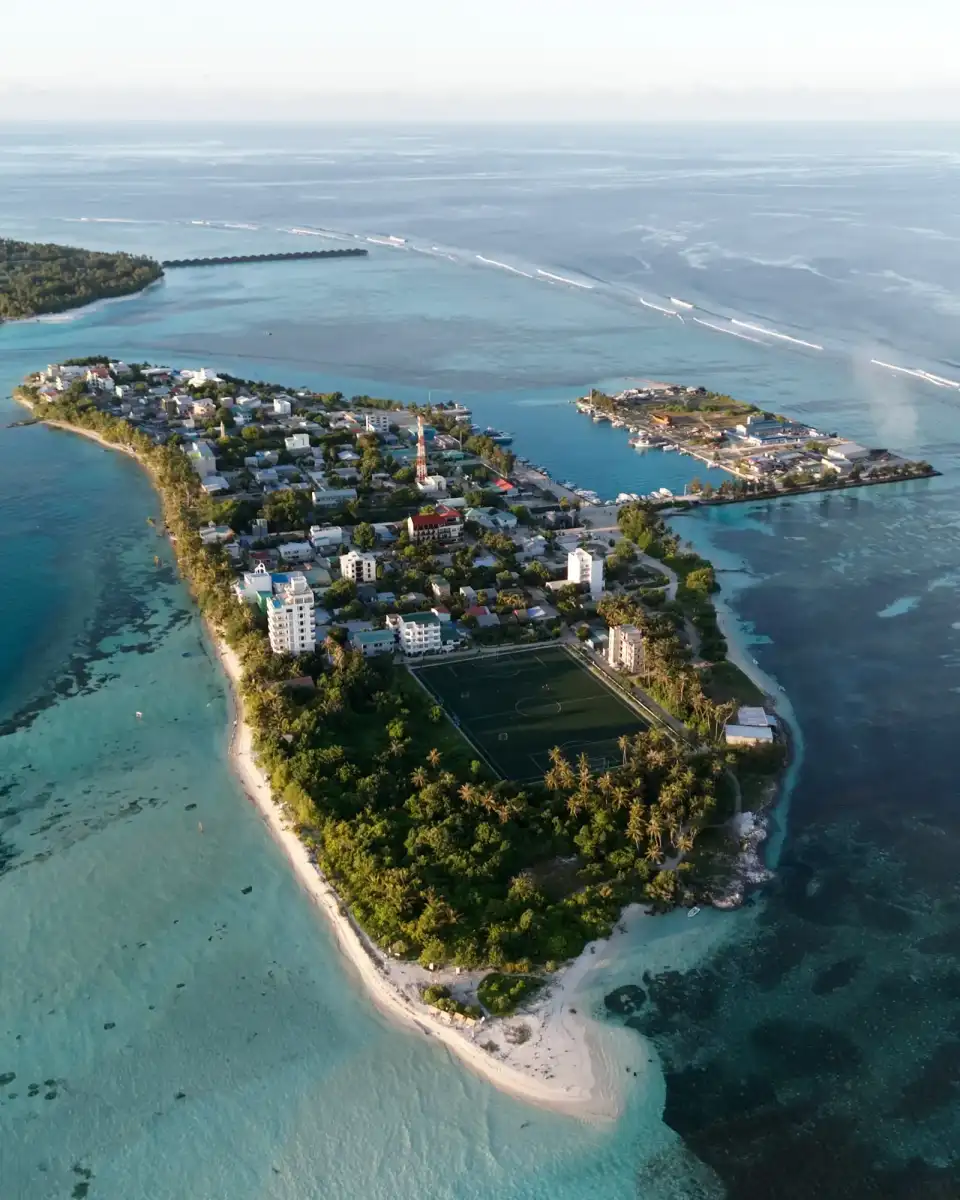
One day in Malé: a walking itinerary
A self-guided walk through Malé in one day: mosques, Sultan Park, the National Museum, the fish market and the Artificial Beach, plus Friday closures, dress and heat tips.
 By Dhiffushi Island Council8 min readUpdated
One day is enough to see the best of Malé on foot. Start early at Republic Square and the Grand Friday Mosque, walk to the old coral stone mosque and the National Museum before the midday heat, then spend the afternoon at the fish market and finish at the Artificial Beach. Go between Sunday and Thursday, because the museum is closed on Fridays and Saturdays and Friday midday prayer stops the city for a while.
Before you start
Malé is small and flat, so you can cross it on foot in well under half an hour. Our Malé city guide gives the wider picture; this page is the route.
Getting to Malé from the airport
Velana International Airport is on Hulhulé, the island next to Malé. You have three simple ways across:
- The airport ferry. A public ferry crosses to Malé’s waterfront in about 10 minutes.
- A public bus. RTL buses run over the Sinamalé Bridge to Malé and Hulhumalé.
- A taxi. The easiest choice with heavy bags.
Times and fares change, so check them on the day. Our guide to arriving at Velana Airport explains each option.
Choose your day
- Sunday to Thursday is best. The National Museum’s official page lists opening days as Sunday to Thursday, closed on Fridays, Saturdays and government holidays.
- Fridays are quiet. Shops and cafés close around the midday prayer.
- During Ramadan, do not eat, drink or smoke in public in daylight. Cafés open in the evening, and the city comes alive after sunset.
What to wear and bring
Malé is an inhabited island, so the usual local island rules apply. Cover your shoulders and knees, and keep swimwear for elsewhere. A light scarf is useful for women near mosques. There are no bikini beaches in Malé. Our guide to what to wear in the Maldives has the details.
Bring water, a hat and sun cream (it is around 30°C all year), rufiyaa in small notes, comfortable shoes and as little luggage as possible.
The walking route at a glance
| Time of day | Stop | Why then |
|---|---|---|
| Early morning | Republic Square and the Grand Friday Mosque | Cooler, and the waterfront is busy with boats |
| Mid-morning | Hukuru Miskiy, Medhu Ziyaaraiy and Muleeaage | Three historic sites close together |
| Late morning | Sultan Park and the National Museum | Shade and air conditioning before the heat peaks |
| Midday | Short eats and a rest | Escape the hottest hours and prayer times |
| Afternoon | Fish market and local market | Boats bring in the catch later in the day |
| Late afternoon | Artificial Beach | Sea breeze and local families at dusk |
Treat these times as a guide; shops and some sites pause at each prayer time.
Morning: the waterfront and the big mosques
Republic Square
Start on Malé’s northern waterfront at Republic Square, the open public space where the national flag flies and official ceremonies take place. The square has had redevelopment works; MMTV reported in February 2026 that parts had reopened as the work neared completion, so some areas may still be fenced off.
The Grand Friday Mosque
Next to the square stands the big white mosque with the golden dome, part of the Islamic Centre that opened on 11 November 1984.
It is a working mosque and home to the Ministry of Islamic Affairs. There is no published visiting policy for non-Muslims. If you would like to look inside, go outside prayer times, dress modestly, ask the attendants at the door and accept their answer. Our guide to the Grand Friday Mosque has more.
Mid-morning: old Malé’s heritage cluster
A short walk inland brings you to three historic sites that sit close together. This is the heart of old Malé.
Hukuru Miskiy (Old Friday Mosque)
The Old Friday Mosque is the country’s best-known coral stone mosque, built in the 1650s under Sultan Ibrahim Iskandhar I. Its walls are made from blocks of reef coral cut to fit tightly, then carved with Arabic script and plant patterns. Beside it stands the round minaret, the Munnaaru, and a graveyard of carved coral headstones.
The mosque is part of the Maldives’ nomination for UNESCO World Heritage status. As of October 2026 it is not yet inscribed. It is an active mosque, so admire it from the surrounding lanes; entry for non-Muslims is limited and may need permission. Read more in our guide to the coral stone mosques of the Maldives.
Medhu Ziyaaraiy
Close by is a small shrine, the Medhu Ziyaaraiy. National news reports describe it as the tomb of Abu al-Barakat Yusuf al-Barbari, the North African scholar credited with bringing Islam to the Maldives in 1153. Public access has been opened only occasionally in the past, so view it respectfully from outside. It is a place of reverence, not a photo stop.
Muleeaage
Nearby is the blue-and-white Muleeaage, built between 1914 and 1919 for a prince, according to the official tourism board. It never served as a sultan’s palace. Since the 1950s it has been used at different times as the president’s official residence. It is a government building, so look from the gate and don’t photograph guards or security posts.
Late morning: Sultan Park and the National Museum
Sultan Park
Sultan Park is the green space laid out on the grounds of the old sultans’ palace. It closed in August 2025 for redevelopment supervised by the Maldives National Defence Force and reopened for Eid al-Fitr in March 2026, as Atoll Times and MMTV reported. In May 2026 Edition reported that remaining work would close the park to the public from 6pm each day. Check locally before planning an evening visit.
The National Museum
The National Museum stands in the park on Chaandhanee Magu. It is the best single place to understand Maldivian history: royal objects, coral stone carvings from the Buddhist era, manuscripts, coins and everyday island objects.
The heritage authority’s official page lists these basics:
- Open Sunday to Thursday, 10:15am to 4pm.
- The ticket counter closes at 3:30pm.
- Closed on Fridays, Saturdays and government holidays.
- No flash photography, food or drink.
Allow an hour or so, and check the official page before you go, as hours can change. Our National Museum guide covers the collection in depth.
Midday: rest, eat and wait out the heat
The middle of the day is the hottest, and prayer times close shops for short spells. Sit down in a small local café for hedhikaa, the Maldivian short eats served with sweet tea; our hedhikaa guide explains what to order. Drink plenty of water. On a Friday, plan this break around the midday prayer.
Afternoon: the fish market and local market
Walk back to the northern waterfront, west of Republic Square, to the fish market and the local market side by side on Boduthakurufaanu Magu. Fishing boats tie up across the road and the catch comes straight in.
Afternoon is the time to go, as more of the fleet returns. You will see:
- Tuna. Skipjack and yellowfin are the everyday fish, cut by hand at the counters with skill and speed.
- Produce next door. The local market sells fruit, vegetables, coconuts and smoked fish brought in from the islands.
These are working markets: wet, noisy and busy. Ask before you photograph anyone up close, and stand back from the cutters. Our Malé fish market guide has the full picture.
Late afternoon: the Artificial Beach
End the day on Malé’s eastern side at the Artificial Beach, a small public beach where local families come to swim and sit by the sea in the evening. It is a local public beach, not a bikini beach: if you swim, wear shorts and a T-shirt. Arrive before sunset and watch the city wind down.
Heat, pace and respect
- Start early and walk on the shady side of the street; duck into the museum or a café when you need a break.
- Step aside for motorbikes and keep your voice down near mosques and homes.
- Alcohol is not sold or allowed in Malé.
If you’re heading to a local island
Many travellers spend a day in Malé at the start or end of a local island stay. Dhiffushi, for example, is about 37 km north-east of Malé, with a shared speedboat taking 40 to 50 minutes. A day in the city pairs well with an afternoon transfer. See how to get to Dhiffushi. If you only have a few hours between flights, our layover guide is a better fit.
Questions people ask
Is one day enough for Malé?
Yes. Malé is small, and the main sights are within a short walk of each other. One day lets you see the mosques, the National Museum, the fish market and the waterfront at an easy pace, with breaks for the heat. If time is short, focus on the old Friday mosque and the museum.
Can I walk around Malé?
Yes, and walking is the best way to see it. The island is flat and compact, so you can cross it on foot in well under half an hour. Pavements are narrow, motorbikes are everywhere and the sun is strong, so walk early, carry water and take care at junctions.
What day should I avoid in Malé?
Friday is the hardest day for sightseeing. Shops and cafés close around the midday prayer, most public ferry routes don’t run and the National Museum is closed. The museum also closes on Saturdays and government holidays. Sunday to Thursday gives you the most open doors, while Friday suits a quiet stroll along the waterfront.
Can tourists go inside the mosques in Malé?
The Old Friday Mosque and the Grand Friday Mosque are both working mosques. Entry for non-Muslim visitors is limited, may need permission and is never possible during prayers. Dress modestly, ask the attendants at the door and accept their answer. You can always admire the coral stone walls, the minarets and the old graveyard from the street outside.
What should I wear for a day in Malé?
Dress as you would on any local island. Cover your shoulders and knees, and choose loose, light clothes for the heat. A light scarf helps women near mosques. Malé has no bikini beaches, so if you swim at the Artificial Beach, wear shorts and a T-shirt. A hat, sunglasses and sun cream are essential for walking in the midday sun.

