Coral spawning in the Maldives: when reefs reproduce
When Maldivian corals spawn, what happens on the night, why it matters for reefs after bleaching, and your realistic chances of seeing it on a night snorkel.
 By Dhiffushi Island Council8 min readUpdated
Coral spawning in the Maldives happens mainly in two seasons: March to April, and October to December, when the monsoon winds change. On a few nights around the full moon, usually one to three hours after sunset, corals release eggs and sperm into the sea. It is hard to predict and rarely seen, but it is how reefs make the next generation of coral.
What coral spawning is
A coral reef is built by colonies of tiny animals called polyps. Corals grow by budding, where a polyp divides to make copies of itself. That adds to a colony but does not create anything genetically new.
To do that, corals reproduce sexually. According to the US National Oceanic and Atmospheric Administration (NOAA), most stony corals are “broadcast spawners”: they release eggs and sperm into the water, where fertilisation happens. A smaller group are “brooders” that keep fertilised eggs inside and release ready-made larvae.
When eggs and sperm meet, they form swimming larvae called planulae. These drift for a few days, sometimes weeks, then sink, attach to hard reef and grow into a new colony.
Why timing matters
A coral cannot move to find a partner. Colonies of the same species may be metres or hundreds of metres apart, so they need to release at the same moment for eggs and sperm to meet. NOAA describes a chain of cues:
- Season: sea temperature and day length set the month.
- Moon: the lunar cycle narrows it to a few nights.
- Sunset: darkness triggers the release itself, usually within hours.
Many Maldivian corals, especially the branching and table corals of the genus *Acropora*, release small, buoyant “bundles” that hold both eggs and sperm. They float up like slow, upside-down snow, then break apart at the surface.
When corals spawn in the Maldives
For a long time there was very little published on this. Researchers writing in the journal *PeerJ* in 2023 noted the lack of data for the Maldives, with only a few earlier reports.
What the government’s marine scientists say
The Maldives Marine Research Institute (MMRI), the research arm of the fisheries ministry, said in 2020 that informal records point to spawning twice a year: in March–April and again in the last quarter of the year. It asked the public to report sightings of spawning and spawn slicks to help map the timing across the country.
What recent studies found
Two peer-reviewed studies from North Malé (Kaafu) Atoll and Baa Atoll have since filled in much of the detail:
- 2023 (*PeerJ*): 1,200 *Acropora* colonies of 22 species were recorded spawning between October 2021 and April 2023. Spawning was seen in eight different months, with clear peaks in April and November.
- 2025 (*PeerJ*): the same programme extended the record to 3,026 colonies from 24 *Acropora* species up to May 2024. More colonies spawned on nights close to the full moon, and the authors confirmed two peak seasons: March/April and October to December, matching the change of monsoon.
- 2025 (*Frontiers in Marine Science*): a year of surveys on a Baa Atoll reef recorded other kinds of coral as well, including brain-like and boulder corals. They also spawned mostly in March–April and October–December.
| Month | *Acropora* colonies recorded spawning (2021–2023) |
|---|---|
| January | 1 |
| February | 2 |
| March | 66 |
| April | 553 |
| May | 2 |
| October | 53 |
| November | 444 |
| December | 79 |
These counts come from two atolls and depend on when researchers were watching, so read them as a pattern, not a forecast. None were recorded from June to September.
Which nights, and what time
- Around the full moon. Most spawning recorded in these studies happened in the days just after the full moon. A smaller number of colonies (36 in the 2023 study) spawned around the new moon instead.
- After dark. On average, *Acropora* in the 2023 study released bundles more than 100 minutes after sunset. In the Baa Atoll study, other corals started roughly one to three hours after sunset.
- Not all at once. Maldivian corals often show “split spawning”, where one species spawns across two lunar months, and some colonies spawn in both seasons. The highest count was 14 species spawning on the same night, 5 April 2023, in North Malé Atoll.
It varies from year to year
The researchers found that the exact night shifted between years and between atolls. Corals in North Malé Atoll tended to spawn earlier in the lunar cycle than those in Baa. Calmer winds, warmer water and lower tides were linked with earlier spawning. The authors also suggested that artificial light near Malé and the airport might play a part, as studies elsewhere show light at night can shift spawning closer to the full moon.
So nobody can promise a spawning night. Even researchers check corals for ripe eggs in advance, then wait in the water night after night.
Why spawning matters for Maldivian reefs
Maldivian reefs have been hit hard by marine heatwaves that cause bleaching, most recently during the global event of 2024. Our guide to coral reefs of the Maldives explains what happened.
New corals from spawning are what let a damaged reef rebuild itself. Because each larva is genetically new, spawning also adds variety, which may help reefs cope with future change. The 2025 *PeerJ* authors note that knowing when corals spawn helps reef managers plan recovery work after bleaching.
Spawning and coral restoration
Most coral restoration grows fragments (clones) of existing corals. A newer approach uses spawning itself: scientists collect spawn, raise the larvae in tanks and settle the young corals on the reef. MMRI has been testing this larval method with Australian research partners, using natural spawning events. Our coral restoration guide covers how it works and what the results show so far.
Planted corals can join in too. The 2023 study found that colonies grown on restoration structures spawned alongside wild corals on the same nights.
Can visitors see coral spawning?
Possibly, but go in with low expectations. Spawning lasts minutes, happens at night and only on certain colonies, and the right night is uncertain even for scientists.
Your best chances
- Time your trip. Visit in March–April or October–December, and look up the full moon dates for your stay.
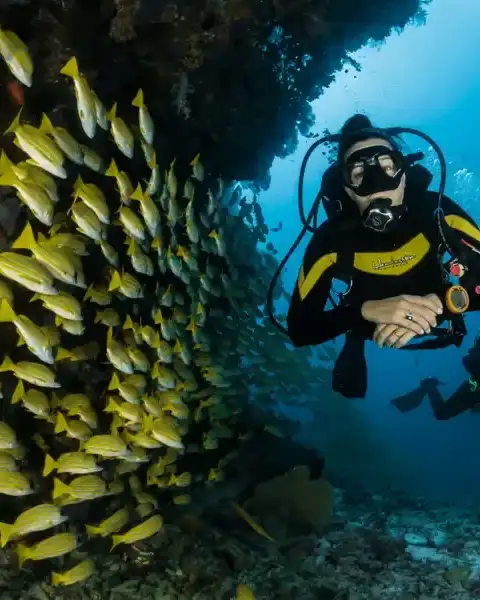
- Go out after dark. A guided night snorkel or night dive in the week after the full moon gives you a chance. Do not snorkel alone at night.
- Ask locally. Dive teams and island guides who are in the water every day often know when corals look ready.
- Look at the surface. The morning after a big spawning, slicks of spawn can collect on calm water. MMRI has asked people to report such slicks.
See our best time to visit the Maldives and the Maldives wildlife calendar for what else is happening, or the Maldives in April and Maldives in November guides.
On a local island
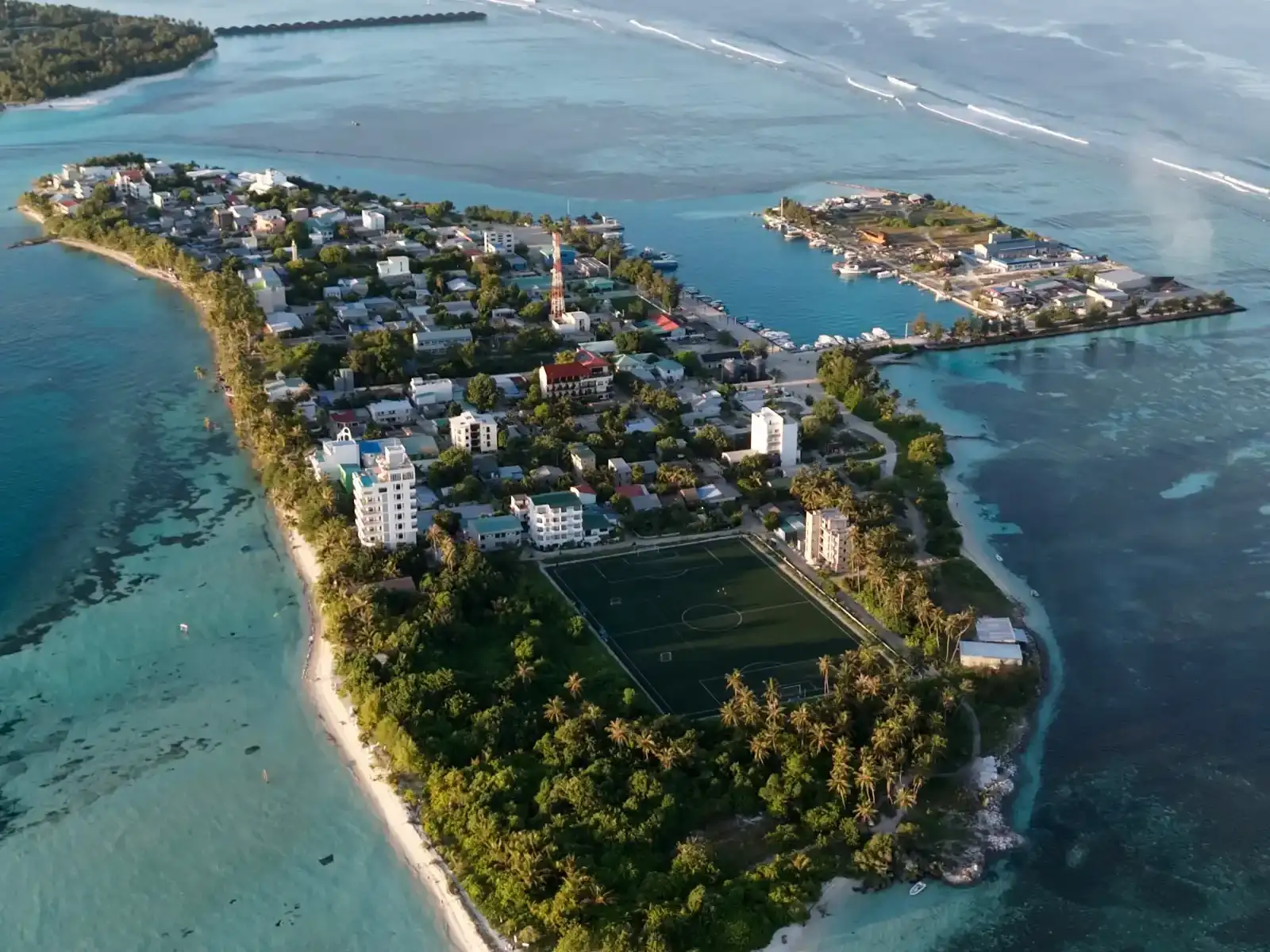
Local islands have house reefs within reach of the beach. On Dhiffushi, the island’s night snorkelling trip is the simplest way to see a reef after dark, and the house reef is close to shore. Spawning is never guaranteed on any trip, but a night on the reef is worth it anyway, and on some nights you may also see glowing plankton.
Good reef manners during spawning season
- Don’t touch corals, at any time. Fins, hands and knees damage polyps.
- Keep lights low. Point your torch at the sand, not straight into colonies, and avoid flash.
- Use reef-safe habits: good buoyancy, no standing on coral, no collecting. Coral and shells need a permit to leave the country, so don’t buy or take any.
- Report what you see. If you spot spawning or a slick, note the place, date, time and a photo, and share it with MMRI through its official channels.
For more on protecting reefs while you travel, read our responsible travel guide and protected species in the Maldives.
Questions people ask
When do corals spawn in the Maldives?
Mainly twice a year: March to April, and October to December. MMRI described this two-season pattern from informal records, and studies in North Malé and Baa atolls since 2021 confirmed it, with the biggest numbers in April and November. Spawning has been recorded in other months too, but rarely. The exact nights vary between years and atolls, so treat these months as a guide rather than a timetable.
What time of night does coral spawning happen?
Usually a little while after dark. In a 2023 study, *Acropora* corals released their egg and sperm bundles on average more than 100 minutes after sunset. A separate Baa Atoll study found other corals starting roughly one to three hours after sunset. Most spawning recorded in the Maldives happened in the days just after a full moon, with a smaller number of colonies spawning around the new moon.
Can I see coral spawning while snorkelling?
You might, but nobody can promise it. Your best chance is a guided night snorkel or dive in March–April or October–December, in the week after the full moon. Spawning only lasts minutes and only some colonies spawn on a given night. Never snorkel alone after dark, and keep your torch pointed away from the coral so you don’t disturb it.
Is it safe to swim at night to look for spawning?
The real risks at spawning time are the usual ones for any night swim: currents, boat traffic and poor visibility. Go with a guide, stay close to your group and check the weather first. The morning after a big spawning, slicks of spawn may float on calm water; it is natural, and MMRI has asked people to report it.
Why does coral spawning matter after bleaching?
Bleaching can kill large areas of coral. New corals grown from spawning are how a reef replaces them, and because each larva is genetically new, spawning adds the variety that may help reefs cope with future heat. Scientists in the Maldives are now using spawning for restoration, collecting larvae and settling young corals on damaged reefs, which is why knowing the timing matters.
Do corals on restoration frames spawn too?
Yes. A 2023 study in North Malé and Baa atolls recorded spawning from corals grown on restoration structures as well as wild colonies, often on the same nights. The authors said restored corals should be included when studying how Maldivian corals reproduce. That matters, because it means planted corals can add larvae to the wider reef rather than simply sitting on it.