Protected species in the Maldives: what the law covers
Sharks, rays, turtles, whale sharks, dolphins, parrotfish and 207 bird species are protected in the Maldives. Here is what the law covers and what it means for you.
 By Dhiffushi Island Council8 min readUpdated
In the Maldives, all sharks (with one narrow fishing exception), all rays, sea turtles, whale sharks, whales and dolphins, parrotfish and 207 bird species are protected by law. Visitors may not catch, kill, keep, feed, harass or buy any of them, or anything made from them. The rules sit mainly in the Protected Species Regulation (2021/R-25), alongside older fisheries bans and the Customs rules on what can leave the country.
Why the Maldives protects its wildlife by law
Almost everything a visitor comes to see in the Maldives lives on or around the reef. Sharks, mantas, turtles and big reef fish are worth far more alive, to fishing families and island economies, than they ever were as catch. Over three decades the country has moved from banning the export of single species to a broad national list.
The main legal tool today is the Natural Resources and Naturally Protected Species Regulation, numbered 2021/R-25 and published in the Government Gazette in 2021. It was made under the Environmental Protection and Conservation Act (Act 4/93). It has been amended several times since. A 2022 amendment added four more shark species to the list, tidied up scientific names and raised penalties, including the possibility of prison. The seventh amendment, 2024/R-96, rewrote the code of conduct for whale shark encounters.
Until August 2025 the Environmental Protection Agency enforced these rules. It was abolished on 12 August 2025, and its work moved to the Ministry of Tourism and Environment. The rules themselves did not change.
What the law covers
Sharks
The Maldives banned shark fishing across its waters in 2010.
From 1 November 2025 a single exception reopened. Licensed boats may catch gulper sharks, a deep-water species, but only outside the atolls, under special licences and for no more than seven months a year, according to the Ministry of Fisheries regulations as reported by Atoll Times. Every other shark species stays protected. For a visitor, nothing changes. You will never be offered gulper shark on a local island, and the reef sharks you snorkel with remain fully protected. Read more in our guide to sharks in the Maldives.
Rays and mantas
All rays in Maldivian waters have been protected since June 2014. That covers reef and oceanic mantas, eagle rays and stingrays. In January 2025 the Environmental Protection Agency ordered that feeding of all rays and skates must stop. It pointed out that the Protected Species Regulation already treats feeding as harmful, and that feeding spots had seen injuries to snorkellers and divers, and sharks drawn into shallow water. See our guides to manta rays and stingrays and eagle rays.
Whale sharks
Whale sharks are on the protected list, and since the 2024 amendment their encounters follow a stricter national code. The main points for swimmers, as reported by Edition in September 2024:
- Stay at least 3 metres from the body and 4 metres from the tail.
- Do not touch, ride or hold on to a whale shark, and do not block its path.
- No feeding, no flash photography or bright lights, and no selfie sticks where whale sharks are sighted.
- Only a small number of boats may be inside the contact zone at once, at very low speed.
Our guide to swimming with whale sharks explains how a good encounter works in practice.
Sea turtles
The Maldives first banned catching sea turtles in 1995, under a ten-year fisheries moratorium. It was renewed, and turtles were later brought under the environment law, which also bans harvesting their eggs (as reported by PSM). In October 2024 the Environmental Protection Agency listed five turtle species and the Indian black turtle among the protected species, and named catching and eating turtles as a continuing problem. Selling or buying tortoiseshell is illegal. Our sea turtles guide covers where to see them and how to behave in the water.
Whales and dolphins
All whales and dolphins are protected. Twenty-three cetacean species have been recorded in Maldivian waters, according to a review published by the International Whaling Commission (Anderson and others, 2012). Spinner dolphins are the ones most visitors meet, often from a boat at sunset.
Parrotfish and the Napoleon wrasse
Parrotfish were added to the protected list in September 2020, and selling or displaying them was banned from 1 March 2021. They graze algae off the reef and grind dead coral into sand, so they matter to every beach in the country. The humphead or Napoleon wrasse, a huge reef fish with a bulging forehead, was the subject of a 1995 export ban. A peer-reviewed study in *Endangered Species Research* (Roe and others, 2022) notes that the Maldives was the first country to ban its export.
Birds
The Environmental Protection Agency said in October 2024 that 207 bird species are protected under the regulation. That covers resident herons and terns as well as the migrants that pass through each year. Catching birds or keeping protected birds as pets is banned. Our guide to birds of the Maldives describes what you are likely to see.
The quick reference
| Group | Protected since | What it means for you |
|---|---|---|
| Turtles | Catching banned since 1995 | Don’t touch, chase or buy tortoiseshell |
| Napoleon wrasse | Export banned 1995 | Admire it, never eat or buy it |
| Sharks | Fishing banned 2010 (gulper exception, Nov 2025) | No feeding, no shark products |
| Rays | June 2014 | No feeding, no touching |
| Parrotfish | September 2020 | Not on any legal menu |
| Birds | 207 species, 2021 regulation | No catching or keeping |
What the law means for visitors
The regulation bans catching, killing, keeping, eating and trading protected species and their parts. In practice, a visitor should follow four simple habits.
Don’t feed
Feeding sharks is illegal under the rules for recreational diving, as reported, and feeding rays and whale sharks is banned under the protected species rules. If an excursion offers to feed fish, rays or sharks to draw them in, say no.
Don’t touch or chase
Keep your hands to yourself, even when an animal comes close. Don’t chase turtles for a photo, block a manta’s path or crowd a whale shark with a group. The Environmental Protection Agency named feeding, touching and boats chasing whale sharks among the harmful behaviour it was seeing.
Don’t buy
Shark jaws, dried shark fin, turtle shell jewellery, coral and shells should never go in your bag, and don’t collect them from the beach or reef either. Many marine products need a permit to leave the country, according to the Maldives Customs passenger guide (December 2024), and the Maldives has been a party to the international CITES treaty on endangered species since 12 March 2013. A foreign visitor was fined MVR 50,000 by the Criminal Court in 2024 for trying to smuggle shark fins out of the country (Edition). Our customs allowances guide explains what you can take home.
Report what you see
If you see a turtle being caught, a ray being fed or a protected animal for sale, note the place and time and tell your guesthouse, the island council or the Maldives Police Service. In an emergency, call 119 for police or 911, the single national emergency number.
Seeing protected species from a local island
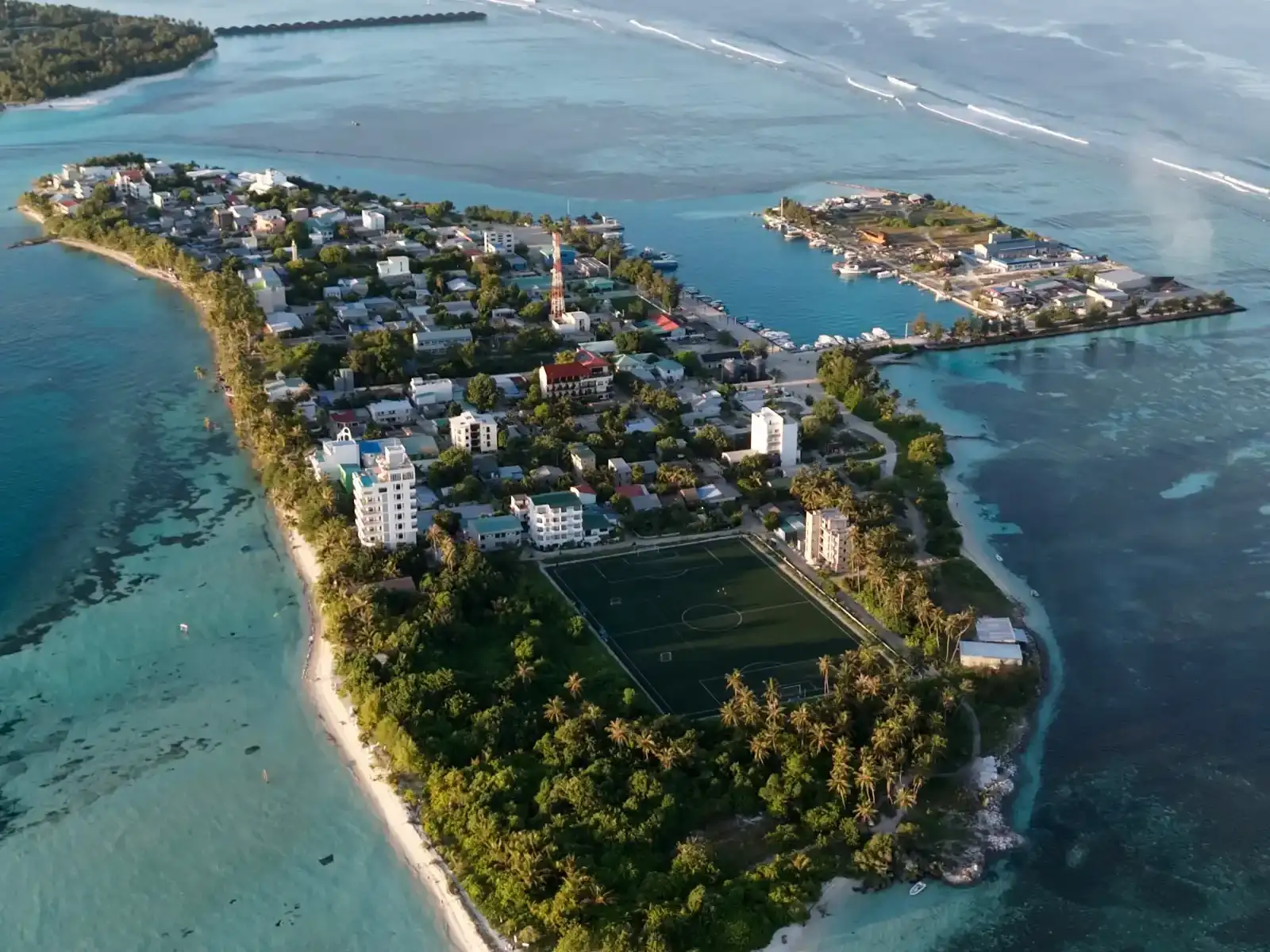
You don’t need a resort or a liveaboard to see protected wildlife. In Dhiffushi, on the eastern rim of North Malé Atoll, beach lights on the north bikini beach draw stingrays and baby reef sharks into the shallows after dark. The island’s guidance is simple: watch only, no feeding. It is a good example of how a local island can share its wildlife without harming it.
Many of the best places for wildlife are also legally protected areas, from Hanifaru Bay in Baa Atoll to South Ari Marine Park. Our guide to protected areas of the Maldives lists what each one protects. For broader advice on travelling lightly, see responsible travel in the Maldives.
Questions people ask
Is it illegal to touch a sea turtle in the Maldives?
Turtles are protected species, and the environment authority has named touching, chasing and crowding protected animals as harmful behaviour. Catching, keeping, killing or eating turtles is banned outright, and so is taking their eggs. The safe rule is simple. Keep a respectful distance, let the turtle swim where it wants and never hold on to its shell for a photo, however calm it seems.
Can I feed stingrays and sharks in the Maldives?
No. In January 2025 the Environmental Protection Agency ordered an end to feeding all rays and skates, saying the Protected Species Regulation already treats it as harmful. Feeding sharks is also illegal under the recreational diving rules, as reported, and feeding whale sharks is banned. Watching rays and sharks in the shallows is fine. Bringing food to attract them is not.
Is shark fishing allowed in the Maldives?
Shark fishing was banned in 2010. From 1 November 2025 the government reopened a tightly controlled, licensed fishery for gulper sharks only, a deep-water species, and only outside the atolls for part of the year. All other sharks remain protected, including the reef sharks you will see while snorkelling. Shark products should never be bought or carried out of the country.
Can I take shells or coral home from the Maldives?
You should not. Many marine products, including coral and shells, need a permit to leave the country, according to Maldives Customs, and protected species and their parts cannot be traded. Leave shells on the beach, where they shelter hermit crabs and slowly become sand. Buy local crafts made from wood, fabric or coconut instead.
Are dolphins and whales protected in the Maldives?
Yes. All whales and dolphins are protected in Maldivian waters, where 23 species have been recorded, according to a review published by the International Whaling Commission. On a dolphin trip, enjoy them from the boat and let them choose how close to come.
Who enforces wildlife law in the Maldives?
The Environmental Protection Agency enforced the protected species rules until it was abolished on 12 August 2025. Its work moved to the Ministry of Tourism and Environment. The Ministry of Fisheries manages fishing rules, Maldives Customs controls exports, and the Maldives Police Service investigates offences. Island councils and guesthouses can also help if you need to report something.