


Combining the Maldives and Sri Lanka in one trip
Pair Sri Lanka’s culture and hill country with a Maldivian local island: entry rules for each, monsoon timing, how many days to plan and what changes when you cross.
 By Dhiffushi Island Council8 min readUpdated
Yes, the Maldives and Sri Lanka pair well in one trip. They are close neighbours with frequent short flights between Colombo and Malé, and each country runs its own simple online entry system. Plan around the monsoons, give each country enough days, and remember that the rules on alcohol and dress change when you cross the water.
Why the two fit together
Sri Lanka and the Maldives offer very different holidays, which is exactly why they combine so well. Sri Lanka is a large island of about 65,610 square kilometres (Department of Census and Statistics), with hill country, tea estates, ancient cities, wildlife parks and long coastlines. The Maldives is a nation of around 1,200 low coral islands, where life is about the reef, the lagoon and the sea.
A common pattern is to tour Sri Lanka first, then finish with slow days on a Maldivian island.
Flights between the two countries
There are regular direct flights between Bandaranaike International Airport near Colombo and Velana International Airport, next to Malé. Several carriers fly the route and frequencies change by season, so check live timetables rather than relying on a fixed schedule.
Some practical points:
- Open-jaw tickets (flying into one country and home from the other) often make more sense than returning to your first airport.
- Book the hop early in busy months, as the regional flights can fill up.
- Leave a buffer. If your long-haul flight home leaves from Colombo, don’t plan to arrive from the Maldives the same day. Weather and boat timings in the Maldives can shift.
For arrival in the Maldives, see our guide on how to get to the Maldives.
Entry rules for each country
You need to meet two separate sets of entry rules. Neither country’s visa covers the other.
Sri Lanka: the ETA
Sri Lanka’s Department of Immigration and Emigration says all foreign visitors must obtain an Electronic Travel Authorization (ETA) before arrival, through the official portal at eta.gov.lk.
- Free for 40 nationalities: from 25 May 2026, nationals of 40 listed countries receive a free tourist ETA, valid for 30 days with double entry from the date of first arrival. The list includes major markets such as the UK, the US, India and Japan; check the official list for your passport.
- Other nationalities: remain under the standard ETA rules and fees.
- Longer stays: extensions beyond 30 days can be applied for, for a fee.
- Passport: the UK government’s travel advice says your passport should be valid for at least six months from the day you arrive. Check with your airline and your own government’s advice.
Double entry helps if you fly Sri Lanka, then the Maldives, then back to Sri Lanka within 30 days.
The Maldives: visa on arrival and IMUGA
The Maldives issues a free 30-day tourist visa on arrival to most nationalities, at the immigration officer’s discretion. Maldives Immigration asks for:
- a passport valid for at least one month (many airlines want six months, so check with your airline);
- an onward or return ticket;
- a confirmed accommodation booking or proof of funds.
Every traveller must also complete the free IMUGA Traveller Declaration online at imuga.immigration.gov.mv within 96 hours before arrival. Children need their own passport. Our Maldives visa and entry guide covers the detail.
Timing your trip around the monsoons
Both countries sit in the monsoon belt, but the monsoons affect them differently. Sri Lanka has a useful twist: when one coast is wet, the other is often drier.
Sri Lanka’s seasons
Sri Lanka’s Department of Census and Statistics describes four seasons:
- Northeast monsoon (December–February): rain falls mainly over the eastern half of the island.
- First inter-monsoon (March–April): convectional showers and thunderstorms can occur anywhere.
- Southwest monsoon (May–September): rain falls mostly over the south-western parts, including the hill country.
- Second inter-monsoon (October–November): often the wettest period overall, with widespread rain.
The Maldives’ seasons
The Maldives Meteorological Service describes the northeast monsoon (January–March) as the dry season and the southwest monsoon (mid-May to November) as the wet season, with April and December as transition months. It is hot all year, with the sea around 28–29°C. See our best time to visit the Maldives guide.
Putting the two together
| Months | Sri Lanka (in general) | Maldives (in general) |
|---|---|---|
| January–March | Drier in the west and south; rain in the east early on | Dry season |
| April | Inter-monsoon showers anywhere | Transition month |
| May–September | Wetter in the south-west and hills; east coast often drier | Wet season, still warm |
| October–November | Often the wettest period | Wet season; November is usually wettest |
| December | Rain in the east | Transition month |
In short, January to March is the easiest window for a classic west and south coast trip plus the Maldives. Between May and September, many travellers favour Sri Lanka’s east coast while the Maldives is in its wetter, quieter season. Monsoon storms can disrupt roads and boats in both countries, so build in slack days.
How many days to plan
There is no single right answer, but these rough splits work for most people:
- 10 days: about 6 days in Sri Lanka and 4 in the Maldives. Choose one region of Sri Lanka rather than trying to see it all.
- 14 days: about 9 and 5. Enough for a loop through the cultural sites or the hill country, plus a proper rest on an island.
- 3 weeks: about 14 and 7. Time for two Maldivian islands, or one island with day trips.
In the Maldives, avoid hopping islands every night. Speedboat transfers and public ferries take time, and the reef rewards slow days. Our 7-day local island itinerary shows a relaxed pace.
Two different cultures
Sri Lanka and the Maldives share the Indian Ocean, but their everyday rules differ.
Alcohol
- Sri Lanka: alcohol is legal and widely sold, but the Excise Department bans its sale island-wide on set days, including every Full Moon Poya day. In 2026 it listed 19 such dry days.
- The Maldives: alcohol is not sold or allowed on local (inhabited) islands. Only resorts, the airport hotel island and liveaboards are licensed. Alcohol is a prohibited import, and any duty-free bought on the way, including in Colombo, is held by Maldives Customs on arrival. See alcohol in the Maldives.
Dress and behaviour
- Sri Lanka: cover shoulders and legs and remove shoes and hats in Buddhist temples. Respect for Buddhist images is taken seriously: the UK government warns that visible Buddha tattoos can lead to refused entry, and that you should not pose with your back to a Buddha statue. Nude or topless sunbathing is not allowed.
- The Maldives: a Muslim country where swimwear is for designated “bikini beaches” on local islands. Elsewhere, cover shoulders and knees. No nude or topless sunbathing anywhere. Shops close for a while at Friday midday prayer, and during Ramadan you should not eat, drink or smoke in public in daylight on local islands. Read our dress code guide.
Things not to carry across
The Maldives prohibits imports of alcohol, pork and pork products, narcotics, pornography and idols for worship. Both countries punish drug offences severely. If you carry prescription medicines, bring the prescription.
Money in brief
Each country has its own currency, so plan cash separately. The Maldives uses the rufiyaa (MVR); US dollars are widely accepted in tourism, but small shops often prefer rufiyaa. Maldivian bills usually add a 17% Tourism GST (since 1 July 2025), a nightly green tax and often a 10% service charge. See Maldives money, costs and taxes.
Finishing on a local island
Ending your trip in the Maldives works well because the international airport is next to Malé, and many local islands are a short boat ride away. That keeps the last transfer simple.
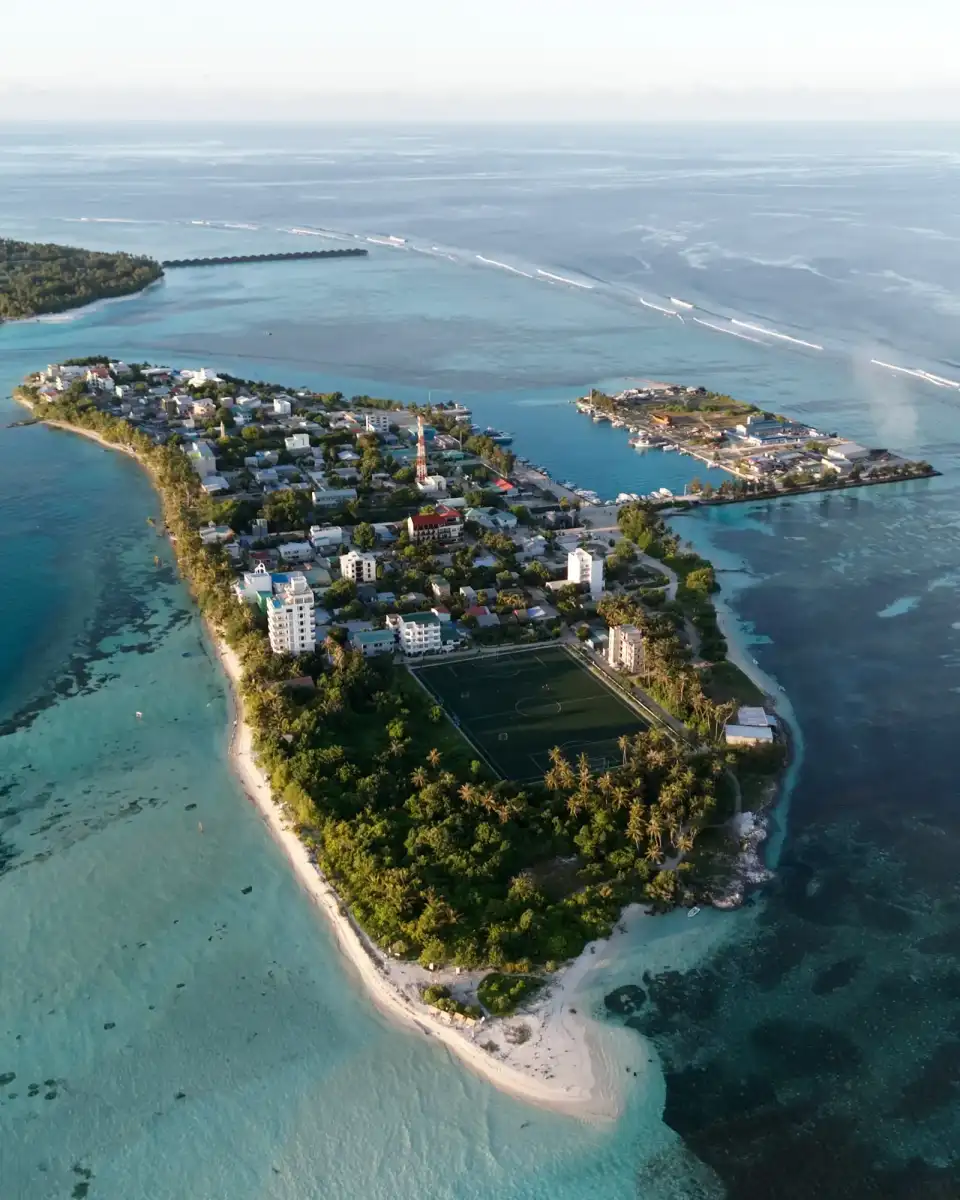
Take Dhiffushi as an example. It sits about 37 km north-east of Malé on the eastern rim of North Malé Atoll, around 40–50 minutes by shared speedboat from the airport. It is the easternmost inhabited island in the Maldives, which makes sunrise here something special after the heat of the Sri Lankan plains. The public ferry does not run on Fridays, so time your arrival with care. Our how to get to Dhiffushi guide has the options.
Before you go, check that your travel insurance covers both countries and any diving.
Questions people ask
Do I need a separate visa for Sri Lanka and the Maldives?
Yes. Each country has its own entry system. Sri Lanka requires an Electronic Travel Authorization (ETA) obtained online before arrival, free for nationals of 40 listed countries since 25 May 2026. The Maldives gives a free 30-day tourist visa on arrival to most nationalities, but you must complete the online IMUGA Traveller Declaration within 96 hours before you land. One does not cover the other.
Which country should I visit first?
Most people visit Sri Lanka first and finish in the Maldives. Touring Sri Lanka involves road and rail travel, sightseeing and early mornings, so ending on a quiet island gives you time to rest before the long flight home. The reverse also works, especially if your flights are cheaper that way. If you fly home from Colombo, leave a spare day after the Maldives in case of delays.
When is the best time to combine Sri Lanka and the Maldives?
January to March is the simplest window. It is the Maldives’ dry season, and Sri Lanka’s west and south coasts are generally drier then, as the northeast monsoon mainly brings rain to the east. Between May and September, Sri Lanka’s east coast is often the drier side, while the Maldives is in its wetter but still warm season. October and November tend to be the wettest overall.
Can I bring alcohol from Sri Lanka into the Maldives?
No. Alcohol is a prohibited import in the Maldives, including duty-free bought in Colombo. Maldives Customs holds it on arrival. On local islands, alcohol is not sold or allowed at all; only resorts, the airport hotel island and liveaboards are licensed. If you want a drink, enjoy it in Sri Lanka, and remember that sales there stop on Full Moon Poya days.
How many days do I need for both countries?
Ten days is a sensible minimum, split roughly six in Sri Lanka and four in the Maldives. With two weeks you can see a region of Sri Lanka properly and still have five relaxed days on a Maldivian island. Three weeks allows a fuller loop of Sri Lanka and a week in the Maldives, perhaps on two different local islands.

